## Screenshot: Coq Code Editor Interface
### Overview
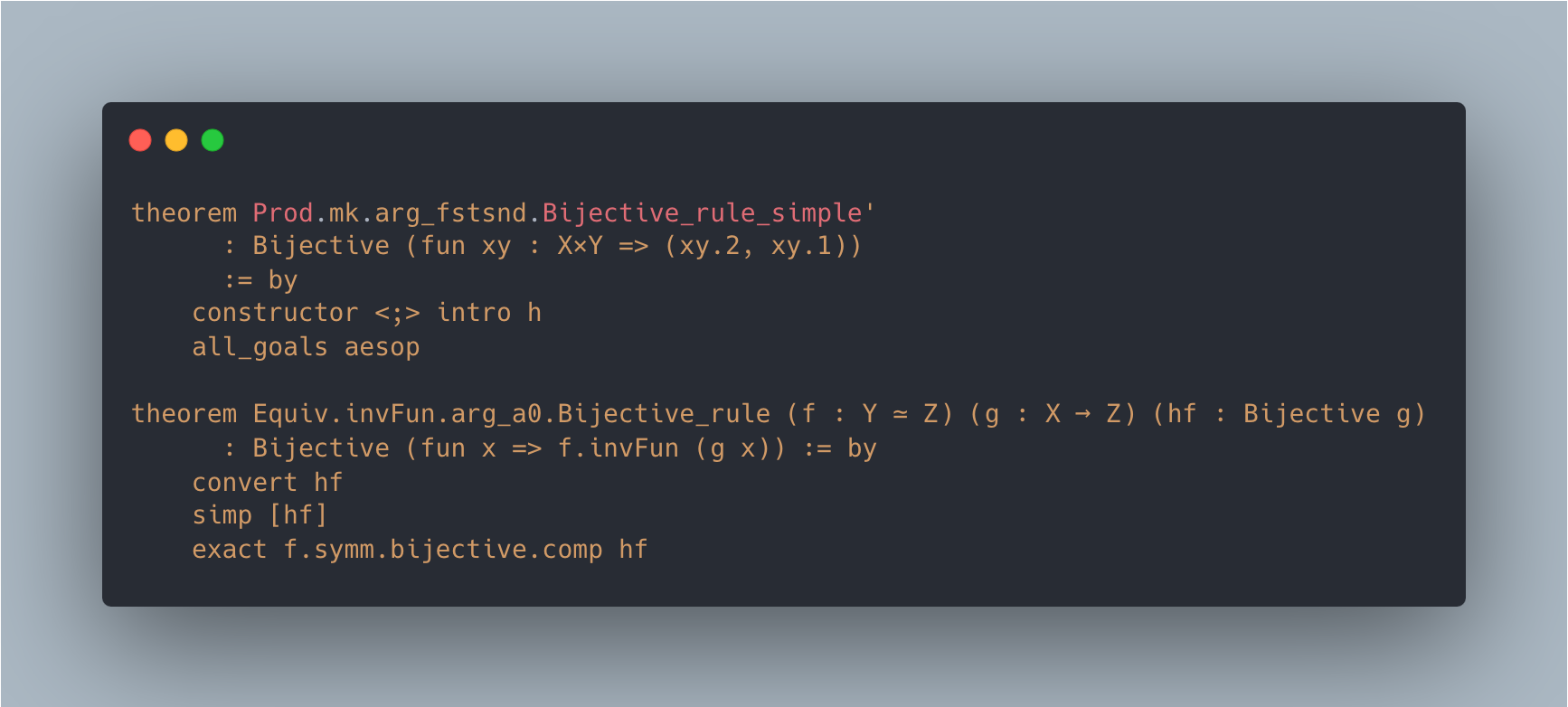
The image shows a code editor interface displaying Coq (a formal proof management system) code. The editor has a dark theme with syntax highlighting. Two theorem definitions are visible, focusing on bijective functions and their properties.
### Components/Axes
- **UI Elements**:
- Top-left corner: Red, yellow, and green circular buttons (standard macOS window controls).
- Dark background with light-colored text (likely for readability).
- **Code Structure**:
- Two theorem definitions:
1. `theorem Prod.mk.arg_fstsnd.Bijective_rule_simple`
2. `theorem Equiv.invFun.arg_a0.Bijective_rule`
- Syntax elements:
- Keywords (e.g., `theorem`, `Bijective`, `constructor`, `intro`, `convert`, `simp`, `exact`).
- Function definitions (e.g., `Bijective (fun xy : X×Y => (xy.2, xy.1))`).
- Logical constructs (e.g., `=>`, `:`, `:= by`).
### Detailed Analysis
#### Theorem 1: `Prod.mk.arg_fstsnd.Bijective_rule_simple`
- **Definition**:
```coq
Bijective (fun xy : X×Y => (xy.2, xy.1))
```
- Defines a bijective function that swaps the second and first components of a pair `(X×Y)`.
- **Proof**:
```coq
:= by
constructor <;> intro h
all_goals aesop
```
- Uses Coq's `constructor` tactic to build the proof.
- Introduces a hypothesis `h` and applies `aesop` (a proof automation tactic).
#### Theorem 2: `Equiv.invFun.arg_a0.Bijective_rule`
- **Definition**:
```coq
Bijective (fun x => f.invFun (g x))
```
- Defines a bijective function composed of `f.invFun` and `g`.
- **Proof**:
```coq
:= by
convert hf
simp [hf]
exact f.symm.bijective.comp hf
```
- Uses `convert` to transform the hypothesis `hf`.
- Simplifies using `hf` and applies `exact` with `f.symm.bijective.comp hf` (a composed bijective property).
### Key Observations
- **Syntax Highlighting**:
- Keywords (e.g., `theorem`, `Bijective`) are in pink.
- Function names (e.g., `Prod.mk.arg_fstsnd.Bijective_rule_simple`) are in yellow.
- Logical operators (e.g., `=>`, `:`, `:=`) are in orange.
- **Code Structure**:
- Theorems are defined with `theorem` followed by a name and a function type.
- Proofs use Coq-specific tactics (`constructor`, `intro`, `simp`, `exact`).
### Interpretation
- **Purpose**:
- The code defines and proves properties of bijective functions in a formal system (likely related to product types and function composition).
- **Key Insights**:
- The first theorem demonstrates that swapping components of a pair preserves bijectivity.
- The second theorem shows that the composition of `f.invFun` and `g` is bijective, relying on symmetry and composition rules.
- **Technical Significance**:
- These proofs are foundational in formal verification, ensuring that functions behave as expected in mathematical or computational contexts.
### Notes on Language
- The code is written in **Coq**, a formal proof language. No other languages are present.
- English terms (e.g., "bijective", "function") are used within the Coq code for clarity.
This description captures all textual and structural elements of the image, focusing on the Coq code's syntax, logic, and purpose.