## Bar Chart: Distribution of Generated Sub-questions per Dataset (MetaQA)
### Overview
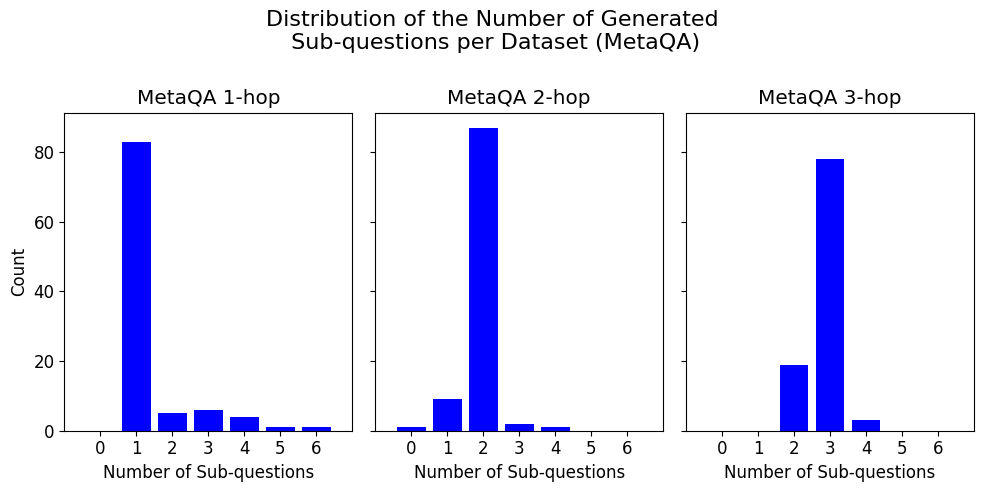
This image presents three bar charts displaying the distribution of the number of generated sub-questions for the MetaQA dataset, broken down by hop count (1-hop, 2-hop, and 3-hop). The y-axis represents the "Count" of occurrences, while the x-axis represents the "Number of Sub-questions," ranging from 0 to 6.
### Components/Axes
* **Title:** "Distribution of the Number of Generated Sub-questions per Dataset (MetaQA)" - positioned at the top-center of the image.
* **Subtitles:** "MetaQA 1-hop", "MetaQA 2-hop", "MetaQA 3-hop" - positioned above each respective bar chart.
* **X-axis Label:** "Number of Sub-questions" - positioned at the bottom-center of each chart.
* **Y-axis Label:** "Count" - positioned on the left side of each chart.
* **X-axis Markers:** 0, 1, 2, 3, 4, 5, 6.
* **Y-axis Scale:** 0 to 80, with increments of 20.
* **Bar Color:** Blue.
### Detailed Analysis
The image consists of three separate bar charts, each representing a different hop count for the MetaQA dataset.
**1. MetaQA 1-hop:**
* The distribution is heavily skewed towards 0 sub-questions.
* The bar at 0 sub-questions has a height of approximately 82.
* The bar at 1 sub-question has a height of approximately 8.
* The bar at 2 sub-questions has a height of approximately 4.
* The bars at 3, 4, 5, and 6 sub-questions have heights of approximately 2, 1, 1, and 1 respectively.
**2. MetaQA 2-hop:**
* The distribution is concentrated around 0 and 1 sub-questions.
* The bar at 0 sub-questions has a height of approximately 85.
* The bar at 1 sub-question has a height of approximately 10.
* The bar at 2 sub-questions has a height of approximately 3.
* The bars at 3, 4, 5, and 6 sub-questions have heights of approximately 1, 0, 0, and 0 respectively.
**3. MetaQA 3-hop:**
* The distribution is centered around 3 sub-questions.
* The bar at 0 sub-questions has a height of approximately 18.
* The bar at 1 sub-question has a height of approximately 6.
* The bar at 2 sub-questions has a height of approximately 10.
* The bar at 3 sub-questions has a height of approximately 78.
* The bar at 4 sub-questions has a height of approximately 3.
* The bars at 5 and 6 sub-questions have heights of approximately 1 and 0 respectively.
### Key Observations
* As the hop count increases, the distribution of sub-questions shifts from being concentrated at 0 to being concentrated at higher numbers of sub-questions.
* The 1-hop dataset primarily generates questions with 0 sub-questions.
* The 2-hop dataset also generates a large number of questions with 0 sub-questions, but also a significant number with 1 sub-question.
* The 3-hop dataset generates a majority of questions with 3 sub-questions.
* The number of questions generated with 5 or 6 sub-questions is consistently low across all hop counts.
### Interpretation
The data suggests that increasing the hop count in the MetaQA dataset leads to a greater need for generating sub-questions to answer the original query. A 1-hop query can often be answered directly, requiring no sub-questions. As the query complexity increases (2-hop, 3-hop), the system needs to break down the problem into smaller, more manageable sub-questions. The peak at 3 sub-questions for the 3-hop dataset indicates that this is a common level of decomposition for these more complex queries. This information is valuable for understanding the behavior of question answering systems and for optimizing the sub-question generation process. The consistent low count for 5 and 6 sub-questions might indicate a diminishing return in complexity or a limitation in the system's ability to effectively decompose queries beyond a certain point.