## Educational Diagram: Geometry Problem Correction
### Overview
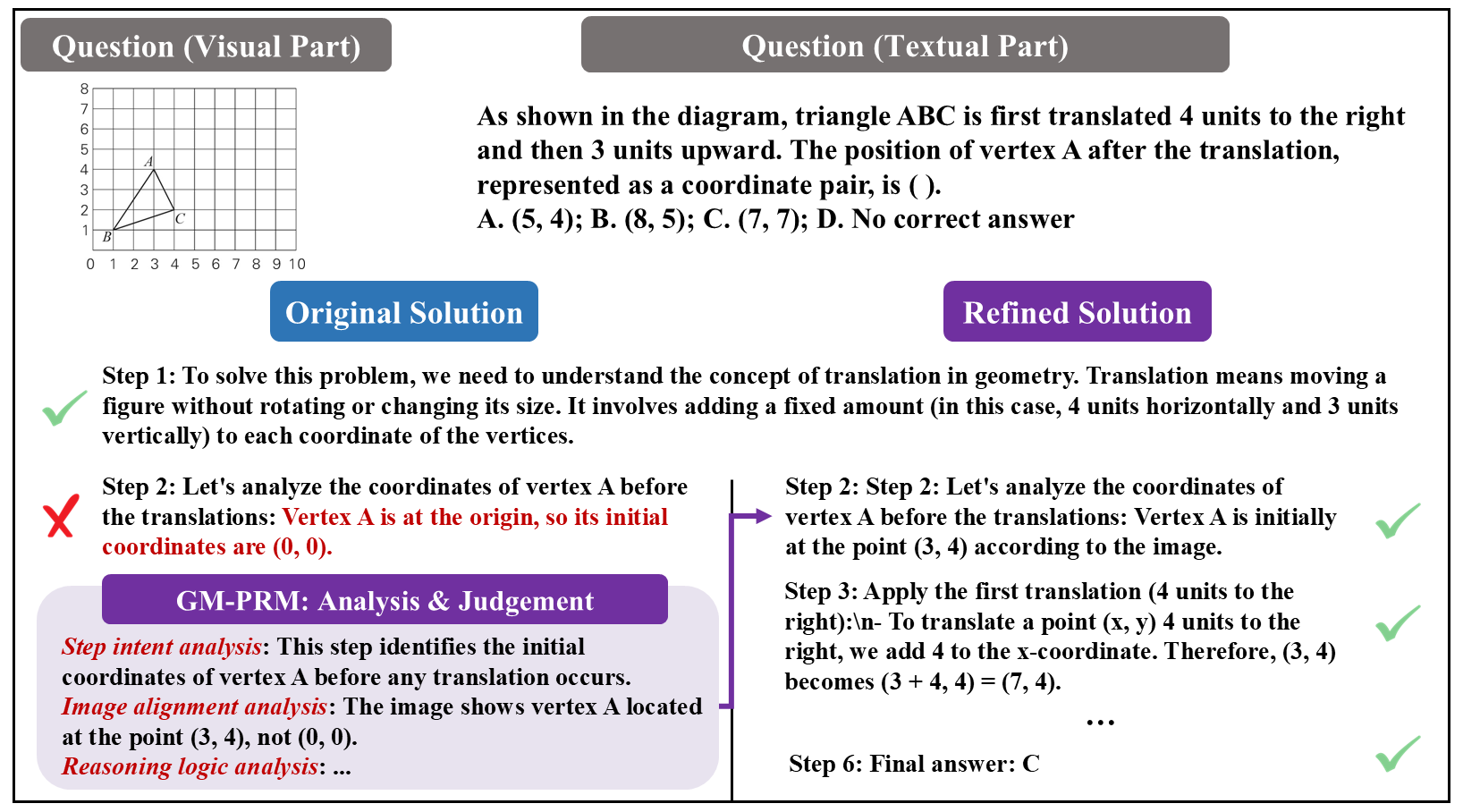
The image is a comparative analysis of a geometry problem solution. It displays a coordinate geometry question involving the translation of a triangle, followed by an "Original Solution" (which contains an error) and a "Refined Solution" (which corrects the error). The image serves as an example of correcting reasoning logic by grounding it in visual data.
### Components/Axes
* **Coordinate Grid (Top Left):**
* **X-axis:** Ranges from 0 to 10.
* **Y-axis:** Ranges from 0 to 8.
* **Triangle ABC:**
* Vertex B is located at (0, 1).
* Vertex C is located at (4, 2).
* Vertex A is located at (3, 4).
* **Textual Sections:**
* **Question (Textual Part):** The problem statement.
* **Original Solution:** Contains an incorrect step marked with a red 'X'.
* **GM-PRM: Analysis & Judgement:** A meta-analysis box critiquing the original solution.
* **Refined Solution:** Contains the corrected steps marked with green checkmarks.
### Detailed Analysis
#### 1. Question (Textual Part)
"As shown in the diagram, triangle ABC is first translated 4 units to the right and then 3 units upward. The position of vertex A after the translation, represented as a coordinate pair, is ( ).
A. (5, 4); B. (8, 5); C. (7, 7); D. No correct answer"
#### 2. Original Solution (Bottom Left)
* **Step 1:** "To solve this problem, we need to understand the concept of translation in geometry. Translation means moving a figure without rotating or changing its size. It involves adding a fixed amount (in this case, 4 units horizontally and 3 units vertically) to each coordinate of the vertices." (Marked with a green checkmark).
* **Step 2:** "Let's analyze the coordinates of vertex A before the translations: Vertex A is at the origin, so its initial coordinates are (0, 0)." (Marked with a red 'X').
* **GM-PRM: Analysis & Judgement:**
* "Step intent analysis: This step identifies the initial coordinates of vertex A before any translation occurs."
* "Image alignment analysis: The image shows vertex A located at the point (3, 4), not (0, 0)."
* "Reasoning logic analysis: ..."
#### 3. Refined Solution (Bottom Right)
* **Step 2:** "Let's analyze the coordinates of vertex A before the translations: Vertex A is initially at the point (3, 4) according to the image." (Marked with a green checkmark).
* **Step 3:** "Apply the first translation (4 units to the right):
- To translate a point (x, y) 4 units to the right, we add 4 to the x-coordinate. Therefore, (3 + 4, 4) = (7, 4)." (Marked with a green checkmark).
* **Step 6:** "Final answer: C" (Marked with a green checkmark).
### Key Observations
* **Visual Grounding Error:** The "Original Solution" failed because it ignored the visual evidence provided by the grid, incorrectly assuming the vertex was at the origin (0,0).
* **Correct Coordinates:** The grid clearly shows Vertex A at (3, 4).
* **Translation Logic:** The problem requires adding 4 to the x-coordinate (3+4=7) and 3 to the y-coordinate (4+3=7), resulting in the final coordinate (7, 7), which corresponds to option C.
### Interpretation
This image demonstrates the importance of **multimodal grounding** in problem-solving. The "Original Solution" represents a failure in reasoning where the system relied on a generic assumption (that a shape starts at the origin) rather than extracting the specific data from the provided visual diagram. The "Refined Solution" demonstrates the correct workflow:
1. **Extract:** Identify the specific coordinates from the visual grid (A = 3, 4).
2. **Apply:** Perform the mathematical operation (translation) on the extracted data.
3. **Verify:** Select the correct option based on the calculated result.
The inclusion of the "GM-PRM: Analysis & Judgement" box suggests this is an educational or diagnostic tool designed to train or evaluate AI models on their ability to reconcile visual data with textual logic.