\n
## Timeline Diagram: Stages of Language Development
### Overview
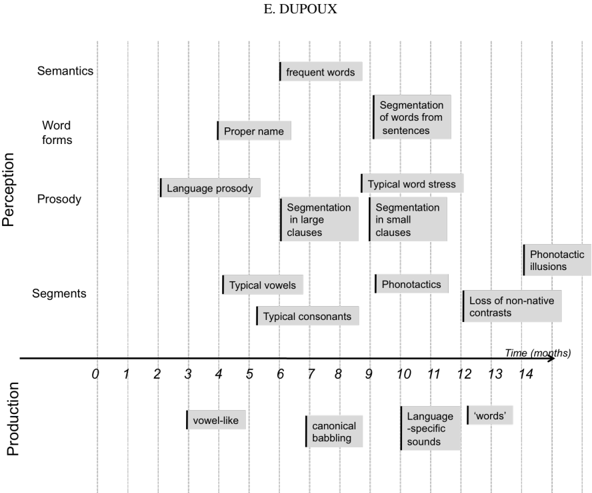
This diagram presents a timeline illustrating the development of language skills in infants, categorized by perception and production. The x-axis represents time in months (0-14), and the y-axis lists different aspects of language development: Semantics, Word Forms, Prosody, Segments, and Production. Each stage is represented by a grey rectangular bar indicating the approximate age range when that skill emerges.
### Components/Axes
* **X-axis:** Time (months), ranging from 0 to 14, with markings at intervals of 1 month.
* **Y-axis:** Language Development Aspects, including:
* Semantics
* Word Forms
* Prosody
* Segments
* Production
* **Title:** "E. DUPOUX" at the top center.
* **Bars:** Grey rectangular bars representing the approximate time frame for each language skill.
### Detailed Analysis or Content Details
The diagram shows the following stages and their approximate timing:
* **Production:**
* "vowel-like" sounds: approximately 0-4 months.
* "canonical babbling": approximately 6-8 months.
* "Language-specific sounds": approximately 10-12 months.
* "words": approximately 12-14 months.
* **Segments:**
* "Typical vowels": approximately 4-5 months.
* "Typical consonants": approximately 5-6 months.
* "Phonotactics": approximately 10-11 months.
* "Loss of non-native contrasts": approximately 12-14 months.
* "Phonotactic illusions": approximately 13-14 months.
* **Prosody:**
* "Language prosody": approximately 2-4 months.
* "Segmentation in large clauses": approximately 7-9 months.
* "Segmentation in small clauses": approximately 10-11 months.
* "Typical word stress": approximately 11-12 months.
* **Word Forms:**
* "Proper name": approximately 4-5 months.
* "Segmentation of words from sentences": approximately 11-12 months.
* **Semantics:**
* "frequent words": approximately 12-14 months.
### Key Observations
* The diagram suggests a hierarchical development of language skills, starting with basic production of sounds (vowel-like) and progressing to more complex skills like semantics and word segmentation.
* There is overlap between the stages, indicating that language development is not strictly linear.
* The diagram highlights the early emergence of prosodic features (language prosody around 2-4 months) before more complex segmental features (typical vowels around 4-5 months).
* The later stages (12-14 months) show a convergence of skills related to word recognition and meaning.
### Interpretation
This diagram provides a simplified model of language acquisition, likely intended for educational or research purposes. It illustrates the developmental sequence of language skills, emphasizing the interplay between perception and production. The timeline suggests that infants initially focus on producing basic sounds and perceiving prosodic features, gradually developing the ability to segment speech, recognize words, and understand their meanings. The diagram's author, E. Dupoux, likely used this visualization to communicate a specific theoretical framework regarding language development. The diagram does not provide specific data points or statistical analysis, but rather a qualitative overview of the typical stages and their approximate timing. The overlapping bars suggest that these stages are not discrete but rather represent a continuous process of development. The diagram is a useful tool for understanding the general trajectory of language acquisition, but it should be noted that individual children may develop at different rates.