## Text Document: Study Tips
### Overview
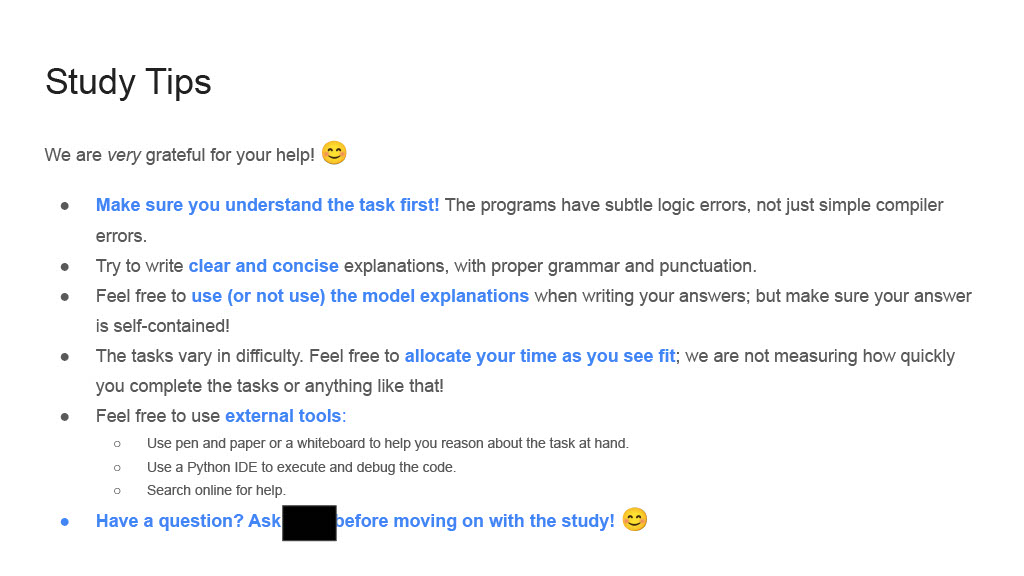
The image displays a text document titled "Study Tips," presented on a plain white background. It provides a set of guidelines and instructions for individuals participating in a study or task. The document begins with an introductory thank-you message, followed by a main bulleted list of five distinct tips, and concludes with a final bullet point regarding asking questions. Key phrases within the tips are highlighted using bold and blue text, and smiling emojis are used to convey a friendly tone.
### Components/Axes
This document does not contain axes, legends, or charts. Its components are purely textual and structural:
* **Header (Top-Left)**: The main title "Study Tips" is prominently displayed in a large, black font.
* **Introductory Text (Below Header)**: A sentence "We are very grateful for your help! 😊" is presented in a smaller, italicized black font, accompanied by a yellow smiling emoji.
* **Main Bulleted List (Central)**: Five primary bullet points, each marked with a black circular bullet, outline the study tips.
* Within these tips, specific phrases are emphasized using bold, blue text.
* One of the main tips includes a nested un-ordered list, comprising three sub-points marked with smaller circular bullets.
* **Concluding Instruction (Bottom-Left)**: A final bullet point, distinguished by a blue circular bullet, provides an instruction about asking questions. This point also features bold blue text and a yellow smiling emoji, with a rectangular black redaction box obscuring some text.
### Detailed Analysis
The document contains the following transcribed text:
1. **Title**:
* "Study Tips"
2. **Introductory Message**:
* "We are very grateful for your help! 😊"
3. **Main Study Tips (Bulleted List)**:
* **Tip 1**: "• **Make sure you understand the task first!** The programs have subtle logic errors, not just simple compiler errors."
* The phrase "Make sure you understand the task first!" is bold and blue.
* **Tip 2**: "• Try to write **clear and concise** explanations, with proper grammar and punctuation."
* The phrase "clear and concise" is bold and blue.
* **Tip 3**: "• Feel free to **use (or not use) the model explanations** when writing your answers; but make sure your answer is self-contained!"
* The phrase "use (or not use) the model explanations" is bold and blue.
* **Tip 4**: "• The tasks vary in difficulty. Feel free to **allocate your time as you see fit**; we are not measuring how quickly you complete the tasks or anything like that!"
* The phrase "allocate your time as you see fit" is bold and blue.
* **Tip 5**: "• Feel free to use **external tools**:"
* The phrase "external tools" is bold and blue.
* **Nested Sub-points (Un-ordered List)**:
* "◦ Use pen and paper or a whiteboard to help you reason about the task at hand."
* "◦ Use a Python IDE to execute and debug the code."
* "◦ Search online for help."
4. **Concluding Instruction (Blue Bullet Point)**:
* "• **Have a question? Ask** [REDACTED TEXT] **before moving on with the study!** 😊"
* The phrase "Have a question? Ask" is bold and blue.
* A solid black rectangular box obscures approximately two to three words between "Ask" and "before".
* The phrase "before moving on with the study!" is bold and blue.
### Key Observations
* The document's primary purpose is to provide guidance and set expectations for participants.
* Emphasis is placed on understanding the task, clear communication, flexibility in using resources, and time management.
* The mention of "logic errors," "compiler errors," and "Python IDE" strongly suggests the study involves programming or software development tasks.
* The tone is encouraging and supportive, using positive language and emojis.
* A specific instruction to ask questions is provided, but the method or contact person for questions is intentionally redacted.
### Interpretation
This "Study Tips" document is designed to prepare participants for a technical assessment or study, likely in a programming or software engineering context. The tips aim to foster a productive and less stressful environment by clarifying expectations and offering flexibility.
The instruction to "Make sure you understand the task first!" and the warning about "subtle logic errors" indicate that the tasks are not trivial and require deep comprehension rather than superficial problem-solving. This suggests the study might be evaluating analytical and debugging skills. The emphasis on "clear and concise explanations" implies that the reasoning process and communication of solutions are as important as the solutions themselves.
The freedom to "use (or not use) the model explanations" and to "allocate your time as you see fit" highlights a focus on individual problem-solving approaches and self-regulation, rather than strict adherence to a prescribed method or speed. This suggests the study values qualitative aspects of problem-solving over mere quantitative output.
The explicit permission to use "external tools" such as pen and paper, a Python IDE, and online search resources indicates that the study simulates a real-world development scenario where resources are readily available. This reinforces that the assessment is about practical problem-solving and resourcefulness, not rote memorization.
The final instruction, "Have a question? Ask [REDACTED TEXT] before moving on with the study! 😊", underscores the importance of clarity and support. The redaction of the contact information suggests this document might be a generic template or a version where specific details are omitted for privacy or broader applicability. Overall, the document aims to empower participants, reduce anxiety, and ensure they approach the tasks with the right mindset and resources.