\n
## Diagram: Language Acquisition Model
### Overview
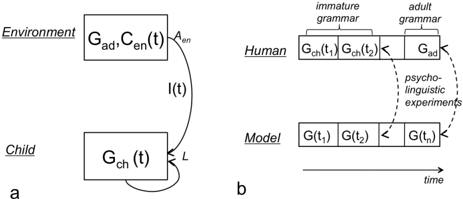
The image presents two diagrams (labeled 'a' and 'b') illustrating a model of language acquisition. Diagram 'a' depicts the interaction between a child and their environment, while diagram 'b' shows a parallel model using a computational approach. Both diagrams represent a process evolving over time, with the goal of transitioning from an immature grammar to an adult grammar.
### Components/Axes
**Diagram a:**
* **Labels:** "Environment", "Child"
* **Variables within boxes:**
* Environment: `G_ad`, `C_en(t)`, `A_en`
* Child: `G_ch(t)`
* **Arrows & Labels:**
* Arrow from Environment to Child: `L` (likely representing learning)
* Arrow from Child to Environment: `I(t)` (likely representing input/output)
* Arrow from Environment to Child (curved): `A_en`
**Diagram b:**
* **Labels:** "Human", "Model"
* **Labels above Human:** "immature grammar", "adult grammar"
* **Labels above Model:** No labels
* **Variables within boxes:**
* Human: `G_ch(t_1)`, `G_ch(t_2)`, `G_ad`
* Model: `G(t_1)`, `G(t_2)`, `G(t_n)`
* **Arrows & Labels:**
* Arrow from `G_ch(t_2)` to `G_ad` (dashed): "psycho-linguistic experiments"
* Arrow from `G(t_2)` to `G(t_n)` (dashed): "psycho-linguistic experiments"
* **Horizontal Axis:** "time" (indicated by an arrow)
### Detailed Analysis / Content Details
**Diagram a:**
The diagram shows a child interacting with their environment. The environment is characterized by `G_ad` (adult grammar), `C_en(t)` (environmental constraints at time t), and `A_en` (environmental actions). The child possesses `G_ch(t)` (child's grammar at time t). The child receives input `I(t)` from the environment and provides output `L` (learning) back to the environment. The curved arrow `A_en` suggests a feedback loop from the environment influencing the child.
**Diagram b:**
This diagram parallels 'a' with a computational model. The "Human" row represents the development of grammar from an immature state (`G_ch(t_1)`, `G_ch(t_2)`) to an adult state (`G_ad`). The "Model" row represents a similar progression (`G(t_1)`, `G(t_2)`, `G(t_n)`). The dashed arrows labeled "psycho-linguistic experiments" indicate a connection between the human and model development, suggesting that experiments are used to inform or validate the model. The time axis indicates that the grammar evolves over time.
### Key Observations
* Both diagrams represent a similar process of grammatical development.
* The model in diagram 'b' is intended to mimic the human process in diagram 'a'.
* The use of time-dependent variables (`t`, `t_1`, `t_2`, `t_n`) emphasizes the dynamic nature of language acquisition.
* The dashed arrows in diagram 'b' suggest a validation or feedback loop between the model and human data.
* The variables are not defined numerically, so no quantitative analysis is possible.
### Interpretation
The diagrams illustrate a cognitive science approach to modeling language acquisition. Diagram 'a' presents a high-level conceptual framework of a child learning from their environment. Diagram 'b' proposes a computational model that attempts to replicate this process. The "psycho-linguistic experiments" link suggests that the model is grounded in empirical data. The use of variables like `G_ad` and `G_ch` implies that the model focuses on the structure of grammar itself. The diagrams suggest a cyclical process where the child's grammar evolves through interaction with the environment, and the model's grammar evolves through experimentation and validation. The diagrams do not provide specific data or numerical values, but rather a conceptual framework for understanding language acquisition. The use of mathematical notation (`G`, `C`, `I`, `L`) suggests a formal, potentially mathematical, representation of the model. The diagrams are a qualitative representation of a theoretical model.