## Bar Chart: CiteME Papers by Year Published
### Overview
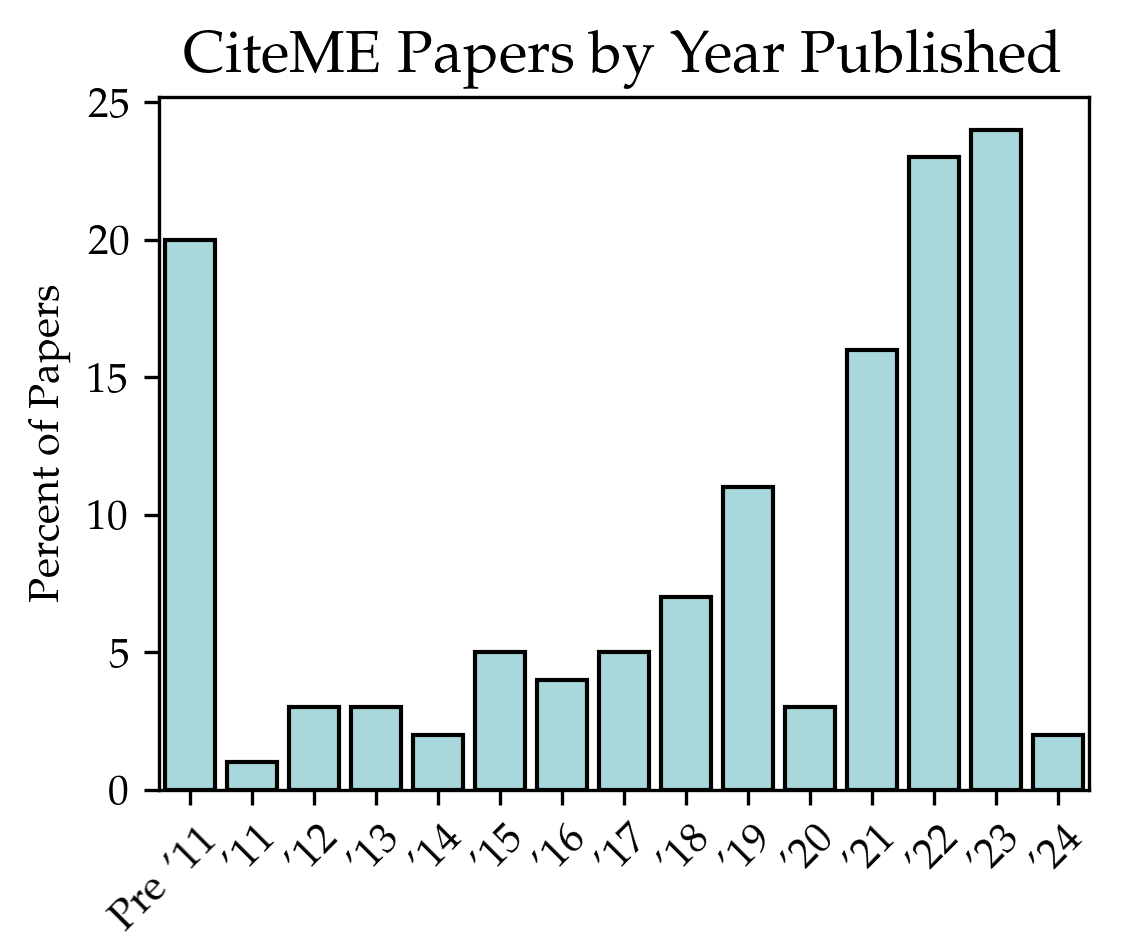
This is a vertical bar chart titled "CiteME Papers by Year Published." It displays the distribution of papers within the "CiteME" dataset or system by their publication year, expressed as a percentage of the total papers. The chart shows a non-uniform distribution with notable peaks at the beginning and end of the timeline.
### Components/Axes
* **Title:** "CiteME Papers by Year Published" (centered at the top).
* **Y-Axis:** Labeled "Percent of Papers." The scale runs from 0 to 25, with major tick marks at intervals of 5 (0, 5, 10, 15, 20, 25).
* **X-Axis:** Represents publication years. The labels are, from left to right: "Pre '11", "'11", "'12", "'13", "'14", "'15", "'16", "'17", "'18", "'19", "'20", "'21", "'22", "'23", "'24". The labels are rotated approximately 45 degrees.
* **Data Series:** A single series represented by light blue bars with black outlines. There is no legend, as there is only one data category.
### Detailed Analysis
The following table reconstructs the approximate percentage values for each year, based on visual estimation against the y-axis scale. Values are approximate due to the visual nature of the extraction.
| Year Label | Approximate Percent of Papers | Visual Trend Note |
| :--- | :--- | :--- |
| Pre '11 | 20% | A tall bar, the second highest on the chart. |
| '11 | ~1% | The lowest bar on the chart. |
| '12 | ~3% | |
| '13 | ~3% | Similar height to '12. |
| '14 | ~2% | Slightly lower than '12/'13. |
| '15 | 5% | Aligns with the 5% grid line. |
| '16 | ~4% | Slightly lower than '15. |
| '17 | 5% | Similar height to '15. |
| '18 | ~7% | |
| '19 | ~11% | The first bar to exceed 10%. |
| '20 | ~3% | A significant drop from '19. |
| '21 | ~16% | A sharp increase. |
| '22 | ~23% | The second tallest bar. |
| '23 | ~24% | The tallest bar on the chart. |
| '24 | ~2% | A sharp drop from the peak in '23. |
**Trend Verification:** The data series shows a bimodal-like distribution. It starts high (Pre '11), drops to a low plateau from '11 to '14, begins a gradual climb from '15 to '19, dips in '20, then surges dramatically from '21 to a peak in '23, before falling sharply again in '24.
### Key Observations
1. **Peaks:** The two most significant concentrations of papers are from before 2011 (~20%) and the years 2022-2023 (~23% and ~24%).
2. **Troughs:** The years 2011 (~1%) and 2024 (~2%) represent the lowest points. The year 2020 (~3%) is also notably low compared to the years immediately before and after it.
3. **Recent Surge:** There is a pronounced and rapid increase in the percentage of papers from 2021 through 2023, suggesting a major growth phase or change in the CiteME system's usage or indexing during this period.
4. **2024 Drop:** The sharp decline in 2024 could indicate incomplete data for the year (if the chart was created mid-year), a change in policy, or a significant reduction in activity.
### Interpretation
The chart suggests that the "CiteME" entity (likely a citation database, a research tool, or a specific collection) has a complex history. The high percentage of "Pre '11" papers indicates it either has a strong foundation of older literature or performed a bulk import of historical data. The low activity in the early 2010s ('11-'14) might reflect a period of low adoption or development.
The most critical insight is the explosive growth from 2021 to 2023. This could correlate with increased academic output, the tool gaining popularity, a successful marketing effort, or integration with other platforms. The anomaly in 2020 (a dip) might be related to global disruptions affecting research output or priorities. The steep drop in 2024 is the most ambiguous point; without temporal context for when this chart was generated, it's unclear if this represents a full-year decline, a mid-year snapshot, or the beginning of a new trend. Overall, the data paints a picture of a system that was established with older content, experienced a quiet period, and then underwent a dramatic resurgence in recent years.