TECHNICAL ASSET FINGERPRINT
d9d5587ae5eadee268facb78
Click to view fullscreen
Press ESC or click to close
FOUND IN PAPERS
EXPERT: healer-alpha-free VERSION 1
RUNTIME: free/openrouter/healer-alpha
INTEL_VERIFIED
## Medical Diagnostic Document: Heart Failure Classification and Knowledge Base
### Overview
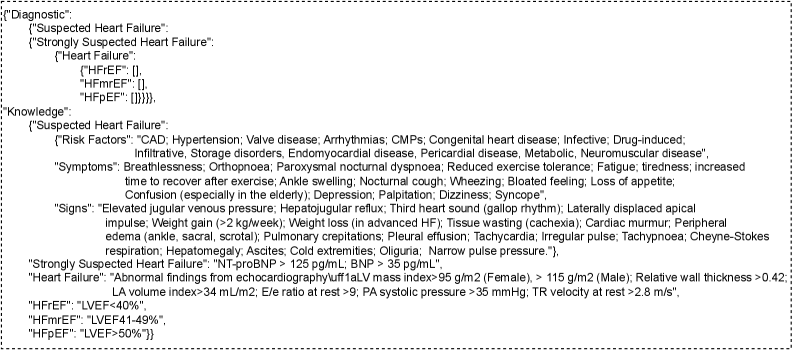
The image displays a structured, text-based medical document outlining the diagnostic hierarchy and comprehensive clinical knowledge related to heart failure. It is divided into two primary sections: a "Diagnostic" classification tree and a "Knowledge" base of associated clinical information. The document appears to be a reference or guideline snippet, possibly from a clinical decision support system or medical textbook.
### Components / Content Structure
The document is organized into two main, top-level sections:
1. **Diagnostic Section (Top Half):** Presents a hierarchical, nested structure for classifying heart failure.
* **Root:** `{"Diagnostic":`
* **Level 1:** `{"Suspected Heart Failure":`
* **Level 2:** `{"Strongly Suspected Heart Failure":`
* **Level 3:** `{"Heart Failure":`
* **Level 4 (Leaf Nodes):** Three specific classifications of heart failure based on left ventricular ejection fraction (LVEF):
* `"HFrEF": []` (Heart Failure with Reduced Ejection Fraction)
* `"HFmrEF": []` (Heart Failure with Mildly Reduced Ejection Fraction)
* `"HFpEF": []` (Heart Failure with Preserved Ejection Fraction)
* The structure uses nested curly braces `{}` and square brackets `[]` to denote hierarchy and lists. The leaf nodes for HFrEF, HFmrEF, and HFpEF are empty (`[]`), suggesting this is a template or the categories are defined elsewhere.
2. **Knowledge Section (Bottom Half):** Provides detailed clinical information related to "Suspected Heart Failure." It is organized into four key subsections:
* **Risk Factors:** A comma-separated list of conditions and etiologies.
* **Symptoms:** A comma-separated list of patient-reported experiences.
* **Signs:** A comma-separated list of clinician-observed physical findings.
* **Diagnostic Criteria:** Specific clinical and echocardiographic thresholds for confirming heart failure and its subtypes.
### Detailed Analysis / Content Details
**1. Diagnostic Hierarchy:**
The flow is linear and deductive: A patient presents with `Suspected Heart Failure` -> Clinical evaluation leads to `Strongly Suspected Heart Failure` -> Confirmation leads to a diagnosis of `Heart Failure` -> Further testing (primarily echocardiography) sub-classifies it into one of three types: `HFrEF`, `HFmrEF`, or `HFpEF`.
**2. Knowledge Base Content:**
* **Risk Factors:**
* Coronary Artery Disease (CAD)
* Hypertension
* Valve disease
* Arrhythmias
* Cardiomyopathies (CMPs)
* Congenital heart disease
* Infective causes
* Drug-induced causes
* Infiltrative disorders
* Storage disorders
* Endomyocardial disease
* Pericardial disease
* Metabolic disorders
* Neuromuscular disease
* **Symptoms:**
* Breathlessness
* Orthopnoea (shortness of breath when lying flat)
* Paroxysmal nocturnal dyspnoea (sudden nighttime shortness of breath)
* Reduced exercise tolerance
* Fatigue, tiredness
* Increased time to recover after exercise
* Ankle swelling
* Nocturnal cough
* Wheezing
* Bloated feeling
* Loss of appetite
* Confusion (especially in the elderly)
* Depression
* Palpitation
* Dizziness
* Syncope (fainting)
* **Signs:**
* Elevated jugular venous pressure
* Hepatjugular reflux
* Third heart sound (gallop rhythm)
* Laterally displaced apical impulse
* Heart murmur
* Weight gain (>2kg in one week)
* Loss of >2kg in one week (noted as a sign, likely indicating diuresis or cachexia)
* Cachexia (muscle wasting)
* Cardiac murmur
* Peripheral edema (ankle, sacral, scrotal)
* Pulmonary crepitations (crackles)
* Pleural effusion
* Tachycardia (fast heart rate)
* Irregular pulse
* Tachypnoea (fast breathing)
* Cheyne-Stokes respiration (abnormal breathing pattern)
* Hepatomegaly (enlarged liver)
* Ascites (fluid in abdomen)
* Cold extremities
* Oliguria (low urine output)
* Narrow pulse pressure
* **Diagnostic Criteria:**
* **Strongly Suspected Heart Failure:** `NT-proBNP > 125 pg/mL` or `BNP > 35 pg/mL`.
* **Heart Failure (Confirmed):** Abnormal findings on echocardiography, including:
* Left Ventricular Mass Index >95 g/m² (Female), >115 g/m² (Male)
* Relative wall thickness >0.42
* Left Atrial (LA) volume index >34 mL/m²
* E/e' ratio at rest >9
* Pulmonary Artery (PA) systolic pressure >35 mmHg
* Tricuspid Regurgitation (TR) velocity at rest >2.8 m/s
* **Subtype Classification by LVEF:**
* `HFrEF`: `LVEF <40%`
* `HFmrEF`: `LVEF 40-49%`
* `HFpEF`: `LVEF >50%`
### Key Observations
1. **Comprehensive Symptom/Sign List:** The document includes both classic (breathlessness, edema) and less commonly emphasized symptoms (confusion, depression, loss of appetite), indicating a holistic diagnostic approach.
2. **Specificity of Diagnostic Thresholds:** The knowledge base provides exact numerical cut-offs for biomarkers (BNP/NT-proBNP) and echocardiographic parameters, moving from suspicion to confirmation to sub-typing.
3. **Structured vs. Unstructured Data:** The "Diagnostic" section uses a formal, machine-readable-like structure, while the "Knowledge" section uses natural language lists. This suggests the document may serve both as a data model and a clinical reference.
4. **Bidirectional Weight Change:** Both weight gain (>2kg/week) and significant weight loss (>2kg/week) are listed as signs, highlighting the importance of monitoring fluid status and cardiac cachexia.
### Interpretation
This document outlines a **standardized, evidence-based pathway for diagnosing and classifying heart failure**. It connects a broad, syndromic presentation ("Suspected Heart Failure") to a precise, pathophysiological diagnosis (HFrEF/HFmrEF/HpEF) through a series of clinical and instrumental gates.
The **"Knowledge" section acts as the clinical evidence base** that justifies moving a patient along the diagnostic pathway. For example, the presence of multiple risk factors and symptoms increases suspicion. A elevated BNP/NT-proBNP level strongly supports suspicion, warranting an echocardiogram. The echocardiogram findings then confirm heart failure and determine its type based on LVEF, which is critical for guiding specific therapies (e.g., certain drugs are only indicated for HFrEF).
The **empty arrays `[]` in the Diagnostic tree** for HFrEF, HFmrEF, and HFpEF are notable. They imply that these are terminal categories in this schema, or that the specific diagnostic criteria for each (which are provided in the Knowledge section) are not nested within the tree itself but are associated attributes.
In essence, the image captures the **logical framework of modern heart failure diagnosis**: from recognizing a clinical syndrome, to using biomarkers for objective suspicion, to employing imaging for definitive diagnosis and phenotyping, all underpinned by a detailed understanding of the disease's multifaceted presentation.
DECODING INTELLIGENCE...