## Block Diagram: Control System Processing Pipeline
### Overview
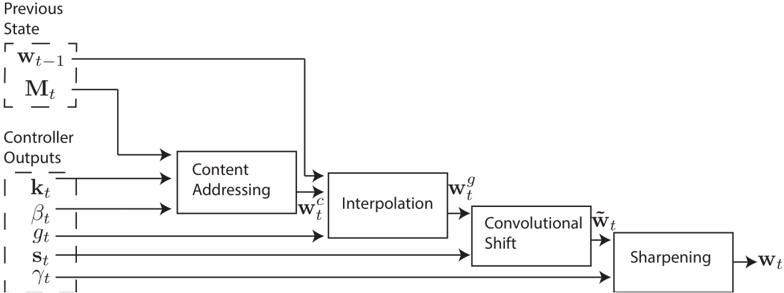
The diagram illustrates a sequential data processing pipeline for a control system. It begins with inputs from a "Previous State" and "Controller Outputs," which are processed through five stages: Content Addressing, Interpolation, Convolutional Shift, and Sharpening. The final output is labeled **w_t**, representing the processed state at time **t**.
---
### Components/Axes
1. **Previous State**
- Contains two variables:
- **w_t-1**: Previous weight vector (input to Content Addressing).
- **M_t**: Matrix associated with the previous state (input to Content Addressing).
2. **Controller Outputs**
- Five variables feeding into Content Addressing:
- **k_t**: Gain parameter.
- **β_t**: Beta parameter.
- **g_t**: Gamma parameter.
- **s_t**: Sigma parameter.
- **γ_t**: Additional control signal.
3. **Content Addressing**
- Inputs: **w_t-1**, **M_t**, **k_t**, **β_t**, **g_t**, **s_t**, **γ_t**.
- Output: **w_c** (content-addressed vector).
4. **Interpolation**
- Input: **w_c**.
- Output: **w_g** (interpolated vector).
5. **Convolutional Shift**
- Input: **w_g**.
- Output: **w_t~** (convolutionally shifted vector).
6. **Sharpening**
- Input: **w_t~**.
- Output: **w_t** (final processed state).
---
### Flow and Relationships
- **Data Flow**:
1. **Previous State** and **Controller Outputs** are combined as inputs to **Content Addressing**.
2. **Content Addressing** processes these inputs to produce **w_c**, which is passed to **Interpolation**.
3. **Interpolation** generates **w_g**, which is fed into **Convolutional Shift**.
4. **Convolutional Shift** outputs **w_t~**, which is refined by **Sharpening** to produce **w_t**.
- **Temporal Dependency**:
The use of **w_t-1** (previous state) suggests the system incorporates historical data for decision-making.
---
### Key Observations
1. **Modular Design**: Each block performs a distinct transformation (e.g., interpolation, convolutional operations).
2. **Controller Integration**: Controller outputs (**k_t**, **β_t**, etc.) directly influence the Content Addressing stage, enabling real-time adjustments.
3. **Temporal Context**: The system retains memory of the previous state (**w_t-1**, **M_t**) to inform current processing.
4. **Final Output**: **w_t** represents the culmination of all transformations, likely used for system control or feedback.
---
### Interpretation
This pipeline appears to model a **reinforcement learning** or **adaptive control system** where:
- **Content Addressing** selects relevant features from historical data (**w_t-1**, **M_t**) and controller signals.
- **Interpolation** and **Convolutional Shift** refine these features spatially or temporally.
- **Sharpening** enhances critical details in the output (**w_t**), possibly for decision-making or actuation.
The system’s reliance on **w_t-1** and **M_t** implies it operates in a dynamic environment requiring memory of past states. The inclusion of multiple controller parameters (**k_t**, **β_t**, etc.) suggests fine-grained tunability for optimization or stability.
No numerical data or trends are present in the diagram; it focuses on architectural relationships and data flow.