\n
## Image Analysis: Question-Answer Pairs with Scene Images
### Overview
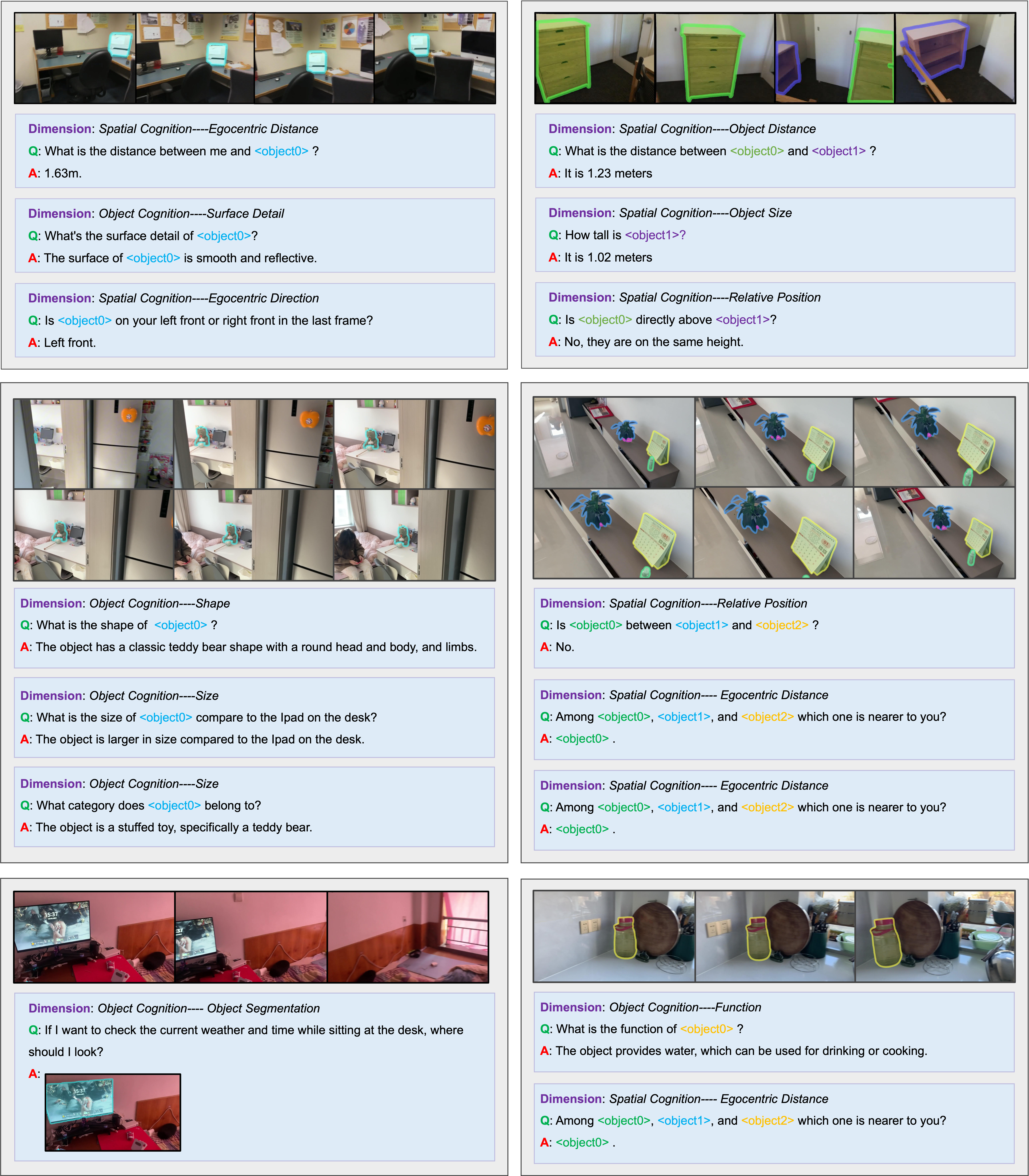
The image presents a series of question-answer pairs, each accompanied by a photograph of a domestic scene. The questions relate to spatial cognition and object recognition, probing understanding of distances, sizes, shapes, positions, and functions of objects within the scenes. Each question is labeled with "Dimension: [Cognitive Area]".
### Components/Axes
The image is structured as a grid of question-answer blocks. Each block contains:
* **Dimension Label:** Indicates the cognitive area being tested (e.g., Spatial Cognition, Object Cognition).
* **Question (Q):** A specific question about the scene.
* **Answer (A):** The provided answer to the question.
* **Scene Image:** A photograph illustrating the context for the question.
### Detailed Analysis / Content Details
Here's a transcription of each question-answer pair, along with observations about the accompanying image:
**1. Dimension: Spatial Cognition—Egocentric Distance**
* Q: What is the distance between me and <object0>?
* A: 1.63m.
* Image: A person is seated at a table with a laptop and a mug. <object0> appears to be the mug.
**2. Dimension: Spatial Cognition—Object Distance**
* Q: What is the distance between <object0> and <object1>?
* A: It is 1.25 meters.
* Image: Same scene as above. <object0> and <object1> appear to be the mug and the laptop, respectively.
**3. Dimension: Object Cognition—Surface Detail**
* Q: What's the surface detail of <object0>?
* A: The surface of <object0> is smooth and reflective.
* Image: Same scene. <object0> is the laptop screen.
**4. Dimension: Spatial Cognition—Object Size**
* Q: How tall is <object1>?
* A: It is 1.02 meters.
* Image: Same scene. <object1> is the person.
**5. Dimension: Spatial Cognition—Egocentric Direction**
* Q: Is <object0> on your left front or right front in the last frame?
* A: Left front.
* Image: Same scene. <object0> is the mug.
**6. Dimension: Spatial Cognition—Relative Position**
* Q: Is <object0> directly above <object1>?
* A: No, they are on the same height.
* Image: Same scene. <object0> is the mug, and <object1> is the laptop.
**7. Dimension: Object Cognition—Shape**
* Q: What is the shape of <object0>?
* A: The object has a classic teddy bear shape with a round head and body, and limbs.
* Image: A child is holding a teddy bear. <object0> is the teddy bear.
**8. Dimension: Spatial Cognition—Relative Position**
* Q: Is <object0> between <object1> and <object2>?
* A: No.
* Image: A child is holding a teddy bear. <object0> is the teddy bear, <object1> is the child's hand, and <object2> is the child's arm.
**9. Dimension: Spatial Cognition—Egocentric Distance**
* Q: What is the size of <object0> compare to the ipad on the desk?
* A: The object is larger in size compared to the ipad on the desk.
* Image: A child is holding a teddy bear next to an iPad on a desk. <object0> is the teddy bear.
**10. Dimension: Spatial Cognition—Egocentric Distance**
* Q: What category does <object0> belong to?
* A: The object is a stuffed toy, specifically a teddy bear.
* Image: A child is holding a teddy bear. <object0> is the teddy bear.
**11. Dimension: Object Cognition—Object Segmentation**
* Q: If I want to check the current weather and time sitting at the desk, where should I look?
* A:
* Image: A person is seated at a desk with a laptop.
**12. Dimension: Object Cognition—Function**
* Q: What is the function of <object0>?
* A: The object provides water, which can be used for drinking or cooking.
* Image: A person is seated at a table with a mug. <object0> is the mug.
**13. Dimension: Spatial Cognition—Egocentric Distance**
* Q: Among <object0>, <object1>, and <object2> which one is nearer to you?
* A: <object0>.
* Image: A person is seated at a table with a mug, a laptop, and a phone. <object0> is the mug, <object1> is the laptop, and <object2> is the phone.
### Key Observations
* The questions consistently use placeholders like `<object0>`, `<object1>`, and `<object2>`, indicating a system for object identification within the images.
* The answers provide quantitative data (distances in meters) and qualitative descriptions (surface details, shapes, functions).
* The scenes depict everyday environments, suggesting the task is to assess understanding of common spatial relationships and object properties.
* The questions cover a range of cognitive abilities, including distance estimation, shape recognition, and functional understanding.
### Interpretation
This image represents a dataset for evaluating AI or human performance in visual understanding and spatial reasoning. The questions are designed to test the ability to perceive and interpret the relationships between objects in a scene, as well as to understand the properties of those objects. The use of precise measurements (distances) suggests a focus on accurate spatial perception. The inclusion of both spatial and object-based questions indicates a holistic assessment of visual cognition. The consistent format and use of placeholders suggest this is part of a larger, automated evaluation system. The unanswered question in block 11 suggests the dataset is incomplete or that some questions are intentionally left open-ended.