\n
## Relational Database Schemas and Logical Expressions
### Overview
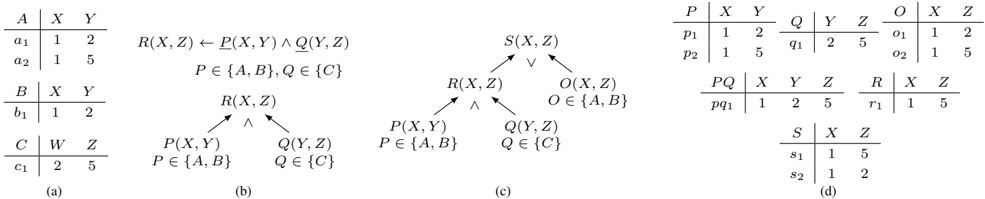
The image presents four distinct representations related to relational database schemas and logical expressions. The first three (a, b, c) depict relational schemas with associated attributes and a logical expression. The fourth (d) shows multiple relational schemas with attributes and values.
### Components/Axes
The image consists of:
* **(a)** A relational schema labeled 'A' with attributes 'X' and 'Y', and values 1, 2, and 5. A schema labeled 'B' with attributes 'X' and 'Y', and values 1, 2. A schema labeled 'C' with attributes 'W' and 'Z', and values 2, 5.
* **(b)** A logical expression: `R(X, Z) ← P(X, Y) ∧ Q(Y, Z)` with the conditions `P ∈ {A, B}` and `Q ∈ {C}`.
* **(c)** A logical expression: `S(X, Z) ∨ (R(X, Z) ∧ O(X, Z))` with the condition `O ∈ {A, B}`.
* **(d)** Four relational schemas: 'P' with attributes 'X', 'Y', and values 1, 2, 5. 'Q' with attributes 'Y', 'Z', and values 2, 5. 'O' with attributes 'X', 'Z', and values 1, 5. 'R' with attributes 'X', 'Z', and values 1, 5. 'S' with attributes 'X', 'Z', and values 1, 5, 1, 2.
### Detailed Analysis or Content Details
**(a) Relational Schemas:**
* **A:** Attributes X, Y. Values: (X=1, Y=2), (X=1, Y=5).
* **B:** Attributes X, Y. Values: (X=1, Y=2).
* **C:** Attributes W, Z. Values: (W=2, Z=5).
**(b) Logical Expression:**
* `R(X, Z) ← P(X, Y) ∧ Q(Y, Z)`: R(X, Z) is true if both P(X, Y) and Q(Y, Z) are true.
* `P ∈ {A, B}`: P can be either schema A or schema B.
* `Q ∈ {C}`: Q must be schema C.
**(c) Logical Expression:**
* `S(X, Z) ∨ (R(X, Z) ∧ O(X, Z))`: S(X, Z) is true, or both R(X, Z) and O(X, Z) are true.
* `O ∈ {A, B}`: O can be either schema A or schema B.
**(d) Relational Schemas:**
* **P:** Attributes X, Y. Values: (X=1, Y=2), (X=1, Y=5). Labeled as p1, p2.
* **Q:** Attributes Y, Z. Values: (Y=2, Z=5). Labeled as q1.
* **O:** Attributes X, Z. Values: (X=1, Z=5). Labeled as o1, o2.
* **R:** Attributes X, Z. Values: (X=1, Z=5). Labeled as r1.
* **S:** Attributes X, Z. Values: (X=1, Z=5), (X=1, Z=2). Labeled as s1, s2.
### Key Observations
* The schemas in (a) are simple, containing only a few tuples.
* The logical expressions in (b) and (c) define dependencies between schemas.
* Schema (d) provides specific data instances for the schemas P, Q, O, R, and S.
* The schemas in (d) share common attributes (X, Y, Z) which is relevant to the logical expressions in (b) and (c).
### Interpretation
The image illustrates a scenario involving relational database schemas and how logical expressions can be used to define relationships and dependencies between them. The schemas in (a) represent potential sources of data, while the logical expressions in (b) and (c) specify how data from these schemas can be combined to derive new information. Schema (d) provides concrete data instances that can be used to test and evaluate the logical expressions.
The use of set notation (e.g., `P ∈ {A, B}`) indicates that the logical expressions are designed to be flexible and can operate on different schemas depending on the specific context. The logical expressions are likely part of a larger database query or rule system. The schemas and expressions together represent a fragment of a knowledge base or a data integration system. The logical expressions define rules for inferring new facts from existing data. The schemas provide the structure for storing and organizing the data. The data instances in schema (d) are used to validate the correctness of the rules and to demonstrate how the system can be used to answer queries.