\n
## Image Series: Rendering Comparison - Octree-DGS vs. Hierarchical-3DGS
### Overview
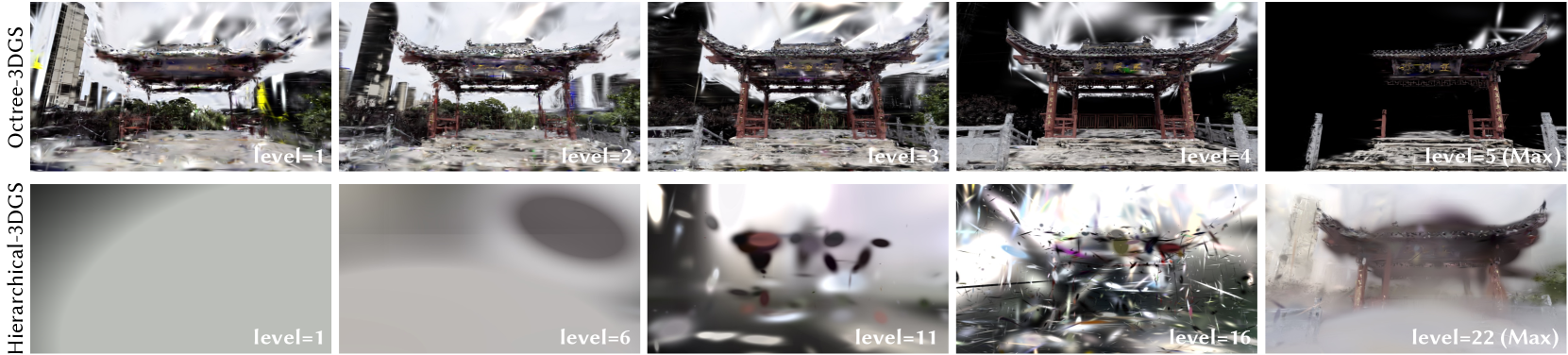
The image presents a comparative visualization of a 3D model of a traditional Asian pagoda rendered using two different data structures: Octree-DGS and Hierarchical-3DGS. Each row represents one of these structures, and each column shows the rendering at increasing levels of detail, labeled from level 1 to a maximum level (indicated as "Max"). The goal appears to be to demonstrate the impact of different data structures on rendering quality and performance as detail increases.
### Components/Axes
The image consists of two rows, labeled "Octree-DGS" on the left and "Hierarchical-3DGS" on the bottom. Each row contains five columns, each displaying a rendering of the pagoda at a specific level of detail. The levels are indicated by text labels at the bottom of each image: "level=1", "level=2", "level=3", "level=4", "level=5 (Max)" for the Octree-DGS row, and "level=1", "level=6", "level=11", "level=16", "level=22 (Max)" for the Hierarchical-3DGS row. There are no explicit axes or legends beyond these level indicators.
### Detailed Analysis or Content Details
**Octree-DGS Row:**
* **Level 1:** The pagoda is rendered as a very low-resolution, almost blocky shape, barely recognizable. The color is a muted grey.
* **Level 2:** The pagoda's basic structure becomes more apparent, with some definition of the roof and supporting columns. The color remains grey.
* **Level 3:** Further refinement of the structure is visible, with more detail in the roof tiles and columns. The color is still grey.
* **Level 4:** The pagoda is rendered with significantly more detail, including visible textures and colors. The roof is red, and the supporting structure is a darker color.
* **Level 5 (Max):** The highest level of detail shows a fully rendered pagoda with intricate details, textures, and colors. The surrounding environment is also visible, including trees and a cloudy sky.
**Hierarchical-3DGS Row:**
* **Level 1:** The image is a uniform grey, with no discernible features.
* **Level 6:** A blurry, spherical shape begins to emerge, hinting at the pagoda's form.
* **Level 11:** The pagoda's structure is becoming more defined, but still very blurry and indistinct. Some basic shapes are visible.
* **Level 16:** The pagoda is rendered with more detail, but it is surrounded by a significant amount of visual noise and artifacts (colored streaks and distortions).
* **Level 22 (Max):** The highest level of detail shows a rendered pagoda, but it is still affected by visual artifacts and noise, although less pronounced than at level 16. The rendering appears less clean and detailed than the Octree-DGS "Max" level.
### Key Observations
* The Octree-DGS structure appears to achieve a higher level of rendering quality with fewer levels of detail compared to the Hierarchical-3DGS structure.
* The Hierarchical-3DGS structure exhibits significant visual artifacts and noise, particularly at higher levels of detail.
* The level increments are not uniform between the two structures (1, 2, 3, 4, 5 vs. 1, 6, 11, 16, 22), suggesting different scaling or optimization strategies.
* The Octree-DGS rendering at level 5 (Max) is significantly clearer and more detailed than the Hierarchical-3DGS rendering at level 22 (Max).
### Interpretation
The image demonstrates a comparison of two different spatial data structures used for rendering 3D models. The Octree-DGS structure appears to be more efficient and produces higher-quality renderings with fewer levels of detail. The Hierarchical-3DGS structure, while capable of achieving a similar level of detail, suffers from significant visual artifacts and noise, suggesting potential limitations in its implementation or suitability for this type of model.
The non-uniform level increments suggest that the two structures have different approaches to managing detail and complexity. The Octree-DGS structure may be more adaptive, allowing for finer control over detail allocation, while the Hierarchical-3DGS structure may be more rigid or require larger jumps in detail to achieve noticeable improvements.
The presence of artifacts in the Hierarchical-3DGS renderings could be due to several factors, including aliasing, insufficient sampling, or limitations in the rendering algorithm. These artifacts indicate that the Hierarchical-3DGS structure may not be as well-suited for rendering complex scenes with fine details.
Overall, the image suggests that the Octree-DGS structure is a more effective and efficient data structure for rendering this particular 3D model, providing higher quality results with fewer computational resources. This comparison highlights the importance of choosing the appropriate data structure for a given rendering task to optimize performance and visual fidelity.