## Comparison Chart: Octree-3DGS vs. Hierarchical-3DGS Reconstruction Levels
### Overview
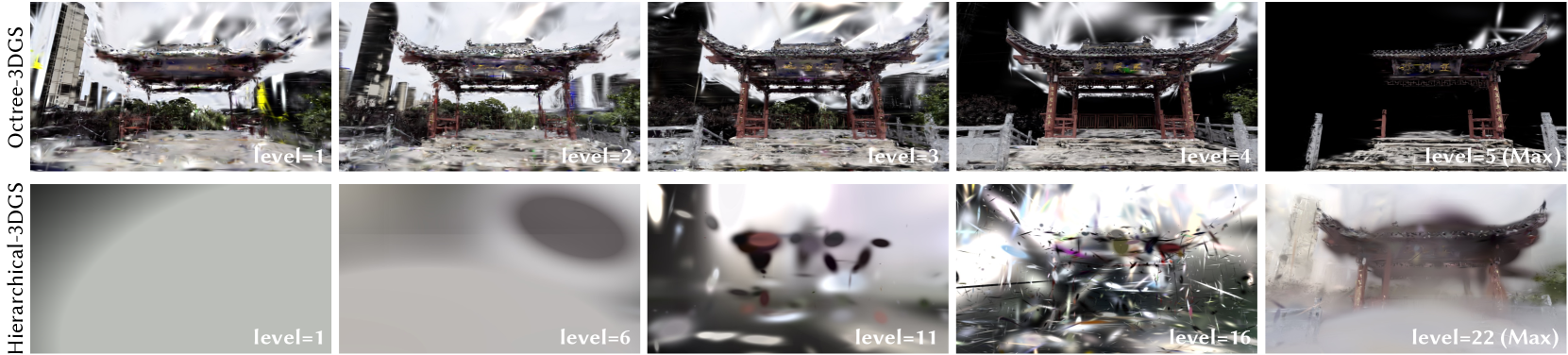
The image is a technical comparison chart displaying the progressive reconstruction quality of two different 3D Gaussian Splatting (3DGS) methods—Octree-3DGS and Hierarchical-3DGS—across increasing computational or detail levels. It consists of two horizontal rows, each containing five sequential images showing the same scene (a traditional Chinese archway or *paifang*) at different stages of reconstruction fidelity.
### Components/Axes
* **Row Labels (Vertical Text, Left Side):**
* Top Row: `Octree-3DGS`
* Bottom Row: `Hierarchical-3DGS`
* **Image Grid:** A 2x5 grid of images.
* **Level Indicators (Text, Bottom-Right of each image):**
* Top Row (Octree-3DGS): `level=1`, `level=2`, `level=3`, `level=4`, `level=5 (Max)`
* Bottom Row (Hierarchical-3DGS): `level=1`, `level=6`, `level=11`, `level=16`, `level=22 (Max)`
* **Scene Content:** Each image depicts a 3D reconstruction of an ornate, traditional Chinese archway with a curved roof, set in an urban environment with modern buildings in the background. The archway has a central plaque with Chinese characters.
### Detailed Analysis
**Row 1: Octree-3DGS**
* **Trend:** Shows a rapid and clear convergence towards a high-fidelity reconstruction.
* **Level 1 (Top-Left):** The scene is recognizable but heavily distorted with blurry, smeared artifacts, especially in the sky and background. The archway structure is visible but lacks fine detail.
* **Level 2 (Top-Center-Left):** Significant improvement. Distortion reduces, the archway's structure becomes sharper, and background buildings gain definition.
* **Level 3 (Top-Center):** Further refinement. Details on the archway's roof and pillars become clearer. The scene appears more stable.
* **Level 4 (Top-Center-Right):** Very close to the final output. Minor artifacts remain, but the overall scene is coherent and detailed.
* **Level 5 (Max) (Top-Right):** The final, high-quality reconstruction. The archway is sharp, with clear textures and colors. The background is clean, and the Chinese characters on the plaque are legible (though not transcribed as data). The image has a black background, suggesting the reconstruction is isolated or the rendering mode changed.
**Row 2: Hierarchical-3DGS**
* **Trend:** Shows a much slower, more abstract convergence process, requiring significantly more levels (22 vs. 5) to achieve a recognizable result.
* **Level 1 (Bottom-Left):** Almost entirely abstract. The image is a smooth, gray gradient with no recognizable scene elements.
* **Level 6 (Bottom-Center-Left):** Still highly abstract. Shows large, soft, blob-like shapes in gray and dark tones. No scene structure is discernible.
* **Level 11 (Bottom-Center):** The first hints of scene structure appear. Abstract shapes begin to coalesce into forms that suggest the archway's silhouette and some color patches, but it remains very blurry and impressionistic.
* **Level 16 (Bottom-Center-Right):** A dramatic shift. The scene becomes recognizable, though filled with high-frequency, chaotic noise and artifacts. The archway and background are visible but severely degraded by visual "static."
* **Level 22 (Max) (Bottom-Right):** The final reconstruction. The scene is coherent and detailed, comparable in quality to Octree-3DGS Level 4 or 5. Some softness or minor artifacts may remain compared to the Octree result.
### Key Observations
1. **Convergence Speed:** Octree-3DGS achieves a high-quality, stable reconstruction in just 5 levels. Hierarchical-3DGS requires 22 levels to reach a similar endpoint, with the intermediate stages (levels 1-16) being vastly more abstract and less informative.
2. **Intermediate Representation:** The two methods produce fundamentally different intermediate representations. Octree-3DGS maintains a recognizable, if distorted, scene from the first level. Hierarchical-3DGS passes through a prolonged phase of abstract, non-representational forms before abruptly resolving into a noisy scene.
3. **Final Quality:** Both methods appear to converge to a similar high-fidelity final output for this scene, as seen in their respective "(Max)" level images.
4. **Text in Scene:** The Chinese characters on the archway's plaque are part of the visual scene being reconstructed. They are not extracted as standalone textual data but are a visual feature that becomes legible at higher reconstruction levels.
### Interpretation
This chart visually demonstrates a core trade-off in hierarchical or progressive 3D reconstruction algorithms. **Octree-3DGS** appears to use a method that preserves coarse scene structure from the outset, refining it efficiently. This is beneficial for applications requiring early, recognizable previews. **Hierarchical-3DGS** seems to employ a more bottom-up approach, possibly optimizing fundamental visual elements (like color blobs or wavelets) before assembling them into a coherent scene. This results in a long "abstract phase" but may offer advantages in handling complex geometry or lighting that are not apparent in this single example.
The key takeaway is not just the difference in final quality (which is similar), but the stark difference in the *path* to that quality. The choice between these methods would depend on whether intermediate visual plausibility (favoring Octree) or other potential backend advantages of the hierarchical approach (like memory efficiency or handling of unstructured data) are more critical for a given application. The chart effectively argues that for this specific scene, Octree-3DGS provides a more immediately useful and interpretable progression.