## Mathematical Plot: The Cantor Function (Devil's Staircase)
### Overview
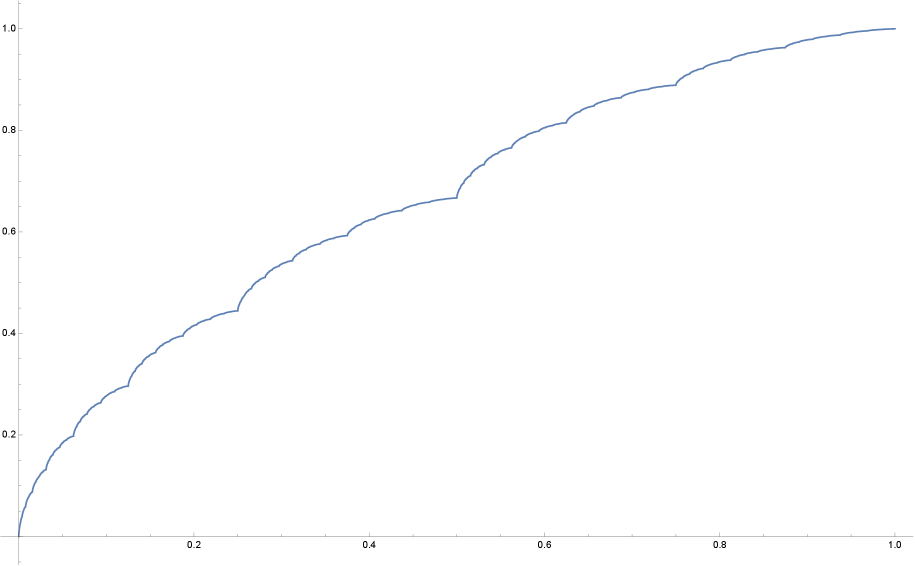
The image displays a mathematical plot of a continuous, monotonically increasing function defined on the interval [0, 1]. The curve exhibits a recursive, fractal-like structure, commonly known as the "Devil's Staircase" or the Cantor function.
### Components/Axes
* **X-Axis (Horizontal):** Represents the domain, ranging from 0.0 to 1.0. Major tick marks are present at 0.2, 0.4, 0.6, 0.8, and 1.0.
* **Y-Axis (Vertical):** Represents the range, ranging from 0.0 to 1.0. Major tick marks are present at 0.2, 0.4, 0.6, 0.8, and 1.0.
* **Data Series:** A single, continuous blue line plotted against the axes.
* **Background:** A uniform, light-gray field.
### Detailed Analysis
* **Trend Verification:** The line originates at the origin (0,0) and terminates at the coordinate (1,1). The function is monotonically increasing; it never decreases.
* **Visual Structure:** The curve is composed of a series of "steps" or plateaus. Upon closer inspection, these steps are self-similar; the pattern of the curve at a large scale is repeated at smaller scales.
* **Key Data Points:**
* **Start:** (0, 0)
* **Midpoint:** (0.5, 0.5)
* **End:** (1, 1)
* **Quarter points:** The curve passes through approximately (0.25, 0.25) and (0.75, 0.75), though the fractal nature means the "flat" sections are dense.
### Key Observations
* **Fractal Nature:** The curve is a classic example of a fractal. It is continuous everywhere but differentiable almost nowhere.
* **"Flat" Regions:** The curve appears to have horizontal segments. In the mathematical definition of the Cantor function, the derivative is zero almost everywhere, meaning the function is "flat" on the complement of the Cantor set.
* **Symmetry:** The function exhibits point symmetry about the center point (0.5, 0.5).
### Interpretation
This plot represents the Cantor function, a counter-intuitive mathematical object.
* **Mathematical Significance:** It is a standard example in real analysis used to demonstrate that a function can be continuous and non-decreasing, yet have a derivative of zero almost everywhere.
* **"Devil's Staircase":** The name arises because the function appears to be a staircase (a series of flat steps), yet it is continuous. It effectively "climbs" from 0 to 1 without ever having a positive slope in the traditional sense over the majority of its domain.
* **Application:** This type of function is often used to illustrate the limitations of the Fundamental Theorem of Calculus, as it is a function that is not the integral of its derivative (since the derivative is 0 almost everywhere, but the function changes from 0 to 1).