\n
## Line Chart: Probability Density of Mean Reward for Different Actions
### Overview
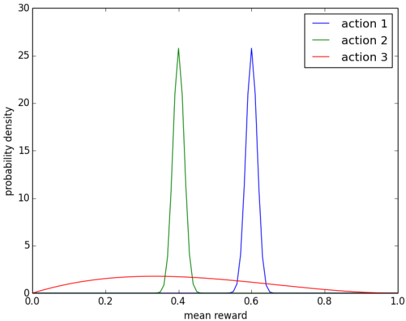
The image presents a line chart illustrating the probability density of the mean reward for three different actions. The x-axis represents the mean reward, ranging from 0.0 to 1.0, while the y-axis represents the probability density, ranging from 0.0 to 30.0. Three distinct lines, each representing an action, depict the distribution of mean rewards.
### Components/Axes
* **X-axis Title:** "mean reward"
* **Y-axis Title:** "probability density"
* **X-axis Range:** 0.0 to 1.0
* **Y-axis Range:** 0.0 to 30.0
* **Legend:** Located in the top-right corner.
* "action 1" - Blue line
* "action 2" - Red line
* "action 3" - Green line
### Detailed Analysis
* **Action 1 (Blue Line):** This line exhibits a unimodal distribution, peaking at approximately 0.65 with a probability density of around 26. The line slopes downward on both sides of the peak, approaching a probability density of 0 at the extremes of the x-axis.
* **Action 2 (Red Line):** This line shows a relatively flat distribution with a slight dip in the center. The probability density remains consistently low, fluctuating between approximately 2 and 8 across the entire range of mean rewards. It appears to have a very broad distribution.
* **Action 3 (Green Line):** This line also displays a unimodal distribution, peaking at approximately 0.4 with a probability density of around 25. Similar to Action 1, the line slopes downward on both sides of the peak, approaching a probability density of 0 at the extremes of the x-axis.
Here's a breakdown of approximate data points:
| Action | Mean Reward | Probability Density |
| :------- | :---------- | :------------------ |
| Action 1 | 0.2 | ~2 |
| Action 1 | 0.4 | ~10 |
| Action 1 | 0.6 | ~25 |
| Action 1 | 0.8 | ~10 |
| Action 2 | 0.2 | ~4 |
| Action 2 | 0.4 | ~6 |
| Action 2 | 0.6 | ~4 |
| Action 2 | 0.8 | ~6 |
| Action 3 | 0.2 | ~5 |
| Action 3 | 0.4 | ~25 |
| Action 3 | 0.6 | ~10 |
| Action 3 | 0.8 | ~5 |
### Key Observations
* Action 1 and Action 3 have similar peak probability densities, but their peaks are located at different mean reward values (0.65 and 0.4, respectively).
* Action 2 has a significantly lower probability density across all mean reward values compared to Action 1 and Action 3.
* The distributions for Action 1 and Action 3 are relatively narrow and concentrated around their respective peaks, indicating a higher certainty in the mean reward for those actions.
* Action 2's distribution is broad and flat, suggesting a high degree of uncertainty in the mean reward.
### Interpretation
The chart suggests that Actions 1 and 3 are more likely to yield higher mean rewards than Action 2. Action 1 is centered around a mean reward of 0.65, while Action 3 is centered around 0.4. Action 2, however, has a low probability density across the entire range, indicating it is less likely to provide a substantial reward. The narrow distributions of Actions 1 and 3 suggest that the rewards are more predictable, while the broad distribution of Action 2 indicates a higher level of risk or variability. This data could be used to inform a decision-making process, favoring Actions 1 and 3 over Action 2. The difference in peak locations between Action 1 and Action 3 suggests that different strategies or approaches may lead to different expected rewards.