\n
## Diagram: Chameleon - Visual Reasoning System
### Overview
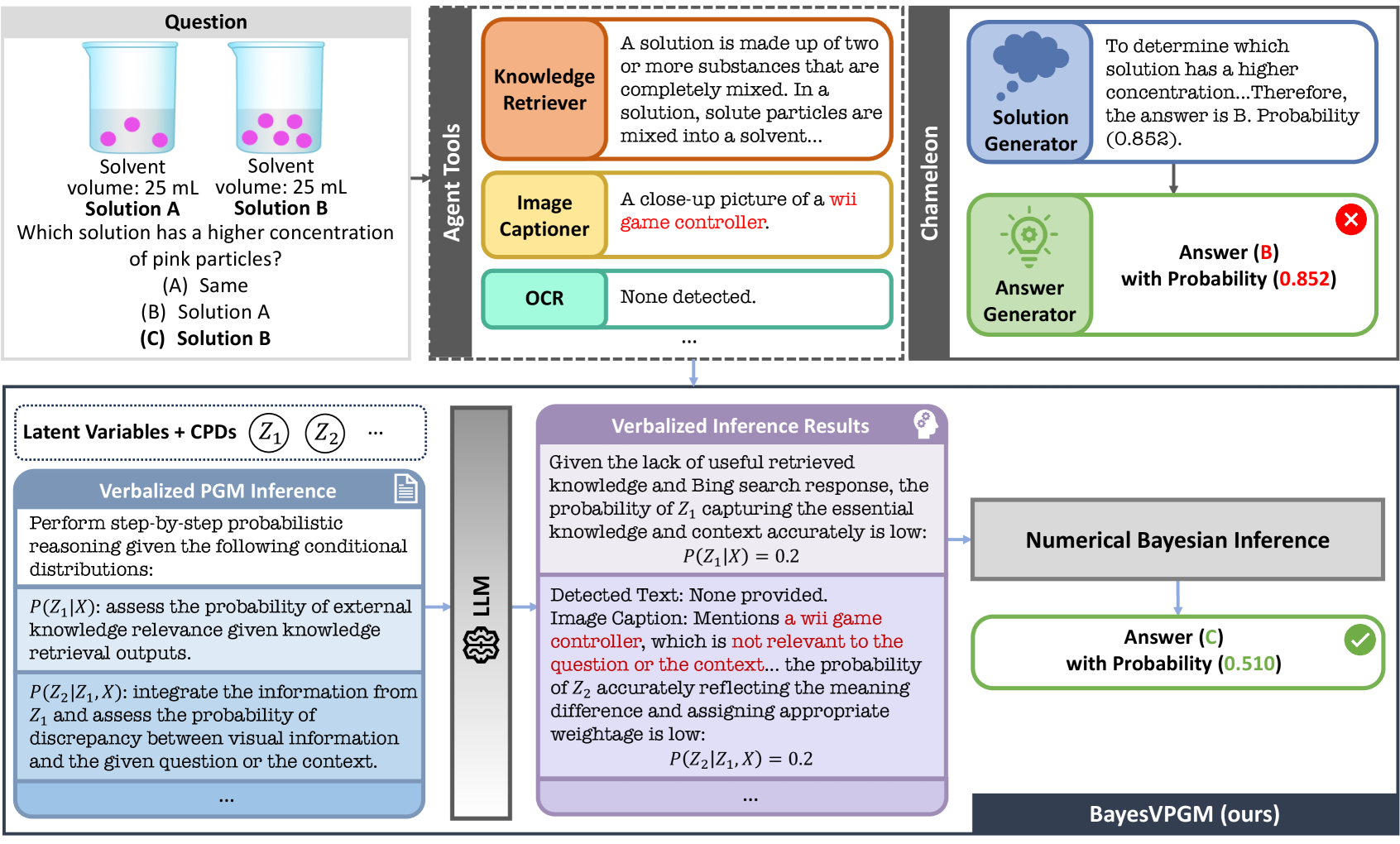
This diagram illustrates the architecture and workflow of a visual reasoning system named "Chameleon". The system aims to answer questions based on visual input (two beakers with pink particles) by integrating knowledge retrieval, image captioning, and probabilistic reasoning. The diagram showcases the process from question input to answer generation, highlighting the probabilities associated with each potential answer.
### Components/Axes
The diagram is segmented into several key areas:
* **Question:** Located on the left, presenting a visual question with multiple-choice answers.
* **Agent Tools:** A vertical block containing "Knowledge Retriever", "Image Captioner", and "OCR".
* **Chameleon:** A central block representing the core reasoning engine, divided into "Solution Generator" and "Answer Generator".
* **Verbalized Inference Results:** A lower-left block detailing the probabilistic graphical model (PGM) inference process.
* **Numerical Bayesian Inference:** A lower-right block showing the results of numerical Bayesian inference.
* **BayesVPGM (ours):** A label indicating the system's approach.
The diagram also includes probability values associated with answers and inference steps.
### Detailed Analysis or Content Details
**Question:**
* Visual: Two beakers, labeled "Solution A" and "Solution B". Each beaker contains a solvent volume of 25 mL and pink particles.
* Text: "Which solution has a higher concentration of pink particles?"
* Options: (A) Same, (B) Solution A, (C) Solution B
**Agent Tools:**
* **Knowledge Retriever:** Text: "A solution is made up of two or more substances that are completely mixed. In a solution, solute particles are mixed into a solvent..."
* **Image Captioner:** Text: "A close-up picture of a Wii game controller."
* **OCR:** Text: "None detected."
**Chameleon:**
* **Solution Generator:** Text: "To determine which solution has a higher concentration... Therefore, the answer is B. Probability (0.852)."
* **Answer Generator:** Text: "Answer (B) with Probability (0.852)" - Marked with a red 'X'.
**Verbalized Inference Results:**
* Text: "Given the lack of useful retrieved knowledge and Bing search response, the probability of Z1 capturing the essential knowledge and context accurately is low: P(Z1|X) = 0.2"
* Text: "Detected Text: None provided. Image Caption: Mentions a Wii game controller, which is not relevant to the question or the context... the probability of Z2 accurately reflecting the meaning difference and assigning appropriate weightage is low: P(Z2|X) = 0.2"
**Numerical Bayesian Inference:**
* Text: "Answer (C) with Probability (0.510)" - Marked with a green checkmark.
**Latent Variables + CPDs:** Z1, Z2, ... (represented as boxes)
**LM:** A symbol representing a Language Model.
### Key Observations
* The system initially suggests "Solution A" (B) with a high probability (0.852), but this is marked as incorrect.
* The Bayesian inference then points to "Solution B" (C) with a probability of 0.510, which is the correct answer.
* The Image Captioner provides an irrelevant caption ("Wii game controller"), indicating a failure in visual understanding.
* The Knowledge Retriever provides a basic definition of a solution, which is relevant but not sufficient to answer the question directly.
* The PGM inference assigns low probabilities (0.2) to both Z1 and Z2, suggesting that the retrieved knowledge and image caption are not helpful for accurate reasoning.
### Interpretation
The diagram demonstrates a visual reasoning pipeline that struggles with contextual understanding and relevance. While the system can retrieve knowledge and generate potential solutions, it initially arrives at an incorrect answer due to the misleading image caption. The subsequent Bayesian inference corrects this error, but with a lower confidence level. This highlights the importance of accurate image understanding and relevant knowledge retrieval for effective visual reasoning. The low probabilities assigned to the latent variables (Z1, Z2) indicate that the system is uncertain about the quality of the information it's using. The discrepancy between the initial high-probability answer and the final correct answer suggests a need for improved integration of different reasoning components and a more robust mechanism for filtering irrelevant information. The system's architecture, "BayesVPGM", appears to be an attempt to address these challenges by incorporating Bayesian inference and probabilistic graphical models. The diagram effectively illustrates the complexities of building a system that can reason about visual information and provide accurate answers to complex questions.