## Textual Template: Prompt for Multimodal Mathematical Reasoning
### Overview
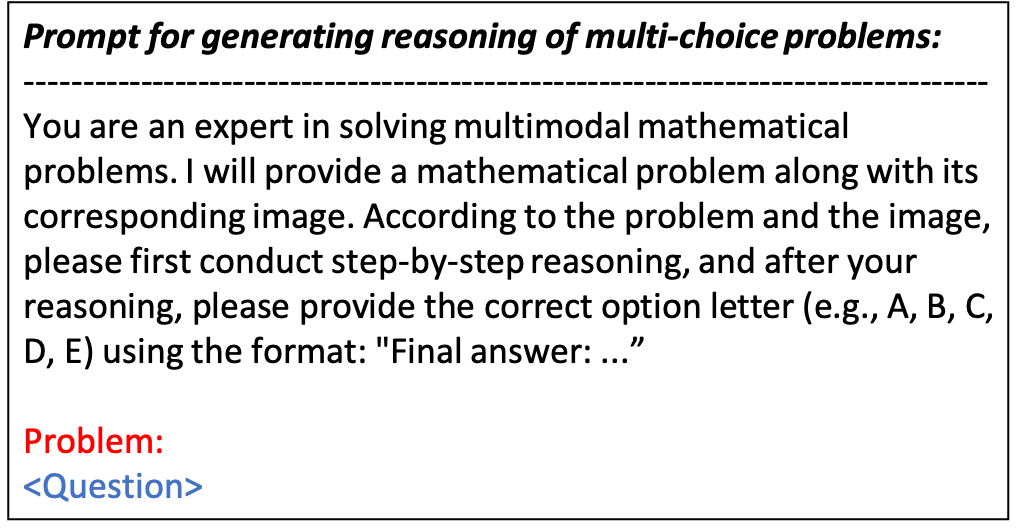
The image displays a structured text prompt designed to instruct an AI model on how to process and solve multimodal mathematical problems. It establishes a persona for the AI, defines the input expectations, mandates a specific reasoning process, and dictates the final output format.
### Components
The text is organized into three distinct sections:
1. **Header:** A title defining the purpose of the prompt.
2. **Separator:** A dashed horizontal line acting as a visual break.
3. **Instructional Body:** The core instructions for the AI model.
4. **Placeholder:** A specific field for the input problem.
### Content Details
The following is the exact transcription of the text contained within the image:
**Header:**
> Prompt for generating reasoning of multi-choice problems:
**Separator:**
> --------------------------------------------------
**Instructional Body:**
> You are an expert in solving multimodal mathematical problems. I will provide a mathematical problem along with its corresponding image. According to the problem and the image, please first conduct step-by-step reasoning, and after your reasoning, please provide the correct option letter (e.g., A, B, C, D, E) using the format: "Final answer: ..."
**Placeholder:**
> Problem:
> <Question>
### Key Observations
* **Chain-of-Thought (CoT) Enforcement:** The prompt explicitly mandates "step-by-step reasoning" before the final answer. This is a standard technique to improve the accuracy of LLMs on complex reasoning tasks.
* **Multimodal Requirement:** The prompt acknowledges that the input will consist of both text ("mathematical problem") and visual data ("corresponding image").
* **Strict Output Formatting:** The prompt requires a specific string format ("Final answer: ...") for the conclusion. This is likely intended to facilitate automated parsing or grading of the model's output.
* **Persona Adoption:** By starting with "You are an expert in solving multimodal mathematical problems," the prompt utilizes role-prompting to prime the model for higher-quality, domain-specific performance.
### Interpretation
This text serves as a **system prompt** or **instructional template** for an AI agent. Its primary purpose is to standardize the interaction between a user and an AI model when dealing with math-based benchmarks or exams.
By forcing the model to articulate its reasoning steps before providing the final answer, the prompt aims to:
1. **Reduce Hallucinations:** By forcing the model to "show its work," it is less likely to guess randomly.
2. **Enable Debugging:** If the model gets the answer wrong, a human evaluator can look at the "step-by-step reasoning" to identify exactly where the logic failed.
3. **Automate Evaluation:** The requirement for the "Final answer: ..." format allows for programmatic extraction of the result, making it easy to score the model's performance against a dataset of correct answers.