## Bar Chart: Number of Questions by Path Length in SPARQL for CWQ and WebQSP
### Overview
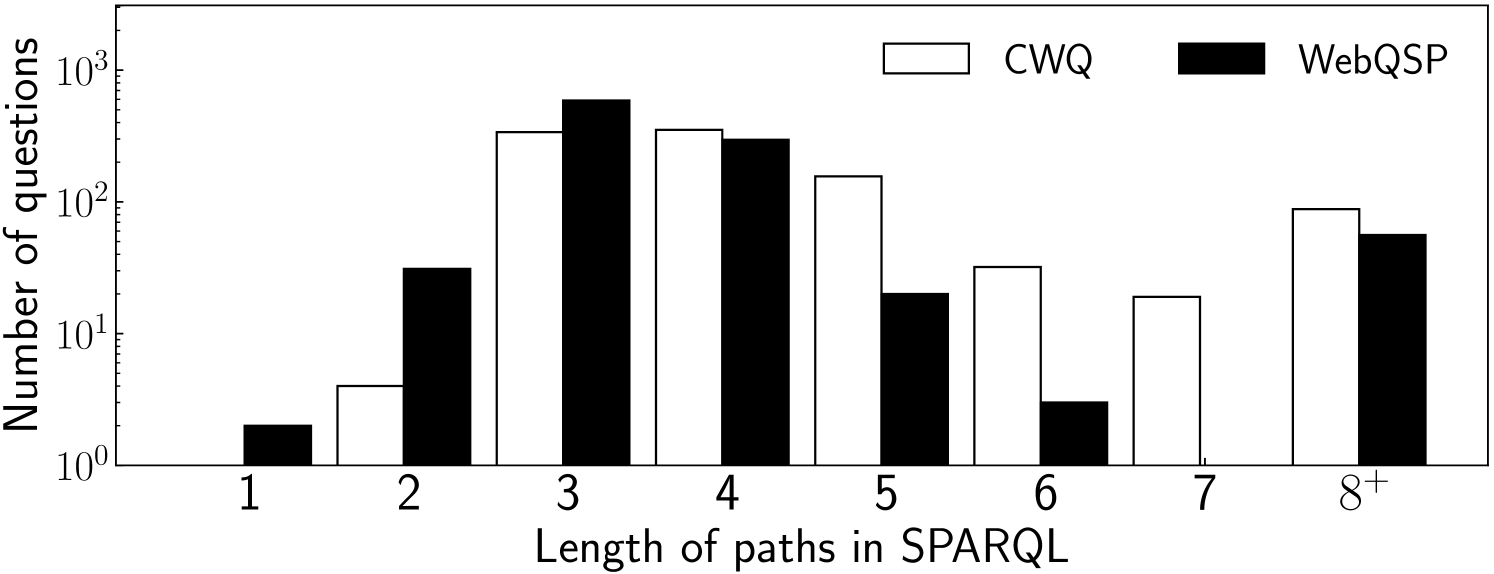
This image is a bar chart comparing the number of questions based on the length of paths in SPARQL queries. Two datasets, CWQ (represented by white bars) and WebQSP (represented by black bars), are presented side-by-side for each path length. The y-axis is on a logarithmic scale, indicating a wide range of question counts.
### Components/Axes
* **Title:** Implicitly, the chart compares question counts by SPARQL path length for two systems.
* **Y-axis Label:** "Number of questions"
* **Y-axis Scale:** Logarithmic, with major tick marks at 10^0 (1), 10^1 (10), and 10^2 (100), and 10^3 (1000).
* **X-axis Label:** "Length of paths in SPARQL"
* **X-axis Categories:** The categories are discrete path lengths, labeled numerically from 1 to 7, and a final category labeled "S^1".
* 1
* 2
* 3
* 4
* 5
* 6
* 7
* S^1
* **Legend:** Located in the top-center of the chart.
* White rectangle: "CWQ"
* Black rectangle: "WebQSP"
### Detailed Analysis
The chart displays the distribution of questions across different SPARQL path lengths for CWQ and WebQSP.
**Path Length 1:**
* CWQ (white bar): Approximately 2 questions.
* WebQSP (black bar): Approximately 20 questions.
**Path Length 2:**
* CWQ (white bar): Approximately 30 questions.
* WebQSP (black bar): Approximately 40 questions.
**Path Length 3:**
* CWQ (white bar): Approximately 180 questions.
* WebQSP (black bar): Approximately 250 questions.
**Path Length 4:**
* CWQ (white bar): Approximately 170 questions.
* WebQSP (black bar): Approximately 150 questions.
**Path Length 5:**
* CWQ (white bar): Approximately 110 questions.
* WebQSP (black bar): Approximately 20 questions.
**Path Length 6:**
* CWQ (white bar): Approximately 35 questions.
* WebQSP (black bar): Approximately 5 questions.
**Path Length 7:**
* CWQ (white bar): Approximately 15 questions.
* WebQSP (black bar): Approximately 10 questions.
**Path Length S^1:**
* CWQ (white bar): Approximately 80 questions.
* WebQSP (black bar): Approximately 60 questions.
### Key Observations
* **Dominance of Shorter Paths:** Both CWQ and WebQSP show a peak in the number of questions for path lengths 3 and 4.
* **WebQSP's Higher Count for Short Paths:** WebQSP has a significantly higher number of questions for path length 1 compared to CWQ.
* **CWQ's Higher Count for Medium Paths:** CWQ has a higher number of questions for path lengths 5 and 7 compared to WebQSP.
* **WebQSP's Peak at Path Length 3:** WebQSP exhibits its highest count at path length 3.
* **CWQ's Peak at Path Length 3:** CWQ also shows a high count at path length 3, slightly lower than WebQSP.
* **"S^1" Category:** This category, appearing after path length 7, shows a notable number of questions for both CWQ and WebQSP, with CWQ having a slightly higher count. The meaning of "S^1" is not explicitly defined in the chart but likely represents a specific type of SPARQL path or query structure.
* **Logarithmic Scale Impact:** The logarithmic scale emphasizes the relative differences, especially for smaller counts. For instance, the difference between 2 and 20 questions (path length 1) is visually significant.
### Interpretation
This bar chart illustrates the distribution of SPARQL query complexity, as measured by path length, for two question-answering systems, CWQ and WebQSP. The data suggests that both systems tend to generate queries with moderate path lengths (3 and 4) most frequently.
WebQSP appears to be more inclined towards generating very short paths (length 1) compared to CWQ, which might indicate a different strategy in query decomposition or generation for simpler queries. Conversely, CWQ shows a stronger presence in questions with path lengths 5 and 7, suggesting it might be capable of handling or generating more complex path structures in certain scenarios.
The "S^1" category is an interesting outlier. Its presence and the relatively high number of questions associated with it for both systems warrant further investigation into what this category represents. It could be a specific type of complex query, a fallback mechanism, or a category for queries that don't fit neatly into the numerical path lengths. The fact that both systems have a substantial number of questions in this category suggests it's a common or important aspect of the question-answering task they are designed for.
Overall, the chart provides insights into the query generation patterns of CWQ and WebQSP, highlighting differences in their handling of query complexity based on SPARQL path length. This information could be valuable for optimizing query engines, understanding user query behavior, or evaluating the capabilities of these systems.