\n
## Document: Scriptural Text Analysis - "Om" Significance in Mandukya Upanishad
### Overview
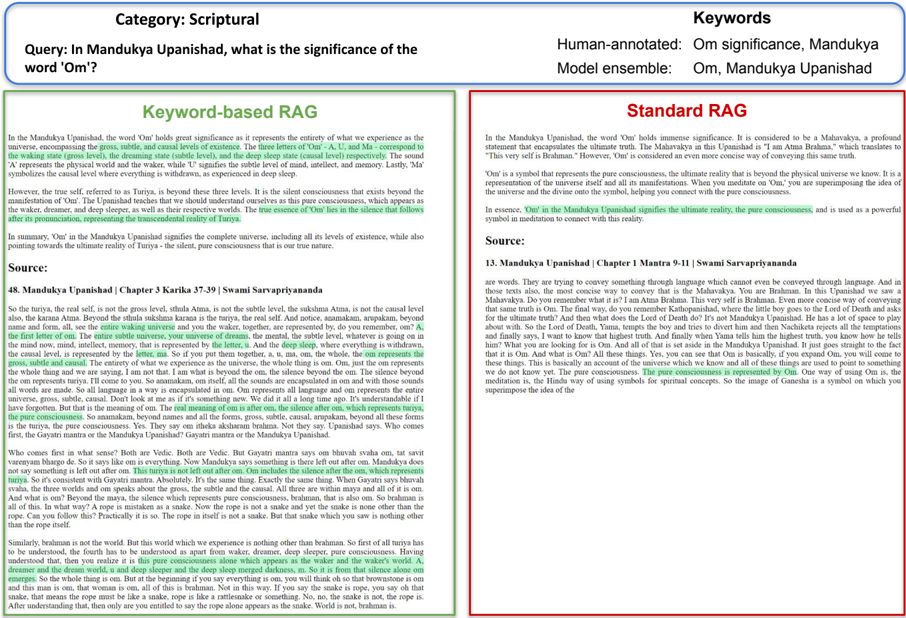
The image presents a comparative analysis of responses to the query "In Mandukya Upanishad, what is the significance of the word 'Om'?" It contrasts a "Keyword-based RAG" (Retrieval-Augmented Generation) approach with a "Standard RAG" approach, alongside human-annotated responses and keywords. The document also includes source citations from the Mandukya Upanishad. The layout is a two-column structure with the left column dedicated to Keyword-based RAG and the right to Standard RAG, both underpinned by a header section.
### Components/Axes
* **Category:** Scriptural (Top-left)
* **Query:** In Mandukya Upanishad, what is the significance of the word 'Om'? (Top-center)
* **Keywords:** Om significance, Mandukya Upanishad, Model ensemble (Top-right)
* **Column 1 Title:** Keyword-based RAG (Left)
* **Column 2 Title:** Standard RAG (Right)
* **Source:** 13. Mandukya Upanishad | Chapter I Mantra 9.11 | Swami Sarvprayananda (Bottom)
* **Source:** 48. Mandukya Upanishad | Chapter 3 | Karika 37-39 | Swami Sarvprayananda (Bottom-left)
### Detailed Analysis or Content Details
**Keyword-based RAG (Left Column):**
The text in the left column is a transcription of a response generated by a Keyword-based RAG system. It is a continuous block of text, approximately 300 words long. Key points include:
* The word "Om" holds great significance, representing the entirety of experience and encompassing the gross, subtle, and causal levels of existence.
* The three letters of "Om" – A, U, and Ma – correspond to the waking state, the dream state, and the deep sleep state (causal level) respectively.
* "Om" symbolizes the causal level where everything withdraws, a state of undifferentiated mind, intellect, and memory.
* The Upanishad teaches that one should understand oneself as pure consciousness, which appears as the waker, dreamer, and deep sleeper, as well as their respective worlds.
* The true essence of "Om" lies in the silence that follows its pronunciation, representing the transcendental reality of Turya.
* The text references Mandukya Upanishad Chapter 3, Karika 37-39, by Swami Sarvprayananda.
**Standard RAG (Right Column):**
The text in the right column is a transcription of a response generated by a Standard RAG system. It is also a continuous block of text, approximately 250 words long. Key points include:
* The word "Om" holds immense significance and is considered to be a Mahavakya, a profound statement that encapsulates the ultimate truth.
* "Om" is considered to convey the same truth more concisely than other phrases.
* "Om" is a symbol that represents the pure consciousness, the ultimate reality that is beyond the physical universe.
* Meditating on "Om" allows one to connect with the pure consciousness and superimpose the idea of the universe and the divine onto the reality.
* The text references Mandukya Upanishad Chapter 1, Mantra 9.11, by Swami Sarvprayananda.
**Human-annotated (Top-right):**
* Om significance, Mandukya Upanishad, Model ensemble.
### Key Observations
* Both RAG systems identify "Om" as profoundly significant in the Mandukya Upanishad.
* The Keyword-based RAG provides a more detailed explanation, referencing the three states of consciousness (waking, dreaming, deep sleep) and the concept of Turya.
* The Standard RAG focuses more on "Om" as a symbol of pure consciousness and its connection to the ultimate reality.
* The Standard RAG response is more concise and emphasizes the power of "Om" as a meditative tool.
* Both responses cite Swami Sarvprayananda's interpretations of the Mandukya Upanishad, but from different chapters/mantras.
* The human-annotated keywords are broad and reflect the core themes of the query.
### Interpretation
This document demonstrates a comparison of two different RAG approaches in answering a specific scriptural question. The Keyword-based RAG appears to leverage a broader range of keywords and contextual information, resulting in a more comprehensive, albeit verbose, response. The Standard RAG, on the other hand, prioritizes conciseness and focuses on the core philosophical implications of "Om."
The differing source citations (Chapter 3 vs. Chapter 1) suggest that the two RAG systems are drawing upon different sections of the Upanishad and potentially different interpretations by Swami Sarvprayananda. This highlights the importance of source selection and the potential for varying perspectives within scriptural texts.
The inclusion of human-annotated keywords provides a baseline for evaluating the relevance and accuracy of the RAG-generated responses. The fact that both systems align with the human-annotated keywords suggests that they are both capturing the essential meaning of the query.
The document serves as a valuable case study for evaluating the strengths and weaknesses of different RAG architectures in the context of complex, nuanced textual data. It also underscores the importance of considering multiple sources and interpretations when engaging with scriptural texts. The document is not presenting data in a numerical or graphical format, but rather a comparative textual analysis.