## Line Chart: Efficiency vs. Node Size
### Overview
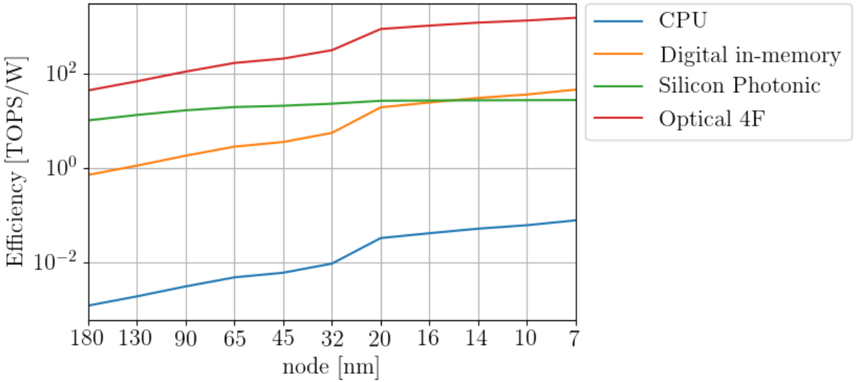
The chart compares the efficiency (in TOPS/W) of four technologies across varying node sizes (in nanometers). Efficiency is plotted on a logarithmic scale (10^-2 to 10^2), while node size decreases from 180 nm to 7 nm on the x-axis. Four data series are represented by distinct colored lines, with a legend on the right.
### Components/Axes
- **X-axis**: "node [nm]" (logarithmic scale, decreasing from 180 to 7 nm).
- **Y-axis**: "Efficiency [TOPS/W]" (logarithmic scale, 10^-2 to 10^2).
- **Legend**:
- Blue: CPU
- Orange: Digital in-memory
- Green: Silicon Photonic
- Red: Optical 4F
- **Lines**: Four distinct colored lines corresponding to the legend.
### Detailed Analysis
1. **CPU (Blue Line)**:
- Starts at ~0.01 TOPS/W at 180 nm.
- Gradually increases to ~0.05 TOPS/W at 7 nm.
- Trend: Slow, linear improvement with decreasing node size.
2. **Digital in-memory (Orange Line)**:
- Begins at ~0.1 TOPS/W at 180 nm.
- Rises sharply to ~10 TOPS/W at 20 nm, then plateaus.
- Trend: Exponential growth until 20 nm, then stabilizes.
3. **Silicon Photonic (Green Line)**:
- Starts at ~0.5 TOPS/W at 180 nm.
- Remains relatively flat (~0.5–10 TOPS/W) across all node sizes.
- Trend: Minimal improvement, consistent performance.
4. **Optical 4F (Red Line)**:
- Begins at ~10 TOPS/W at 180 nm.
- Increases sharply to ~100 TOPS/W at 20 nm, then plateaus.
- Trend: Exponential growth until 20 nm, then stabilizes.
### Key Observations
- **Optical 4F** consistently outperforms all other technologies across all node sizes, maintaining the highest efficiency.
- **Digital in-memory** shows the steepest improvement at smaller nodes (20 nm and below), surpassing Silicon Photonic.
- **CPU** exhibits the slowest efficiency gains, remaining the least efficient technology throughout.
- All technologies improve efficiency as node size decreases, but the rate of improvement varies significantly.
### Interpretation
The data suggests that **Optical 4F** is the most scalable and efficient technology for high-performance applications, even at larger node sizes. **Digital in-memory** demonstrates strong potential for efficiency gains at smaller nodes, though it lags behind Optical 4F. **Silicon Photonic** offers stable but moderate efficiency, while **CPU** remains the least efficient, indicating limitations in scaling for power-constrained systems. The logarithmic scale emphasizes the exponential advantages of photonic and 4F technologies over traditional CPU architectures as node sizes shrink.