## Flowchart: Linguistic Phrase Structure and Grammatical Relationships
### Overview
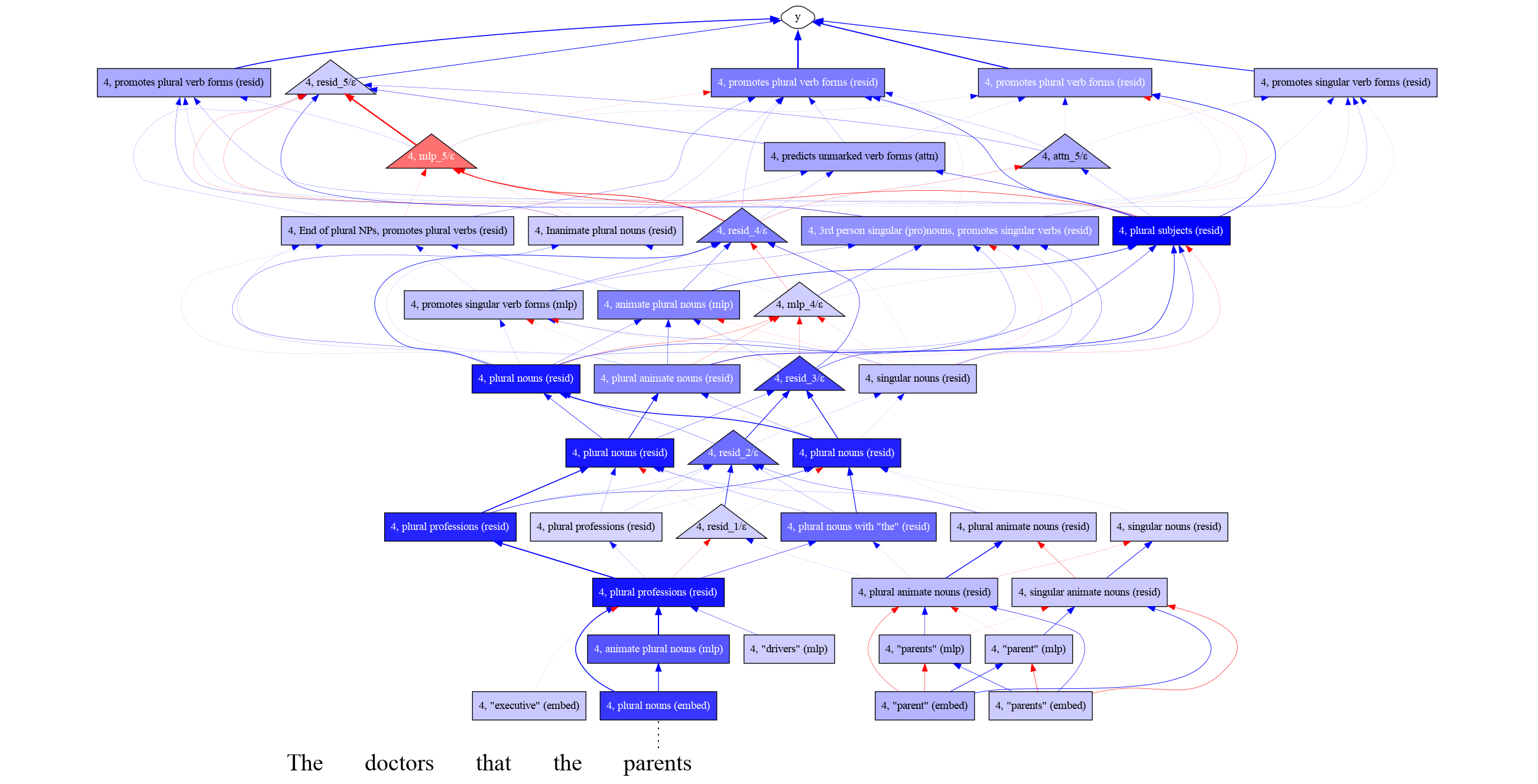
The diagram illustrates a hierarchical linguistic structure mapping grammatical relationships between noun and verb forms. It uses color-coded nodes (blue, red, gray) and directional arrows to represent dependencies, promotions, and transformations between linguistic categories. The central node "y" acts as the root, with cascading grammatical relationships branching downward.
### Components/Axes
- **Nodes**: Labeled with grammatical categories (e.g., "4, plural nouns (resid)", "4, promotes singular verb forms (resid)") and embedded phrases (e.g., "4, 'parent' (embed)").
- **Arrows**:
- **Blue**: Solid arrows indicate core grammatical dependencies (e.g., "promotes", "animate").
- **Red**: Dashed arrows represent alternative or secondary relationships (e.g., "predicts", "animate plurals").
- **Gray**: Dotted arrows denote embedded or contextualized phrases.
- **Colors**:
- Blue nodes: Core grammatical categories.
- Red nodes: Transformational or alternative forms.
- Gray nodes: Embedded or contextualized phrases.
### Detailed Analysis
1. **Top Layer (Root "y")**:
- Connects to four primary nodes:
- "4, promotes plural verb forms (resid)" (blue)
- "4, predicts unmarked verb forms (attn)" (red)
- "4, 3rd person singular (pro)nouns promotes singular verbs (resid)" (blue)
- "4, plural subjects (resid)" (blue)
2. **Second Layer**:
- **Left Branch**:
- "4, plural nouns (resid)" (blue) → "4, plural animate nouns (resid)" (blue) → "4, plural professions (resid)" (blue).
- **Center**:
- "4, singular nouns (resid)" (blue) → "4, singular animate nouns (resid)" (blue).
- **Right Branch**:
- "4, plural animate nouns (resid)" (blue) → "4, singular animate nouns (resid)" (blue).
3. **Embedded Phrases**:
- "4, 'parent' (embed)" and "4, 'parents' (embed)" (gray) connect to "4, plural animate nouns (resid)" (blue), suggesting contextualized usage.
4. **Transformational Relationships**:
- Red dashed arrows link "4, plural nouns (resid)" to "4, plural animate nouns (resid)" and "4, plural professions (resid)", indicating alternative grammatical interpretations.
### Key Observations
- **Hierarchical Dependency**: Grammatical categories (e.g., plural nouns) propagate dependencies downward (e.g., to animate nouns, professions).
- **Color-Coded Relationships**: Blue arrows dominate core dependencies, while red arrows highlight alternative transformations.
- **Embedded Context**: Gray nodes ("parent", "parents") integrate contextualized phrases into the structure.
- **Ambiguity in Red Nodes**: "4, predicts unmarked verb forms (attn)" and "4, mpl_5/6" (red) suggest unresolved or variant grammatical interpretations.
### Interpretation
The diagram models a **phrase structure grammar** where:
1. **Core Grammar** (blue nodes) establishes foundational relationships (e.g., plural nouns → animate nouns).
2. **Transformational Rules** (red arrows) allow deviations (e.g., plural nouns → professions).
3. **Contextual Embedding** (gray nodes) integrates lexical items ("parent", "parents") into grammatical frameworks.
**Notable Patterns**:
- **Redundancy**: Multiple pathways (e.g., "plural nouns" → "animate nouns" via blue and red arrows) suggest competing grammatical interpretations.
- **Ambiguity in "attn" Nodes**: "4, predicts unmarked verb forms (attn)" lacks clear connections, indicating unresolved dependencies.
- **Embedded Phrases**: "4, 'parent' (embed)" and "4, 'parents' (embed)" anchor abstract concepts to concrete grammatical categories.
**Underlying Implications**:
- The diagram reflects **linguistic ambiguity** in phrase structure, where a single grammatical category (e.g., "plural nouns") can trigger multiple downstream relationships.
- The central node "y" may represent a **universal syntactic principle** governing these transformations.
- Red nodes ("attn", "mpl_5/6") highlight **exceptional cases** or unresolved grammatical debates.