## Character and Equation Samples: DBA vs. RBA
### Overview
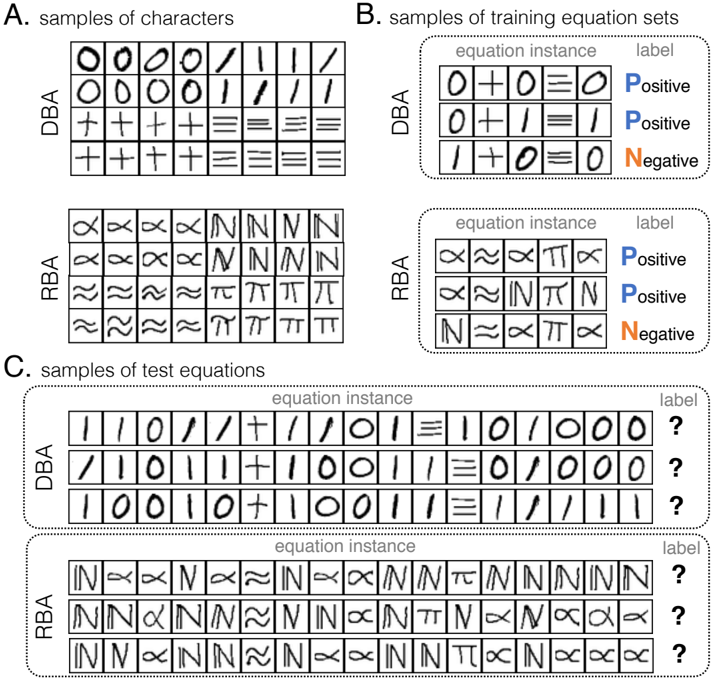
The image presents samples of characters and equations processed using two different methods, DBA and RBA. It's divided into three sections: A) samples of characters, B) samples of training equation sets, and C) samples of test equations. Each section compares the output of DBA and RBA.
### Components/Axes
* **Section A Title:** samples of characters
* **Y-Axis Labels:** DBA, RBA
* **Characters:** The characters displayed are numerical digits (0, 1), mathematical symbols (+, =), and Greek letters (α, ≈, π, N).
* **Section B Title:** samples of training equation sets
* **Column Labels:** equation instance, label
* **Y-Axis Labels:** DBA, RBA
* **Labels:** Positive (Blue), Negative (Orange)
* **Section C Title:** samples of test equations
* **Column Labels:** equation instance, label
* **Y-Axis Labels:** DBA, RBA
* **Labels:** ?
### Detailed Analysis
**Section A: samples of characters**
* **DBA:**
* The DBA method displays the characters 0, 1, +, and =.
* The characters are arranged in a grid format.
* The characters are relatively clear and distinct.
* **RBA:**
* The RBA method displays the characters α, ≈, π, and N.
* The characters are arranged in a grid format.
* The characters are relatively clear and distinct.
**Section B: samples of training equation sets**
* **DBA:**
* Equation instances: 0+0=0 (Positive), 0+1=1 (Positive), 1+0=0 (Negative)
* The equations use numerical digits and basic mathematical operators.
* The labels indicate whether the equation is mathematically correct (Positive) or incorrect (Negative).
* **RBA:**
* Equation instances: α≈απ α (Positive), α≈Nπ N (Positive), N≈απ α (Negative)
* The equations use Greek letters and the approximation symbol.
* The labels indicate whether the equation is consistent with a defined rule set (Positive) or inconsistent (Negative).
**Section C: samples of test equations**
* **DBA:**
* Equation instances: Three rows of equations using 1, 0, +, =, and /.
* The labels are all marked with a question mark (?).
* **RBA:**
* Equation instances: Three rows of equations using N, α, ≈, π.
* The labels are all marked with a question mark (?).
### Key Observations
* The image compares the performance of DBA and RBA in processing characters and equations.
* Section A shows the basic character recognition capabilities of each method.
* Section B demonstrates the ability of each method to classify equations as positive or negative based on training data.
* Section C presents test equations for which the correct classification is unknown, indicated by the question mark labels.
### Interpretation
The image likely illustrates a comparison of two different algorithms (DBA and RBA) for optical character recognition (OCR) and equation solving. DBA seems to focus on numerical and basic mathematical symbols, while RBA focuses on Greek letters and approximation-based equations. The training sets in Section B are used to teach the algorithms to recognize patterns and classify equations. The test sets in Section C are used to evaluate the performance of the trained algorithms on unseen data. The question marks indicate that the expected outputs for these test equations are not provided in the image, implying that the algorithms are being tested for their ability to generalize and predict the correct answers.