\n
## Diagram: PiT-PO System Architecture
### Overview
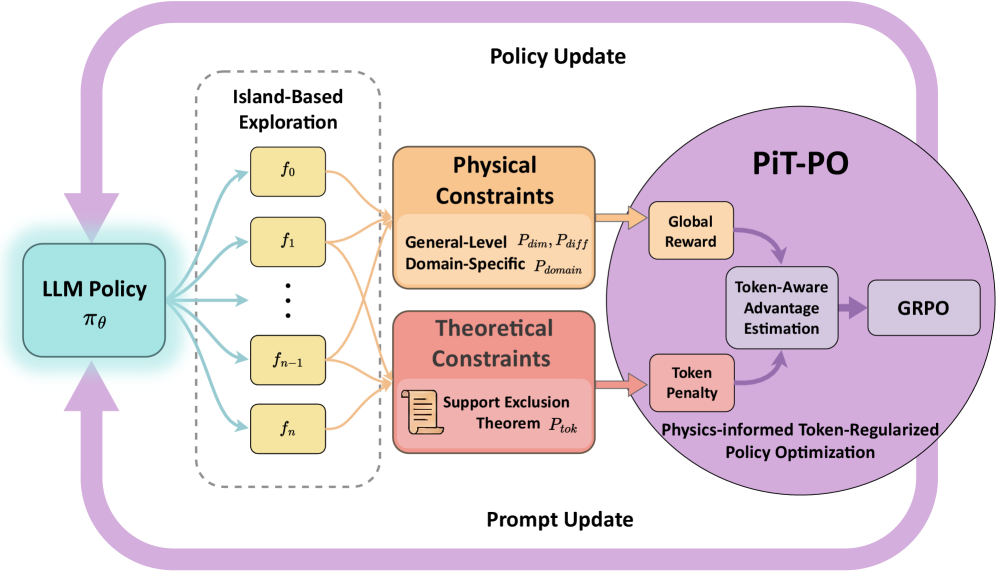
The image depicts a diagram illustrating the architecture of a "PiT-PO" (Physics-informed Token-Regularized Policy Optimization) system. It shows a cyclical process involving an LLM Policy, Island-Based Exploration, Physical and Theoretical Constraints, and a Policy Update mechanism. The diagram emphasizes the flow of information and the interplay between different components.
### Components/Axes
The diagram consists of the following key components:
* **LLM Policy (πθ):** A light blue, rounded rectangle positioned on the left side of the diagram.
* **Island-Based Exploration:** A rectangular box containing a series of labeled functions (f₀, f₁, ..., fₙ) connected by grey arrows.
* **Physical Constraints:** An orange rectangular box labeled with "General-Level pdims, pdiff" and "Domain-Specific pdomain".
* **Theoretical Constraints:** A red rectangular box labeled with "Support Exclusion Theorem ptok".
* **PiT-PO:** A purple circular shape representing the core optimization process.
* **GRPO:** A dark purple rectangular box within PiT-PO.
* **Policy Update:** A curved arrow at the top of the diagram indicating the direction of policy improvement.
* **Prompt Update:** A curved arrow at the bottom of the diagram indicating the direction of prompt refinement.
* **Global Reward:** A connection from Physical Constraints to PiT-PO.
* **Token-Aware Advantage Estimation:** A connection from Physical Constraints to PiT-PO.
* **Token Penalty:** A connection from Theoretical Constraints to PiT-PO.
* **Physics-informed Token-Regularized Policy Optimization:** Text labeling the process within PiT-PO.
### Detailed Analysis or Content Details
The diagram illustrates a feedback loop. The LLM Policy (πθ) generates outputs that are then used for Island-Based Exploration. This exploration generates a set of functions (f₀ to fₙ). These functions are then fed into both Physical Constraints and Theoretical Constraints. The Physical Constraints are defined by "General-Level pdims, pdiff" and "Domain-Specific pdomain". The Theoretical Constraints are defined by the "Support Exclusion Theorem ptok".
The outputs of both Physical and Theoretical Constraints are then fed into the PiT-PO module. PiT-PO contains GRPO and utilizes "Global Reward", "Token-Aware Advantage Estimation", and "Token Penalty" to perform "Physics-informed Token-Regularized Policy Optimization".
Finally, PiT-PO updates both the Policy (via "Policy Update") and the Prompt (via "Prompt Update"), completing the cycle.
The functions f₀ through fₙ are connected to both the Physical and Theoretical Constraints with grey arrows. The number of functions 'n' is not explicitly defined, but is represented by the ellipsis (...).
### Key Observations
The diagram highlights the integration of physical and theoretical constraints into the policy optimization process. The cyclical nature of the diagram suggests an iterative refinement process. The use of "Token-Aware" and "Token Penalty" indicates a focus on token-level regularization, likely within the context of a large language model. The diagram is highly conceptual and does not contain numerical data.
### Interpretation
The diagram represents a novel approach to policy optimization that leverages the strengths of LLMs while incorporating physical and theoretical constraints to improve performance and robustness. The "Island-Based Exploration" suggests a method for generating diverse candidate policies. The constraints act as a filter, ensuring that the policies are physically plausible and theoretically sound. The PiT-PO module then refines these policies using token-level regularization, potentially addressing issues such as hallucination or instability. The feedback loop ensures that the policy and prompt are continuously improved based on the constraints and optimization process. The diagram suggests a system designed to create more reliable and physically grounded LLM-based policies. The use of the term "theorem" suggests a mathematically rigorous foundation for the theoretical constraints. The diagram is a high-level architectural overview and does not provide details on the specific algorithms or implementation techniques used.