\n
## Diagram: Fact-Check Result for Population Claim
### Overview
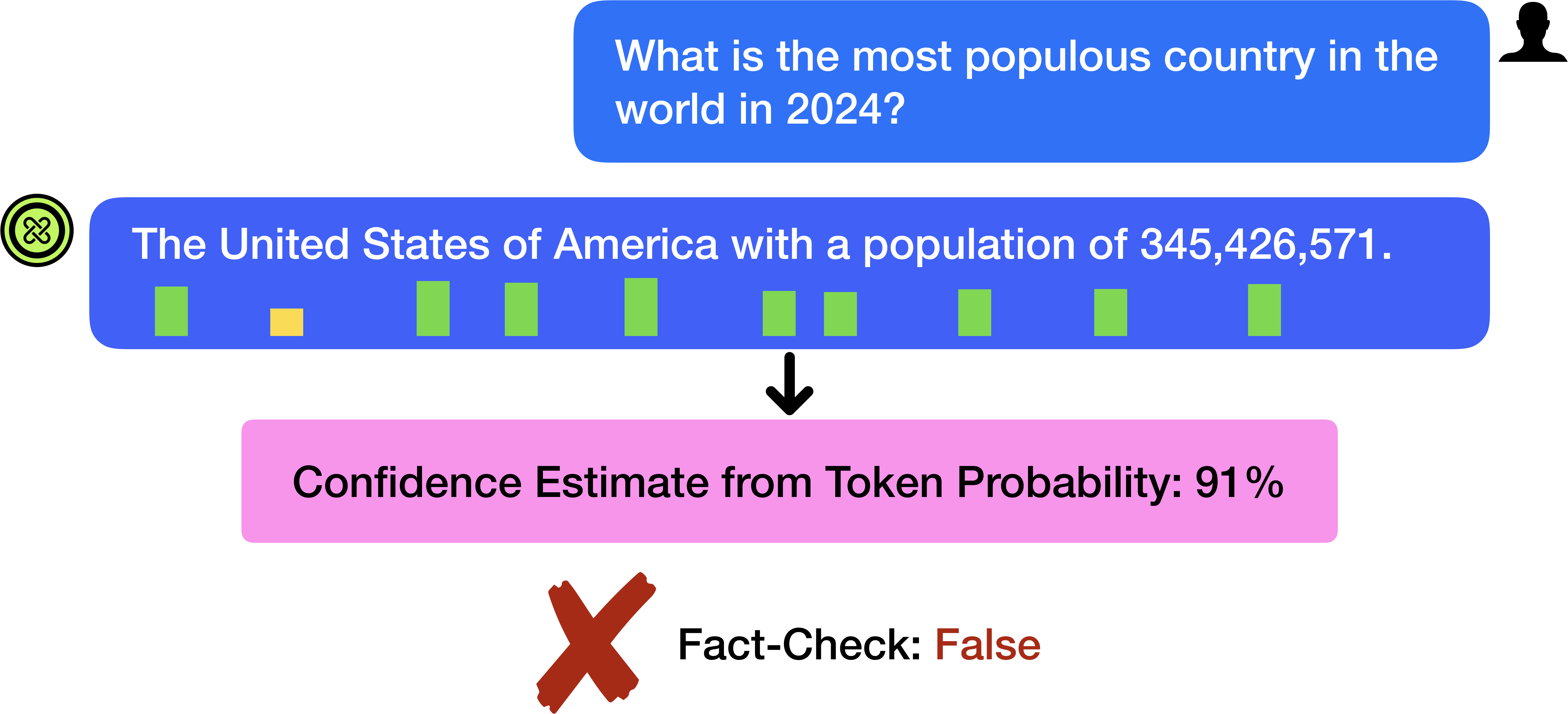
This diagram presents a fact-check result for the claim regarding the most populous country in the world in 2024. It shows a question, a proposed answer with a population figure, a confidence estimate, and a final fact-check verdict.
### Components/Axes
The diagram consists of four main blocks arranged vertically:
1. **Question Block (Top):** A light blue rectangle containing the question: "What is the most populous country in the world in 2024?"
2. **Answer Block (Middle-Top):** A light purple rectangle stating: "The United States of America with a population of 345,426,571." This block also contains a series of small square icons, alternating between green and yellow.
3. **Confidence Block (Middle-Bottom):** A magenta rectangle displaying: "Confidence Estimate from Token Probability: 91%"
4. **Fact-Check Block (Bottom):** A red "X" symbol with the text: "Fact-Check: False"
### Detailed Analysis or Content Details
* **Question:** "What is the most populous country in the world in 2024?"
* **Proposed Answer:** The United States of America with a population of 345,426,571.
* **Icon Sequence:** The answer block contains 10 small square icons. The sequence is: Green, Yellow, Green, Green, Yellow, Green, Yellow, Green, Green, Yellow.
* **Confidence Estimate:** 91%
* **Fact-Check Result:** False.
### Key Observations
The diagram indicates a high confidence (91%) in the proposed answer, yet the fact-check result is "False". This suggests the model is confident in its response, but the response is inaccurate. The alternating green and yellow icons in the answer block are not explained and their purpose is unclear.
### Interpretation
The diagram demonstrates a scenario where a language model or AI system confidently provides an incorrect answer to a factual question. The high confidence estimate highlights a potential issue with the model's knowledge base or reasoning capabilities. The fact that the model confidently states the United States is the most populous country in 2024 is demonstrably false, as China and India both have significantly larger populations. The icons may represent some internal confidence scoring or token probabilities, but their meaning is not explicitly stated. This example underscores the importance of fact-checking AI-generated content, even when presented with high confidence. The diagram serves as a cautionary example of the limitations of AI and the need for critical evaluation of its outputs.