## Diagram: Multi-scale Vector Quantization Process
### Overview
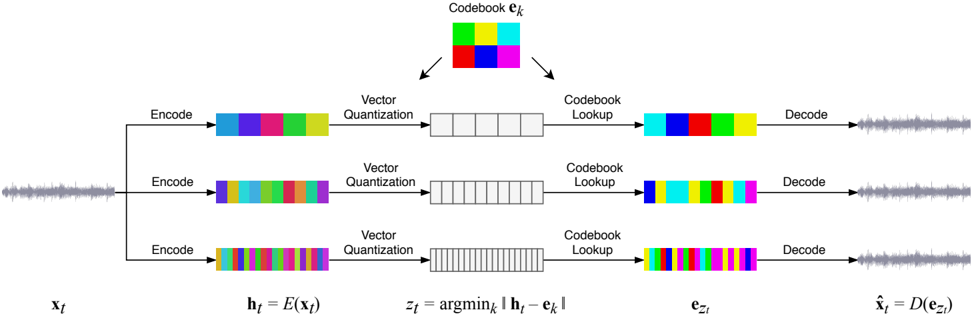
This diagram illustrates a multi-scale vector quantization (VQ) architecture, commonly used in signal processing (such as audio or image compression). The process takes an input signal ($x_t$) and processes it through three parallel branches of increasing resolution (coarse to fine). Each branch encodes the signal, quantizes it using a shared codebook ($e_k$), and subsequently decodes it to reconstruct the signal ($\hat{x}_t$).
### Components/Axes
The diagram is organized into three horizontal processing branches, with a shared codebook component at the top center.
* **Input/Output:**
* **Left:** $x_t$ (Input signal waveform).
* **Right:** $\hat{x}_t = D(e_{z_t})$ (Reconstructed output signal waveform).
* **Mathematical Notations (Bottom Row):**
* $h_t = E(x_t)$: The encoded representation of the input.
* $z_t = \text{argmin}_k || h_t - e_k ||$: The quantization step, selecting the nearest codebook vector.
* $e_{z_t}$: The quantized representation (the codebook vectors selected).
* **Central Component:**
* **Codebook $e_k$:** Located at the top-center, represented as a 2x3 grid of colored blocks (Yellow, Cyan, Red, Blue, Green, Magenta).
* **Processing Steps (Left to Right):**
* **Encode:** Transforms input into a latent representation.
* **Vector Quantization:** A white box with vertical dividers representing the selection process.
* **Codebook Lookup:** Maps the quantized index to the actual codebook vector.
* **Decode:** Reconstructs the signal from the quantized vectors.
### Detailed Analysis
The diagram is segmented into three parallel horizontal branches, representing different scales of quantization:
1. **Top Branch (Coarse Scale):**
* **Encoded Representation ($h_t$):** Contains 5 distinct colored segments.
* **Vector Quantization:** The white box contains 4 vertical dividers (creating 5 slots).
* **Codebook Lookup ($e_{z_t}$):** Produces 5 colored segments, matching the input $h_t$ pattern.
2. **Middle Branch (Medium Scale):**
* **Encoded Representation ($h_t$):** Contains 10 distinct colored segments.
* **Vector Quantization:** The white box contains 9 vertical dividers (creating 10 slots).
* **Codebook Lookup ($e_{z_t}$):** Produces 10 colored segments, matching the input $h_t$ pattern.
3. **Bottom Branch (Fine Scale):**
* **Encoded Representation ($h_t$):** Contains 20 distinct colored segments.
* **Vector Quantization:** The white box contains 19 vertical dividers (creating 20 slots).
* **Codebook Lookup ($e_{z_t}$):** Produces 20 colored segments, matching the input $h_t$ pattern.
### Key Observations
* **Resolution Scaling:** There is a clear progression in resolution. The top branch is the "coarsest" (lowest number of segments), while the bottom branch is the "finest" (highest number of segments).
* **Shared Codebook:** The arrows originating from the "Codebook $e_k$" block point to all three "Vector Quantization" stages, indicating that the same codebook is utilized across all scales.
* **Reconstruction Fidelity:** The output $\hat{x}_t$ on the right shows a waveform that visually resembles the input $x_t$ on the left, demonstrating the reconstruction capability of the system.
* **Mathematical Logic:** The formula $z_t = \text{argmin}_k || h_t - e_k ||$ explicitly defines the quantization process as finding the codebook vector ($e_k$) that minimizes the Euclidean distance to the encoded input ($h_t$).
### Interpretation
This diagram represents a **Residual Vector Quantization (RVQ)** or a **Multi-scale VQ** system.
* **Functionality:** The system decomposes the input signal into hierarchical layers. The top layer captures the most significant, low-frequency, or "coarse" information, while the lower layers capture increasingly granular, high-frequency, or "fine" details.
* **Efficiency:** By using a shared codebook ($e_k$) across different scales, the model can efficiently represent complex signals using a limited set of learned patterns.
* **Process Flow:** The "Vector Quantization" block acts as a bottleneck or a decision point. It forces the continuous encoded signal ($h_t$) to be mapped to discrete values from the codebook. The "Codebook Lookup" then retrieves these discrete values ($e_{z_t}$), which are then passed to the decoder to reconstruct the signal.
* **Significance:** This architecture is fundamental in modern neural audio codecs (like EnCodec or SoundStream), where high-fidelity audio must be compressed into a low-bitrate discrete representation and then reconstructed with minimal perceptual loss.