## Diagram: AI for Mathematics
### Overview
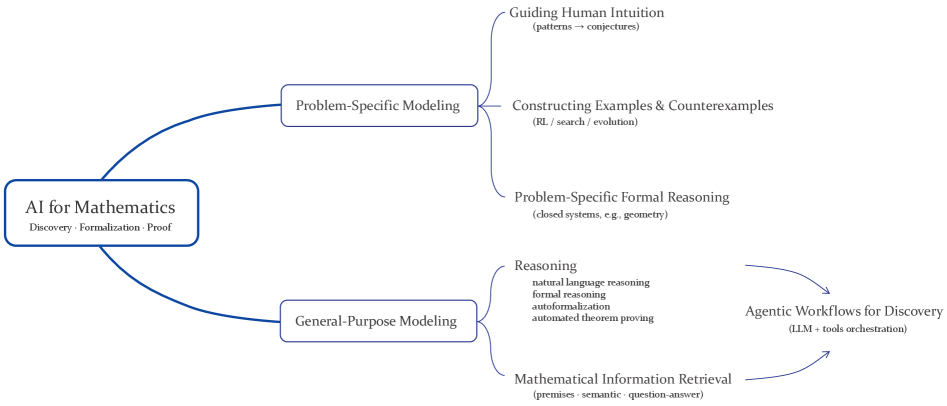
The image is a concept diagram illustrating the application of Artificial Intelligence (AI) in the field of Mathematics. It outlines two primary approaches: Problem-Specific Modeling and General-Purpose Modeling, and their respective sub-categories and applications. The diagram uses a mind-map style layout with connecting lines to show relationships between concepts.
### Components/Axes
* **Central Node:** "AI for Mathematics" with sub-categories "Discovery", "Formalization", and "Proof".
* **Main Branches:**
* "Problem-Specific Modeling"
* "General-Purpose Modeling"
* **Sub-Branches of "Problem-Specific Modeling":**
* "Guiding Human Intuition" (patterns -> conjectures)
* "Constructing Examples & Counterexamples" (RL / search / evolution)
* "Problem-Specific Formal Reasoning" (closed systems, e.g., geometry)
* **Sub-Branches of "General-Purpose Modeling":**
* "Reasoning" (natural language reasoning, formal reasoning, autoformalization, automated theorem proving)
* "Mathematical Information Retrieval" (premises, semantic, question-answer)
* "Agentic Workflows for Discovery" (LLM + tools orchestration)
### Detailed Analysis or ### Content Details
The diagram starts with the central concept of "AI for Mathematics," which is further divided into three aspects: Discovery, Formalization, and Proof. From this central node, two main branches emerge: Problem-Specific Modeling and General-Purpose Modeling.
* **Problem-Specific Modeling:** This branch focuses on AI techniques tailored to specific mathematical problems. It includes:
* **Guiding Human Intuition:** Using AI to identify patterns and form conjectures.
* **Constructing Examples & Counterexamples:** Employing AI techniques like Reinforcement Learning (RL), search algorithms, or evolutionary algorithms to generate examples and counterexamples.
* **Problem-Specific Formal Reasoning:** Applying AI to formal reasoning within closed systems, such as geometry.
* **General-Purpose Modeling:** This branch focuses on AI techniques that can be applied to a broader range of mathematical problems. It includes:
* **Reasoning:** Utilizing AI for natural language reasoning, formal reasoning, autoformalization, and automated theorem proving.
* **Mathematical Information Retrieval:** Using AI to retrieve relevant mathematical information based on premises, semantics, and question-answering.
* **Agentic Workflows for Discovery:** Orchestrating Large Language Models (LLMs) and other tools to create workflows for mathematical discovery.
### Key Observations
* The diagram highlights the dual approach of using AI in mathematics: one focused on specific problems and the other on general-purpose techniques.
* The sub-branches provide concrete examples of how AI can be applied in each approach.
* The diagram emphasizes the role of AI in both assisting human mathematicians (e.g., guiding intuition) and automating mathematical tasks (e.g., automated theorem proving).
### Interpretation
The diagram illustrates the multifaceted role of AI in mathematics, spanning from assisting human intuition to automating complex reasoning processes. The distinction between problem-specific and general-purpose modeling suggests a strategic approach to AI implementation, where tailored solutions are used for specific challenges, while broader techniques are applied to more general mathematical tasks. The inclusion of "Agentic Workflows for Discovery" indicates a forward-looking perspective on AI's potential to drive new mathematical discoveries through automated exploration and reasoning. The diagram suggests that AI is not just a tool for solving existing problems but also a catalyst for generating new mathematical knowledge.