## Diagram: Causal Relationship Between Neighbour, Attacks, and Child
### Overview
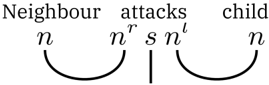
The diagram illustrates a directional relationship between three entities: "Neighbour," "attacks," and "child." Arrows indicate the flow of interaction, with labels specifying the nature of the relationships. Mathematical notation is embedded in the labels to denote variables and operations.
### Components/Axes
- **Nodes**:
- **Neighbour**: Labeled `n` (lowercase italic `n`).
- **Attacks**: Labeled `n^r s n^t` (superscript `r` on `n`, followed by `s`, then superscript `t` on `n`).
- **Child**: Labeled `n` (same as Neighbour).
- **Arrows**:
- **Neighbour → Attacks**: Labeled "attacks."
- **Attacks → Child**: Labeled "child."
### Detailed Analysis
- **Node Labels**:
- The "Neighbour" and "Child" nodes share the same variable `n`, suggesting they may represent the same entity in different contexts or roles.
- The "Attacks" node uses a compound formula `n^r s n^t`, which could imply an operation (e.g., multiplication, concatenation) between modified instances of `n` (e.g., `n^r` and `n^t`).
- **Arrow Labels**:
- The arrow from "Neighbour" to "Attacks" is explicitly labeled "attacks," indicating the action or event.
- The arrow from "Attacks" to "Child" is labeled "child," suggesting the target or outcome of the attack.
### Key Observations
- The diagram implies a causal chain: the Neighbour (`n`) initiates an "attacks" action, which is mathematically represented as `n^r s n^t`, and this action directly affects the Child (`n`).
- The reuse of `n` for both Neighbour and Child may indicate a shared variable or a recursive relationship (e.g., the Child is a subordinate or dependent of the Neighbour).
### Interpretation
This diagram likely models a system where an entity (Neighbour) exerts influence or harm (attacks) on another entity (Child), with the "attacks" node acting as an intermediary. The formula `n^r s n^t` could represent a transformation or interaction between the Neighbour and Child, such as:
- **Mathematical**: A function where `n^r` and `n^t` are variables modified by exponents `r` and `t`, combined via an operation `s`.
- **Logical**: A rule where the Neighbour's action (`n^r`) combined with a secondary factor (`n^t`) results in an attack on the Child.
The bidirectional use of `n` for Neighbour and Child might suggest symmetry or reciprocity in the relationship, though the directional arrows clarify the primary flow from Neighbour to Child via the "attacks" node. This structure could apply to fields like game theory, social dynamics, or algorithmic modeling, where entities interact through defined operations.