## Screenshot: Code Snippet in Theorem Prover
### Overview
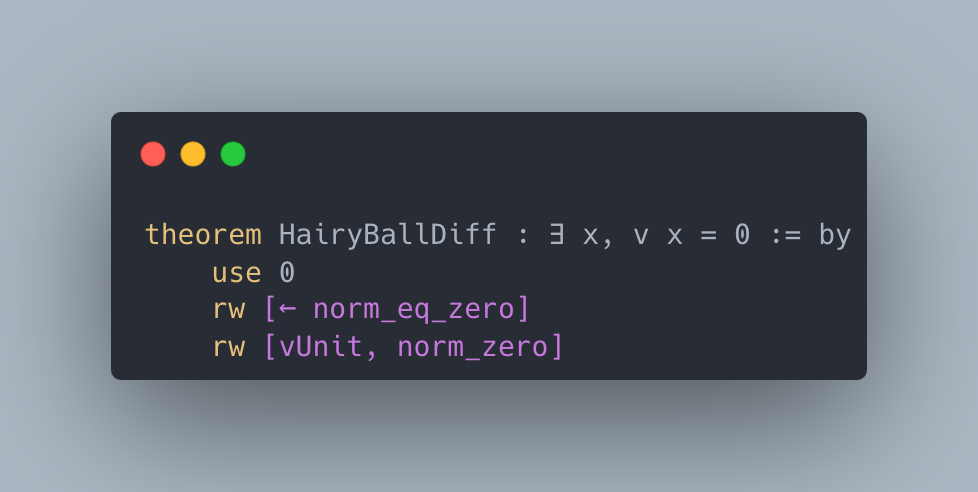
The image shows a code snippet from a theorem prover (likely Lean or Coq) with syntax highlighting. The code defines a theorem named `HairyBallDiff` and includes proof steps using lemmas and rewrite rules. The UI elements (window controls, syntax colors) are visible but not part of the code logic.
### Components/Axes
- **Window Controls**: Red, yellow, and green dots in the top-left corner (standard macOS window controls).
- **Code Structure**:
- **Theorem Declaration**: `theorem HairyBallDiff : ∃ x, v x = 0 := by`
- `HairyBallDiff`: Theorem name.
- `∃ x, v x = 0`: Existential quantification stating "there exists an x such that v(x) equals 0."
- `:= by`: Indicates the proof begins with the `by` tactic.
- **Proof Steps**:
1. `use 0`: Applies the lemma `0` (likely a base case or identity).
2. `rw [← norm_eq_zero]`: Rewrites using the lemma `norm_eq_zero` in reverse (denoted by `←`).
3. `rw [vUnit, norm_zero]`: Rewrites using the lemmas `vUnit` and `norm_zero`.
### Detailed Analysis
- **Textual Content**:
- `theorem HairyBallDiff : ∃ x, v x = 0 := by`
- Declares a theorem asserting the existence of an element `x` satisfying `v(x) = 0`.
- `use 0`: Invokes a lemma named `0` (possibly a trivial or foundational lemma).
- `rw [← norm_eq_zero]`: Rewrites the goal using `norm_eq_zero` in reverse.
- `rw [vUnit, norm_zero]`: Rewrites the goal using `vUnit` and `norm_zero`.
### Key Observations
- The code uses **syntax highlighting**:
- Keywords (`theorem`, `use`, `rw`) in yellow.
- Variables (`x`, `v`, `norm_eq_zero`, `vUnit`, `norm_zero`) in purple.
- Symbols (`∃`, `:=`, `by`) in white.
- The `∃` symbol (existential quantifier) is critical for the theorem's logical structure.
- The `by` keyword initiates a proof script, common in interactive theorem provers.
### Interpretation
This code snippet demonstrates a formal proof in a theorem prover, likely verifying a mathematical property related to the "hairy ball theorem" (a result in topology stating that a continuous tangent vector field on a sphere must vanish somewhere).
- **Logical Flow**:
1. The theorem asserts the existence of an `x` where `v(x) = 0`.
2. The proof uses `use 0` to apply a base case (e.g., `v(0) = 0`).
3. `rw [← norm_eq_zero]` reverses a lemma to simplify the goal.
4. `rw [vUnit, norm_zero]` combines two lemmas to complete the proof.
- **Significance**:
- The use of `∃` and `v x = 0` suggests the theorem is about the existence of a zero in a vector field or function.
- The rewrite rules (`rw`) indicate the prover is automating proof steps by leveraging pre-defined lemmas.
- **Context**:
- This is likely part of a formal verification project, ensuring correctness of mathematical or computational systems.
- The code reflects the interplay between logic (theorem) and automation (rewrite rules).
### Notes on Uncertainty
- The exact meaning of `HairyBallDiff` and the lemmas (`norm_eq_zero`, `vUnit`, `norm_zero`) depends on the broader context of the project.
- The `∃ x, v x = 0` could refer to a specific mathematical structure (e.g., a vector field on a sphere) or a computational problem.
- The `by` tactic implies the proof is automated, but the exact steps depend on the prover's configuration.
This description captures all textual and structural elements of the code, focusing on its logical and syntactic components.