\n
## Diagram: Agent Architecture for Question Answering
### Overview
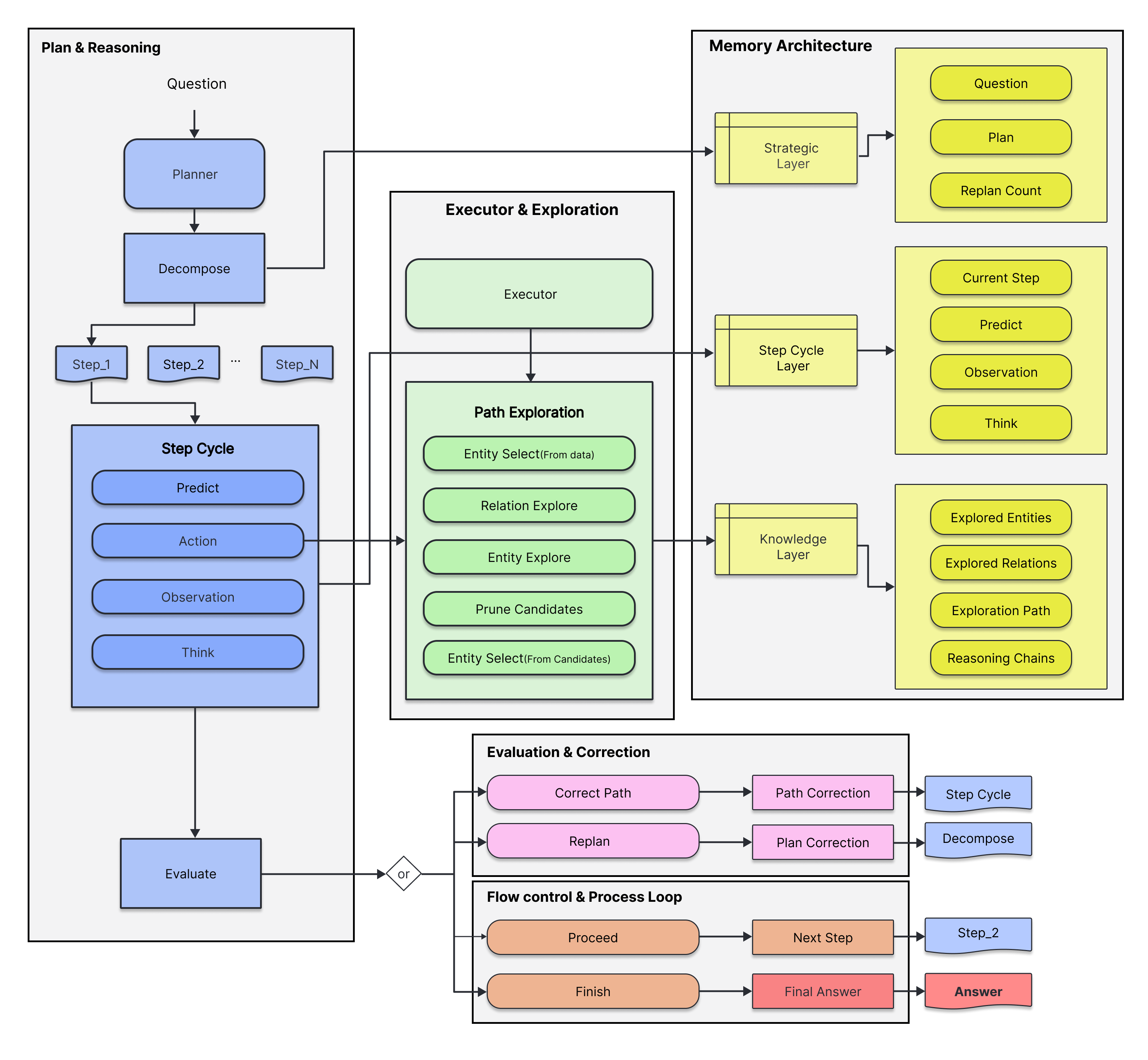
This diagram illustrates the architecture of an agent designed for question answering. It depicts a cyclical process involving planning, execution, exploration, evaluation, and correction, coupled with a memory architecture that stores and retrieves relevant information. The diagram is segmented into four main sections: "Plan & Reasoning", "Memory Architecture", "Executor & Exploration", and "Evaluation & Correction", with a "Flow control & Process Loop" section at the bottom. Arrows indicate the flow of information between these components.
### Components/Axes
The diagram consists of several rectangular blocks representing different components. These blocks are interconnected by arrows indicating the flow of information. The blocks are color-coded to distinguish different types of processes or data. Key components include:
* **Plan & Reasoning:** Question, Planner, Decompose, Step_1, Step_2, Step_N, Step Cycle (Predict, Action, Observation, Think)
* **Memory Architecture:** Strategic Layer (Question, Plan, Replan Count), Step Cycle Layer (Current Step, Predict, Observation, Think), Knowledge Layer (Explored Entities, Explored Relations, Exploration Path, Reasoning Chains)
* **Executor & Exploration:** Executor, Path Exploration (Entity Select(From data), Relation Explore, Entity Explore, Prune Candidates, Entity Select(From Candidates))
* **Evaluation & Correction:** Evaluate, Correct Path, Replan, Path Correction, Plan Correction, Flow control & Process Loop (Proceed, Finish, Next Step, Final Answer)
* **Flow control & Process Loop:** Proceed, Finish, Next Step, Final Answer, Answer
### Detailed Analysis or Content Details
The diagram shows a cyclical flow of information.
1. **Plan & Reasoning:** A "Question" is input to a "Planner" which "Decomposes" it into multiple "Steps" (Step_1, Step_2, ... Step_N). A "Step Cycle" consisting of "Predict", "Action", "Observation", and "Think" is repeated for each step.
2. **Executor & Exploration:** The "Executor" utilizes "Path Exploration" which involves selecting entities from data, exploring relations, exploring entities, pruning candidates, and selecting entities from candidates.
3. **Memory Architecture:** The "Memory Architecture" is layered. The "Strategic Layer" stores the "Question", "Plan", and "Replan Count". The "Step Cycle Layer" stores the "Current Step", "Predict", "Observation", and "Think". The "Knowledge Layer" stores "Explored Entities", "Explored Relations", "Exploration Path", and "Reasoning Chains".
4. **Evaluation & Correction:** The "Evaluate" component determines whether the "Correct Path" is followed or if a "Replan" is necessary. This leads to "Path Correction" and "Plan Correction".
5. **Flow control & Process Loop:** The "Flow control & Process Loop" determines whether to "Proceed" or "Finish", leading to the "Next Step" and ultimately the "Final Answer". The "Answer" is the final output.
The diagram uses arrows to show the flow of information. For example:
* The "Question" flows from the top-left to the "Planner".
* The "Step Cycle" outputs flow to the "Executor".
* The "Executor" outputs flow to the "Memory Architecture".
* The "Evaluate" component receives input from the "Step Cycle" and the "Executor".
* The "Flow control & Process Loop" receives input from the "Evaluation & Correction" and outputs the "Answer".
The diagram uses color-coding:
* Light Green: Represents input/output or initial states (Question, Answer).
* Light Blue: Represents processes within the Step Cycle (Predict, Action, Observation, Think).
* Yellow: Represents components related to planning and decomposition (Planner, Decompose, Step_1, Step_2, Step_N).
* Light Orange: Represents evaluation and correction components (Evaluate, Correct Path, Replan).
* Light Purple: Represents path exploration components (Entity Select, Relation Explore, Entity Explore, Prune Candidates).
* Light Brown: Represents flow control components (Proceed, Finish, Next Step).
* Gray: Represents memory layers (Strategic Layer, Step Cycle Layer, Knowledge Layer).
### Key Observations
The diagram emphasizes a cyclical and iterative process. The agent continuously plans, executes, evaluates, and corrects its approach to answering a question. The memory architecture plays a crucial role in storing and retrieving information throughout this process. The "Replan" loop suggests the agent can adapt its strategy if the initial plan fails. The diagram is highly structured and visually represents a complex system in a clear and organized manner.
### Interpretation
This diagram represents a sophisticated agent architecture for question answering, likely inspired by cognitive architectures or reinforcement learning approaches. The separation of planning, execution, and evaluation allows for a modular and adaptable system. The memory architecture provides the agent with the ability to learn and retain information, improving its performance over time. The cyclical nature of the process suggests a continuous refinement of the agent's understanding and approach to the question. The inclusion of "Prune Candidates" indicates a mechanism for reducing computational complexity by focusing on the most promising paths. The diagram highlights the importance of both strategic planning and detailed exploration in achieving accurate and reliable answers. The architecture is designed to handle complex questions that require multiple steps and reasoning chains. The diagram doesn't provide specific data or numerical values, but rather a conceptual framework for building an intelligent agent. It's a high-level design document rather than a report of experimental results.