\n
## Diagram: AnalogNAS T500 and ResNet32 Architectures
### Overview
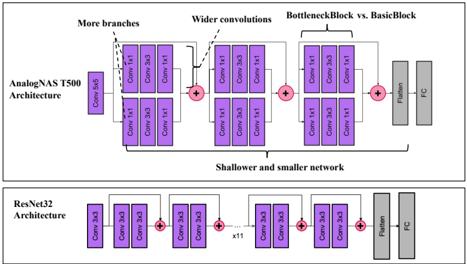
The image presents a comparative diagram illustrating the architectural differences between AnalogNAS T500 and ResNet32. It visually contrasts the building blocks (BottleneckBlock vs. BasicBlock) and overall network structure of the two architectures. The diagram focuses on the convolutional layers and their connections.
### Components/Axes
The diagram is divided into two horizontal sections, one for each architecture:
* **Top Section:** AnalogNAS T500 Architecture
* **Bottom Section:** ResNet32 Architecture
Each section depicts a series of interconnected blocks representing convolutional layers and other operations. Key labels include:
* "More branches" (pointing to the AnalogNAS T500 section)
* "Wider convolutions" (pointing to the AnalogNAS T500 section)
* "BottleneckBlock vs. BasicBlock" (spanning both sections)
* "Shallower and smaller network" (pointing to the ResNet32 section)
* "Conv 3x3" (labeling convolutional layers in ResNet32)
* "Conv 1x1" (labeling convolutional layers in AnalogNAS T500)
* "Flatten" (labeling the flattening layer in both architectures)
* "FC" (labeling the fully connected layer in both architectures)
* "x11" (indicating repetition of a block in ResNet32)
* "S×S" (indicating a square convolutional layer in AnalogNAS T500)
### Detailed Analysis or Content Details
**AnalogNAS T500 Architecture:**
The AnalogNAS T500 architecture begins with a "Conv S×S" layer. This is followed by a series of blocks. Each block consists of multiple "Conv 1x1" layers, with connections indicated by plus signs (+). The diagram shows a branching structure, with multiple paths diverging from the initial convolutional layer. The blocks are connected sequentially, leading to a "Flatten" layer and finally a "FC" (Fully Connected) layer. The diagram highlights "More branches" and "Wider convolutions" as key characteristics.
**ResNet32 Architecture:**
The ResNet32 architecture consists of a series of blocks, each containing multiple "Conv 3x3" layers connected with plus signs (+). The "x11" label indicates that a particular block is repeated 11 times. The blocks are connected sequentially, leading to a "Flatten" layer and a "FC" layer. The diagram emphasizes that ResNet32 is a "Shallower and smaller network".
The blocks in AnalogNAS T500 appear to have more layers within them than the blocks in ResNet32. The connections within the AnalogNAS blocks are more complex, with multiple branches.
### Key Observations
* AnalogNAS T500 utilizes "Conv 1x1" layers extensively, while ResNet32 uses "Conv 3x3" layers.
* AnalogNAS T500 has a more branched structure compared to the linear flow of ResNet32.
* ResNet32 is described as "Shallower and smaller", suggesting a lower number of layers and parameters.
* The diagram visually emphasizes the "BottleneckBlock" structure in AnalogNAS T500 and the "BasicBlock" structure in ResNet32.
### Interpretation
The diagram illustrates the fundamental architectural differences between AnalogNAS T500 and ResNet32. AnalogNAS T500 appears to be designed for greater representational capacity through wider convolutions and more branching, potentially at the cost of increased computational complexity. ResNet32, on the other hand, prioritizes simplicity and efficiency with a shallower and smaller network structure. The use of different convolutional kernel sizes (1x1 vs. 3x3) suggests different approaches to feature extraction and processing. The diagram suggests that AnalogNAS T500 aims to capture more complex features through its wider and branched architecture, while ResNet32 focuses on efficient feature learning with a simpler structure. The "BottleneckBlock" vs. "BasicBlock" distinction highlights the different building blocks used in each architecture, which likely influence their performance characteristics. The diagram does not provide quantitative data, but it offers a clear visual comparison of the architectural designs.