## Flowchart: Attention Mechanism with Quantization and Rotation
### Overview
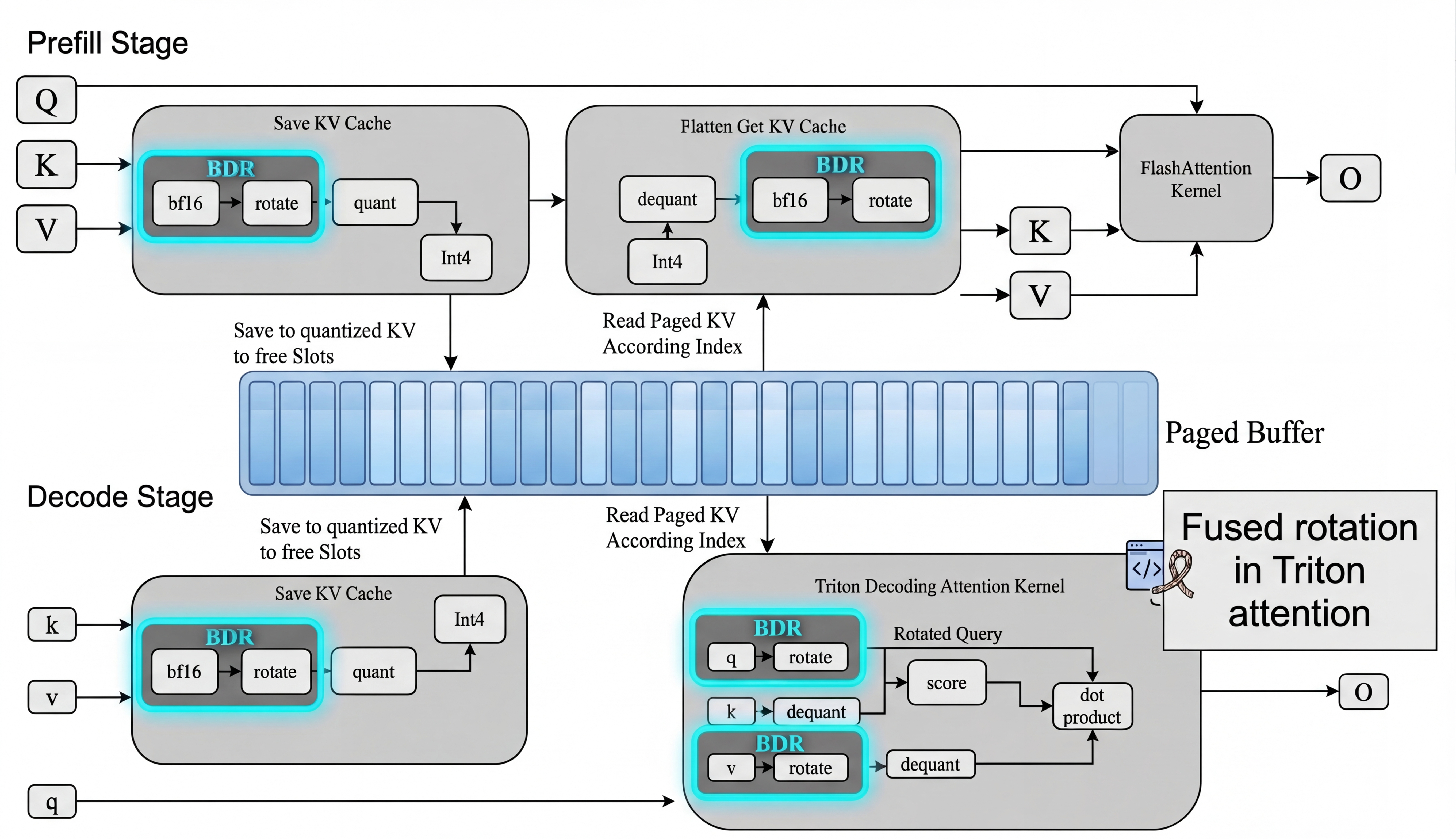
The diagram illustrates a two-stage attention mechanism optimized for memory efficiency, featuring quantization, rotation, and fused operations. It includes a Paged Buffer for intermediate storage and specialized kernels for attention computation.
### Components/Axes
**Key Components:**
1. **Prefill Stage**
- Inputs: Q (query), K (key), V (value)
- Blocks:
- Save KV Cache (bf16 → rotate → quant → Int4)
- Flatten Get KV Cache (dequant → bf16 → rotate → Int4)
- FlashAttention Kernel (outputs O)
- Output: Quantized KV saved to free slots
2. **Paged Buffer**
- Visualized as a horizontal bar with alternating light/dark blue slots
- Functions as intermediate storage for quantized KV pairs
3. **Decode Stage**
- Inputs: k (key), v (value), q (query)
- Blocks:
- Save KV Cache (bf16 → rotate → quant → Int4)
- Triton Decoding Attention Kernel
- Rotated Query (q → rotate)
- Scoring (k → dequant → dot product)
- Value Processing (v → rotate → dequant)
- Output: O (output)
**Special Features:**
- BDR (Block Data Rotation) module present in both stages
- Fused rotation operations in Triton attention
- Quantization (bf16 → Int4) and dequantization steps
- Index-based access to Paged Buffer
### Detailed Analysis
**Prefill Stage Flow:**
1. Q, K, V inputs enter BDR module
2. bf16 format conversion → rotation → quantization to Int4
3. Quantized KV stored in free slots of Paged Buffer
4. Flattened KV cache retrieved via index
5. FlashAttention Kernel computes output O
**Decode Stage Flow:**
1. k, v, q inputs enter BDR module
2. Quantized KV retrieved from Paged Buffer via index
3. Triton kernel performs:
- Query rotation
- Key dequantization
- Dot product scoring
- Value dequantization
4. Final output O generated
### Key Observations
1. **Memory Optimization**: Quantization (bf16 → Int4) reduces memory footprint
2. **Rotation Operations**: Applied to both queries and values for attention computation
3. **Indexed Access**: Paged Buffer uses positional indexing for KV retrieval
4. **Fused Operations**: Rotation integrated directly into Triton attention kernel
5. **Stage Separation**: Clear division between prefill (cache population) and decode (attention computation) phases
### Interpretation
This architecture demonstrates a memory-efficient attention implementation through:
- **Quantization**: Reduces memory usage by 4x (bf16 → Int4)
- **Rotation**: Enables efficient attention computation without full matrix operations
- **Paged Buffer**: Allows dynamic memory management during sequence processing
- **Fused Kernels**: Combines rotation and attention computation for performance gains
The design suggests optimization for long sequence processing where memory constraints are critical, with careful balancing between computation efficiency and memory usage. The BDR module appears central to both stages, indicating its importance in maintaining data consistency through format conversions and rotations.