## Pie Chart: Distribution of Categories
### Overview
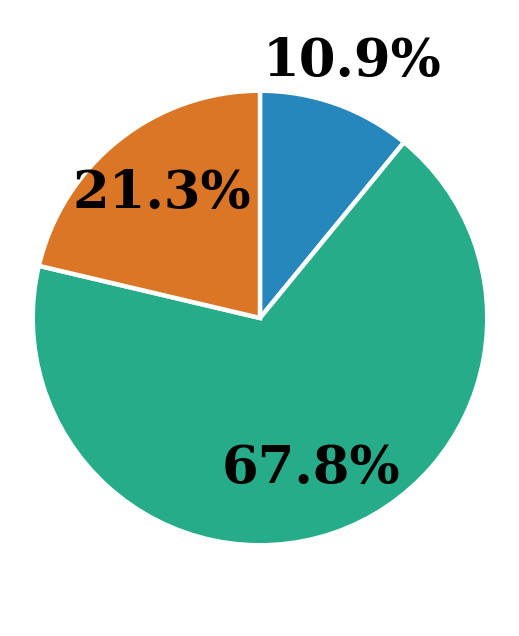
The image displays a pie chart divided into three distinct segments, each labeled with a percentage. The chart visually represents the proportional distribution of three categories, with the largest segment occupying the majority of the circle.
### Components/Axes
- **Segments**: Three colored sections (teal, orange, blue) representing different categories.
- **Percentages**: Labeled directly on each segment in black text.
- **Colors**:
- Teal (#008080) for the largest segment.
- Orange (#FFA500) for the second segment.
- Blue (#0000FF) for the smallest segment.
- **No explicit legend** is present, but colors are directly associated with their respective percentages.
### Detailed Analysis
1. **Teal Segment (67.8%)**:
- Occupies the largest portion of the pie chart, positioned at the bottom-right quadrant.
- Labeled with "67.8%" in black text.
2. **Orange Segment (21.3%)**:
- Located in the top-left quadrant, adjacent to the teal segment.
- Labeled with "21.3%" in black text.
3. **Blue Segment (10.9%)**:
- Smallest segment, positioned in the top-right quadrant.
- Labeled with "10.9%" in black text.
### Key Observations
- The teal segment dominates the chart, accounting for **67.8%** of the total, significantly larger than the other two categories.
- The orange segment (21.3%) is the second-largest, while the blue segment (10.9%) is the smallest.
- Percentages sum to **100%**, confirming a complete distribution.
### Interpretation
The chart suggests a hierarchical distribution where the teal category is the dominant group, potentially representing a majority in a dataset (e.g., market share, survey responses, or resource allocation). The orange and blue segments represent smaller, secondary categories. The stark contrast in sizes emphasizes the disparity between the largest and smaller groups. The absence of a legend implies that the colors are self-explanatory within the context of the chart, but additional context (e.g., labels for categories) would enhance clarity.