## Bar Chart: Distribution of Triples per Entity in MetaQA
### Overview
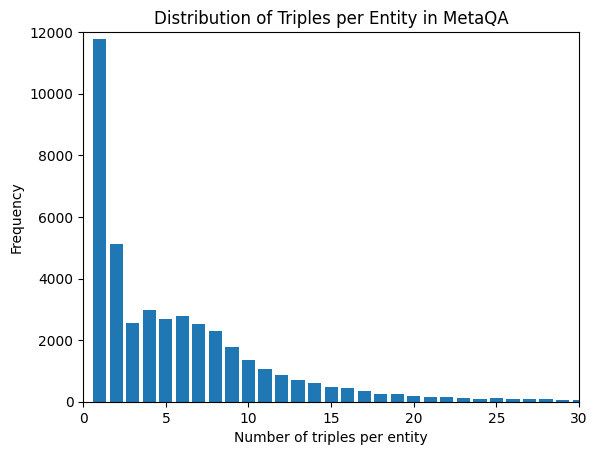
The image presents a bar chart illustrating the distribution of the number of triples per entity within the MetaQA dataset. The chart displays the frequency of entities having a specific number of triples.
### Components/Axes
* **Title:** "Distribution of Triples per Entity in MetaQA" - positioned at the top-center of the chart.
* **X-axis:** "Number of triples per entity" - ranging from 0 to approximately 30, with tick marks at integer values.
* **Y-axis:** "Frequency" - ranging from 0 to 12000, with tick marks at 2000-unit intervals.
* **Data Series:** A single series of blue bars representing the frequency of each number of triples per entity.
### Detailed Analysis
The chart shows a highly skewed distribution. The frequency of entities decreases rapidly as the number of triples per entity increases.
* **0 Triples:** Approximately 11,800 entities have 0 triples.
* **1 Triple:** Approximately 5,300 entities have 1 triple.
* **2 Triples:** Approximately 2,400 entities have 2 triples.
* **3 Triples:** Approximately 2,100 entities have 3 triples.
* **4 Triples:** Approximately 1,800 entities have 4 triples.
* **5 Triples:** Approximately 1,600 entities have 5 triples.
* **6 Triples:** Approximately 1,400 entities have 6 triples.
* **7 Triples:** Approximately 1,200 entities have 7 triples.
* **8 Triples:** Approximately 1,000 entities have 8 triples.
* **9 Triples:** Approximately 800 entities have 9 triples.
* **10 Triples:** Approximately 650 entities have 10 triples.
* **11 Triples:** Approximately 500 entities have 11 triples.
* **12 Triples:** Approximately 400 entities have 12 triples.
* **13 Triples:** Approximately 300 entities have 13 triples.
* **14 Triples:** Approximately 200 entities have 14 triples.
* **15 Triples:** Approximately 150 entities have 15 triples.
* **16 Triples:** Approximately 100 entities have 16 triples.
* **17 Triples:** Approximately 80 entities have 17 triples.
* **18 Triples:** Approximately 60 entities have 18 triples.
* **19 Triples:** Approximately 40 entities have 19 triples.
* **20 Triples:** Approximately 30 entities have 20 triples.
* **21 Triples:** Approximately 20 entities have 21 triples.
* **22 Triples:** Approximately 10 entities have 22 triples.
* **23 Triples:** Approximately 10 entities have 23 triples.
* **24 Triples:** Approximately 5 entities have 24 triples.
* **25 Triples:** Approximately 5 entities have 25 triples.
* **26-30 Triples:** Fewer than 5 entities have 26-30 triples.
The bar heights decrease consistently from 0 to approximately 15 triples, then the decrease becomes more gradual.
### Key Observations
* The distribution is heavily skewed towards entities with a small number of triples (0-5).
* A significant portion of entities (over 11,000) have no triples associated with them.
* The frequency drops off rapidly as the number of triples increases.
* There are very few entities with a large number of triples (above 20).
### Interpretation
The chart suggests that the MetaQA dataset contains a large number of entities that are not well-connected or have limited information associated with them. This could be due to several factors, such as incomplete data, the nature of the entities themselves, or the way the dataset was constructed. The high concentration of entities with zero triples indicates that a substantial portion of the dataset may consist of entities that are placeholders or have not yet been fully populated with data. The rapid decline in frequency as the number of triples increases suggests that the dataset follows a power-law distribution, where a small number of entities have a large number of triples, while the vast majority have very few. This type of distribution is common in many real-world datasets, such as social networks and the web. The data suggests that any analysis relying on the number of triples per entity should account for this skewed distribution and potentially focus on the entities with a higher number of triples to avoid being biased by the large number of entities with few or no triples.