## Heatmap: R=dynamic (ID 22-hop) Halting Rule Performance
### Overview
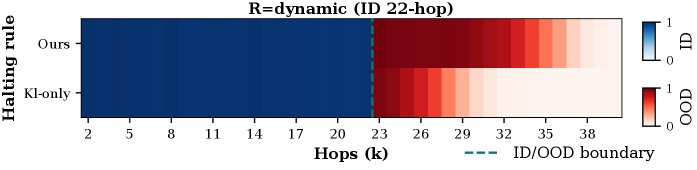
This heatmap visualizes the performance of two halting rules ("Ours" and "Kl-only") across varying numbers of hops (k=2 to 38) in a dynamic R environment (ID 22-hop). A dashed vertical line at k=23 marks the ID/OOD boundary, with color gradients indicating performance scores (0=blue, 1=red).
### Components/Axes
- **X-axis (Hops (k))**: Integer values from 2 to 38, representing the number of hops.
- **Y-axis (Halting rule)**: Two categories:
- "Ours" (dark blue)
- "Kl-only" (red-to-white gradient)
- **Legend**:
- Blue (0) to Red (1) gradient, indicating performance scores.
- Dashed line at k=23 labeled "ID/OOD boundary".
### Detailed Analysis
- **"Ours" (dark blue)**:
- Uniform dark blue across all hops (k=2–38), indicating a consistent performance score of **0**.
- No variation observed, suggesting stable behavior across all hops.
- **"Kl-only" (red-to-white gradient)**:
- Starts as dark red (score ~1) at k=2–22.
- Gradually transitions to light red (score ~0.5) at k=23–29.
- Becomes white (score ~0) at k=30–38.
- The transition aligns with the ID/OOD boundary at k=23.
### Key Observations
1. **"Ours" maintains a constant 0 score**, implying no performance degradation or improvement with increasing hops.
2. **"Kl-only" shows a clear decline** in performance (from 1 to 0) as hops increase, with a sharp transition at k=23.
3. The **ID/OOD boundary at k=23** coincides with the midpoint of the "Kl-only" gradient, suggesting a critical threshold for model behavior.
### Interpretation
- **"Ours" demonstrates robustness**: Its consistent performance (score=0) across all hops suggests it is unaffected by the number of hops or the ID/OOD boundary.
- **"Kl-only" exhibits sensitivity**: The gradient indicates performance degradation as hops increase, with a notable shift at k=23. This may reflect overfitting to in-distribution data (k<23) and failure to generalize beyond the boundary.
- The **ID/OOD boundary at k=23** acts as a pivot point for "Kl-only", highlighting its reliance on hop count for performance. This contrasts with "Ours", which remains invariant, potentially due to architectural or algorithmic differences in handling dynamic R environments.