## Textual Comparison: Math Problem Solutions
### Overview
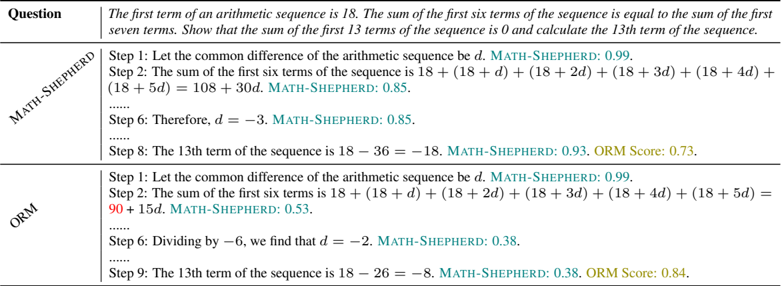
The image presents a comparison of two solutions to the same arithmetic sequence problem, generated by "MATH-SHEPHERD" and "ORM". The problem statement is at the top, followed by step-by-step solutions from each system, along with associated confidence scores.
### Components/Axes
The image is structured into columns:
* **Question:** Contains the problem statement.
* **MATH-SHEPHERD:** Displays the solution steps generated by the MATH-SHEPHERD system, along with a confidence score labeled "MATH-SHEPHERD".
* **ORM:** Displays the solution steps generated by the ORM system, along with a confidence score labeled "ORM Score".
The problem statement is: "The first term of an arithmetic sequence is 18. The sum of the first six terms of the sequence is equal to the sum of the first seven terms. Show that the sum of the first 13 terms of the sequence is 0 and calculate the 13th term of the sequence."
### Content Details
**Question:**
"The first term of an arithmetic sequence is 18. The sum of the first six terms of the sequence is equal to the sum of the first seven terms. Show that the sum of the first 13 terms of the sequence is 0 and calculate the 13th term of the sequence."
**MATH-SHEPHERD Solution:**
* **Step 1:** Let the common difference of the arithmetic sequence be d. MATH-SHEPHERD: 0.99
* **Step 2:** The sum of the first six terms of the sequence is 18 + (18 + d) + (18 + 2d) + (18 + 3d) + (18 + 4d) + (18 + 5d) = 108 + 30d. MATH-SHEPHERD: 0.85
* **Step 6:** Therefore, d = -3. MATH-SHEPHERD: 0.85
* **Step 8:** The 13th term of the sequence is 18 – 36 = –18. MATH-SHEPHERD: 0.93. ORM Score: 0.73
**ORM Solution:**
* **Step 1:** Let the common difference of the arithmetic sequence be d. MATH-SHEPHERD: 0.99
* **Step 2:** The sum of the first six terms is 18 + (18 + d) + (18 + 2d) + (18 + 3d) + (18 + 4d) + (18 + 5d) = 90 + 15d. MATH-SHEPHERD: 0.53
* **Step 6:** Dividing by –6, we find that d = -2. MATH-SHEPHERD: 0.38
* **Step 9:** The 13th term of the sequence is 18 – 26 = –8. MATH-SHEPHERD: 0.38. ORM Score: 0.84
### Key Observations
* Both systems start with the same initial step.
* There is a discrepancy in Step 2: MATH-SHEPHERD calculates the sum as 108 + 30d, while ORM calculates it as 90 + 15d. This is a significant error in the ORM solution.
* Consequently, the calculated common difference 'd' differs between the two systems (d = -3 for MATH-SHEPHERD and d = -2 for ORM).
* The final 13th term also differs (-18 for MATH-SHEPHERD and -8 for ORM).
* MATH-SHEPHERD consistently has higher confidence scores for its steps compared to ORM.
* The "MATH-SHEPHERD" label appears in the ORM solution section, likely indicating a cross-evaluation or comparison metric.
### Interpretation
The image demonstrates a comparison of two automated problem-solving systems. MATH-SHEPHERD appears to provide a more accurate solution to the arithmetic sequence problem, as evidenced by the correct calculation of the common difference and the 13th term. The ORM system makes an error in calculating the sum of the first six terms, leading to an incorrect solution. The confidence scores suggest that MATH-SHEPHERD is more certain about its steps, which aligns with its accuracy. The presence of "MATH-SHEPHERD" scores within the ORM section suggests a potential evaluation framework where MATH-SHEPHERD's output is used as a benchmark for assessing ORM's performance. This comparison highlights the challenges in automated mathematical reasoning and the importance of verifying the correctness of solutions generated by such systems.