\n
## Mathematical Solution Comparison: Arithmetic Sequence Problem
### Overview
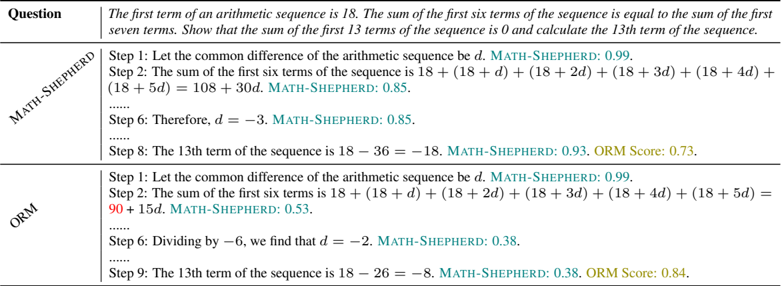
The image displays a side-by-side comparison of two different solution methods (labeled "MATH-SHEPHERD" and "ORM") for the same arithmetic sequence problem. The problem statement is presented at the top, followed by the two solution approaches in a table-like format. Each solution shows selected steps, mathematical expressions, and associated scoring metrics.
### Components/Axes
* **Problem Statement (Top):** "The first term of an arithmetic sequence is 18. The sum of the first six terms of the sequence is equal to the sum of the first seven terms. Show that the sum of the first 13 terms of the sequence is 0 and calculate the 13th term of the sequence."
* **Solution Labels (Left Column, Rotated Text):**
* Top Row: "MATH-SHEPHERD"
* Bottom Row: "ORM"
* **Solution Steps (Right Column):** Each solution presents a series of numbered steps (e.g., Step 1, Step 2, Step 6, Step 8/9) with mathematical derivations. Ellipses ("......") indicate omitted intermediate steps.
* **Scoring Metrics:** Embedded within the steps are colored text annotations providing scores:
* `MATH-SHEPHERD: [value]` (in teal/cyan)
* `ORM Score: [value]` (in gold/yellow, appears only in the final step of the ORM solution)
### Detailed Analysis
**MATH-SHEPHERD Solution:**
* **Step 1:** "Let the common difference of the arithmetic sequence be *d*." Score: `MATH-SHEPHERD: 0.99`.
* **Step 2:** "The sum of the first six terms of the sequence is 18 + (18 + *d*) + (18 + 2*d*) + (18 + 3*d*) + (18 + 4*d*) + (18 + 5*d*) = 108 + 30*d*." Score: `MATH-SHEPHERD: 0.85`.
* **Step 6:** "Therefore, *d* = -3." Score: `MATH-SHEPHERD: 0.85`.
* **Step 8:** "The 13th term of the sequence is 18 - 36 = -18." Scores: `MATH-SHEPHERD: 0.93`, `ORM Score: 0.73`.
**ORM Solution:**
* **Step 1:** "Let the common difference of the arithmetic sequence be *d*." Score: `MATH-SHEPHERD: 0.99`.
* **Step 2:** "The sum of the first six terms of the sequence is 18 + (18 + *d*) + (18 + 2*d*) + (18 + 3*d*) + (18 + 4*d*) + (18 + 5*d*) = **90 + 15*d***." (The expression "90 + 15*d*" is highlighted in red). Score: `MATH-SHEPHERD: 0.53`.
* **Step 6:** "Dividing by -6, we find that *d* = -2." Score: `MATH-SHEPHERD: 0.38`.
* **Step 9:** "The 13th term of the sequence is 18 - 26 = -8." Scores: `MATH-SHEPHERD: 0.38`, `ORM Score: 0.84`.
### Key Observations
1. **Divergent Results:** The two methods yield different values for the common difference (*d* = -3 vs. *d* = -2) and consequently different answers for the 13th term (-18 vs. -8).
2. **Error Identification:** The MATH-SHEPHERD score for Step 2 of the ORM solution is notably low (0.53), and the resulting sum expression "90 + 15*d*" is highlighted in red, indicating an identified error in that calculation.
3. **Scoring Pattern:** The MATH-SHEPHERD scores generally decrease for the ORM solution as the error propagates through the steps (0.99 -> 0.53 -> 0.38 -> 0.38). The final ORM Score for its own solution is 0.84.
4. **Problem Requirements:** The problem asks to *show* the sum of the first 13 terms is 0. Neither solution explicitly shows this proof in the visible steps, focusing instead on finding *d* and the 13th term.
### Interpretation
This image is likely a diagnostic or evaluation output from an automated math-solving or tutoring system. It compares a correct or reference solution (MATH-SHEPHERD) against a student or alternative attempt (ORM).
* **What the data suggests:** The MATH-SHEPHERD solution appears to be the correct pathway. The error in the ORM solution's Step 2 (incorrect summation leading to 90 + 15*d* instead of 108 + 30*d*) is the root cause of its incorrect final answer. The scoring metrics (MATH-SHEPHERD scores) seem to assess the correctness or quality of each individual step, flagging the erroneous step with a low score.
* **Relationship between elements:** The side-by-side layout facilitates direct comparison of methodology and accuracy. The colored scores provide immediate, step-wise feedback. The red highlighting on the incorrect expression serves as a visual cue for the point of divergence.
* **Notable anomaly:** The final "ORM Score: 0.84" for the incorrect ORM solution is surprisingly high given the fundamental error. This might indicate the scoring system weights certain aspects (like problem setup or final answer format) heavily, or that the score is not purely a measure of mathematical correctness but perhaps of process or partial credit. This discrepancy between the low step-wise MATH-SHEPHERD scores and the higher final ORM Score is a key point for investigation into the scoring algorithm's design.