TECHNICAL ASSET FINGERPRINT
e98890225ebbfe98e74411c6
Click to view fullscreen
Press ESC or click to close
FOUND IN PAPERS
EXPERT: healer-alpha-free VERSION 1
RUNTIME: free/openrouter/healer-alpha
INTEL_VERIFIED
## Diagram: Healthcare Data Processing and Instruction Fine-Tuning Workflow
### Overview
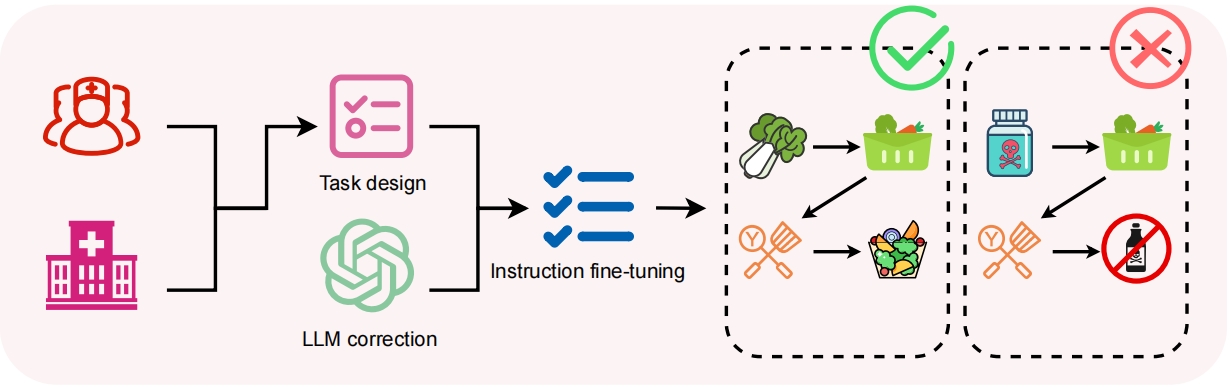
The image is a process flow diagram illustrating a workflow for refining data or instructions, likely for a machine learning model, using inputs from healthcare sources. The flow moves from left to right, starting with data sources, moving through processing steps, and culminating in two distinct outcome pathways—one marked as correct and the other as incorrect.
### Components/Axes
The diagram is composed of several icon-based components connected by directional arrows, indicating the flow of information or process steps. There are no traditional chart axes. The components are arranged in a horizontal sequence.
**Left Section (Inputs):**
1. **Icon 1 (Top-Left):** A red outline icon depicting a group of three people, with the central figure wearing a medical cross on their head. This likely represents **healthcare professionals** or **medical staff**.
2. **Icon 2 (Bottom-Left):** A pink icon of a hospital building with a medical cross. This represents a **hospital** or **medical institution**.
* *Spatial Grounding:* These two icons are vertically aligned on the far left. Arrows from both converge into a single path.
**Middle Section (Processing Steps):**
3. **Icon 3 (Top-Middle):** A pink icon of a document with a checkmark and lines, labeled **"Task design"** below it.
4. **Icon 4 (Bottom-Middle):** A green, intricate, knot-like or brain-like icon, labeled **"LLM correction"** below it.
* *Spatial Grounding:* These two icons are vertically aligned. The converging arrow from the inputs splits to point to both of them. Arrows from both "Task design" and "LLM correction" then converge into the next step.
5. **Icon 5 (Center):** A blue icon showing three horizontal lines with checkmarks, labeled **"Instruction fine-tuning"** below it. This is the central processing node.
**Right Section (Outcomes):**
The flow from "Instruction fine-tuning" splits into two distinct, dashed-border boxes, each representing a different outcome pathway.
* **Left Outcome Box (Correct Pathway):**
* **Top Icon:** A green checkmark inside a circle.
* **Flow Sequence:**
1. An icon of **broccoli and a carrot** (raw vegetables).
2. An arrow points to an icon of a **green shopping basket** containing vegetables.
3. An arrow points from the basket to an icon of **cooking utensils** (spatula and fork).
4. An arrow points from the utensils to an icon of a **bowl of prepared salad**.
* *Interpretation of Flow:* This sequence depicts a correct process: selecting fresh ingredients, placing them in a basket, preparing/cooking them, resulting in a healthy prepared meal.
* **Right Outcome Box (Incorrect Pathway):**
* **Top Icon:** A red "X" inside a circle.
* **Flow Sequence:**
1. An icon of a **blue jar with a skull and crossbones** (representing poison or harmful substance).
2. An arrow points to an icon of a **green shopping basket** containing vegetables (same basket icon as the correct path).
3. An arrow points from the basket to the same **cooking utensils** icon.
4. An arrow points from the utensils to an icon of a **bottle with a red prohibition circle over it** (likely representing alcohol or a banned substance).
* *Interpretation of Flow:* This sequence depicts an incorrect or dangerous process: selecting a harmful substance, placing it in the same basket as food, using the same preparation tools, resulting in a prohibited or unsafe final product.
### Detailed Analysis
The diagram is a conceptual flowchart, not a data chart. Therefore, it contains no numerical data points, trends, or statistical distributions. The "analysis" involves tracing the logical connections between the symbolic components.
* **Process Flow:** The workflow is linear until the "Instruction fine-tuning" step, after which it bifurcates into two parallel, contrasting outcome scenarios.
* **Component Relationships:** The inputs (healthcare professionals, hospital) feed into two complementary processes: "Task design" (creating the structure) and "LLM correction" (refining via a Large Language Model). Their outputs are combined for "Instruction fine-tuning," which is the core training or adjustment phase.
* **Outcome Contrast:** The two final boxes are visually parallel but semantically opposite. They use identical icons for intermediate steps (shopping basket, cooking utensils) but different starting points (vegetables vs. poison) and end points (salad vs. prohibited bottle) to highlight the critical importance of the initial input and the fine-tuning process in determining the safety and correctness of the output.
### Key Observations
1. **Metaphorical Language:** The diagram uses a cooking/food preparation metaphor to explain a technical process (likely data processing or AI training). The "correct" path yields a healthy meal (good outcome), while the "incorrect" path yields a dangerous product (bad outcome).
2. **Color Coding:** Colors are used symbolically: red/pink for medical/healthcare inputs, green for correction and "good" outcomes, blue for the central fine-tuning process, and red for the "incorrect" outcome marker.
3. **Critical Junction:** The "Instruction fine-tuning" step is the pivotal point where the process can diverge toward success or failure, emphasizing its importance.
4. **Shared Intermediate Steps:** The fact that both the correct and incorrect paths use the same basket and utensil icons suggests that the *process steps* themselves may be neutral; the outcome depends entirely on the *content* (ingredients) fed into them and the quality of the initial fine-tuning.
### Interpretation
This diagram illustrates a framework for developing safe and effective AI systems, particularly in a sensitive domain like healthcare. It argues that raw data from medical sources must be carefully processed through deliberate task design and LLM-based correction before undergoing instruction fine-tuning.
The core message is that the fine-tuning phase is decisive. Properly tuned instructions lead to beneficial, safe outputs (represented by the healthy salad). Improperly tuned instructions, even when using the same procedural steps, can lead to harmful or prohibited outcomes (represented by the poisoned bottle). The metaphor warns that without careful oversight and correction ("LLM correction") at the design stage, the AI system might learn to process dangerous inputs correctly in a procedural sense, leading to dangerously confident but harmful results.
The diagram advocates for a rigorous, multi-stage pipeline where human expertise (healthcare professionals, task design) and automated correction (LLM correction) are integrated before final model training, to ensure the system's outputs are aligned with safety and correctness.
DECODING INTELLIGENCE...