## Diagram: Standard Fairness Model (SFM) vs. Fairness Cookbook
### Overview
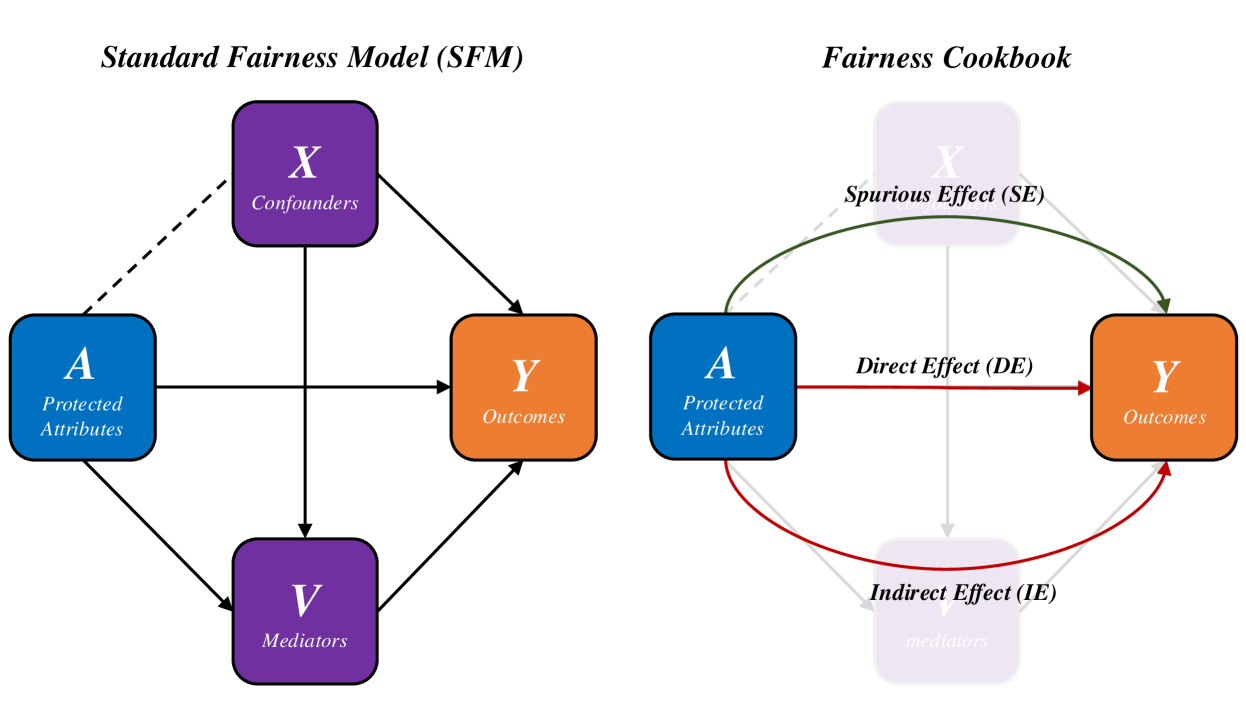
The image presents two diagrams side-by-side, illustrating different models for understanding fairness. The left diagram depicts the "Standard Fairness Model (SFM)," while the right diagram shows a "Fairness Cookbook" model. Both diagrams use nodes representing variables (A, X, Y, V) and arrows to indicate relationships between them. The "Fairness Cookbook" diagram provides more nuanced relationships, including direct, indirect, and spurious effects.
### Components/Axes
**Left Diagram (Standard Fairness Model (SFM))**
* **Title:** Standard Fairness Model (SFM)
* **Nodes:**
* **A (Blue):** Labeled "Protected Attributes" (bottom-left)
* **X (Purple):** Labeled "Confounders" (top-center)
* **Y (Orange):** Labeled "Outcomes" (center-right)
* **V (Purple):** Labeled "Mediators" (bottom-center)
* **Arrows:**
* A -> Y (Black, solid): Direct effect from Protected Attributes to Outcomes.
* A -> V (Black, solid): Effect from Protected Attributes to Mediators.
* X -> Y (Black, solid): Effect from Confounders to Outcomes.
* X -> V (Black, solid): Effect from Confounders to Mediators.
* V -> Y (Black, solid): Effect from Mediators to Outcomes.
* X -- A (Black, dashed): Effect from Confounders to Protected Attributes.
**Right Diagram (Fairness Cookbook)**
* **Title:** Fairness Cookbook
* **Nodes:**
* **A (Blue):** Labeled "Protected Attributes" (center-left)
* **X (Light Purple, faded):** Labeled "Confounders" (top-center, faded)
* **Y (Orange):** Labeled "Outcomes" (center-right)
* **V (Light Purple, faded):** Labeled "mediators" (bottom-center, faded)
* **Arrows:**
* A -> Y (Red, solid): Labeled "Direct Effect (DE)"
* A -> Y (Red, curved, solid): Indirect Effect (IE)
* A -> X -> Y (Green, curved, solid): Labeled "Spurious Effect (SE)"
* X -> Y (Gray, solid, faded): Effect from Confounders to Outcomes.
* X -> V (Gray, solid, faded): Effect from Confounders to Mediators.
* V -> Y (Gray, solid, faded): Effect from Mediators to Outcomes.
### Detailed Analysis or ### Content Details
**Left Diagram (Standard Fairness Model (SFM))**
* The diagram shows a basic model where protected attributes, confounders, and mediators can all influence outcomes.
* Confounders may also influence protected attributes.
**Right Diagram (Fairness Cookbook)**
* This diagram breaks down the effects into direct, indirect, and spurious effects.
* The confounders and mediators are faded, suggesting they are considered but not the primary focus.
* The direct effect (DE) is a direct influence of protected attributes on outcomes.
* The indirect effect (IE) is the influence of protected attributes on outcomes through other variables (mediators).
* The spurious effect (SE) is the influence of protected attributes on outcomes through confounders.
### Key Observations
* The "Fairness Cookbook" model provides a more detailed breakdown of the relationships between variables compared to the "Standard Fairness Model."
* The use of color and line styles in the "Fairness Cookbook" highlights the different types of effects (direct, indirect, spurious).
* The fading of nodes in the "Fairness Cookbook" suggests a prioritization of certain relationships over others.
### Interpretation
The diagrams illustrate two approaches to understanding fairness in a system. The "Standard Fairness Model" provides a basic framework, while the "Fairness Cookbook" offers a more nuanced perspective by distinguishing between direct, indirect, and spurious effects. The "Fairness Cookbook" model suggests that understanding these different types of effects is crucial for addressing fairness concerns. The fading of the confounder and mediator nodes in the "Fairness Cookbook" may indicate that the model is primarily concerned with the direct and indirect effects of protected attributes on outcomes, as well as the spurious effects introduced by confounders.