\n
## Diagram: Fairness Models Comparison
### Overview
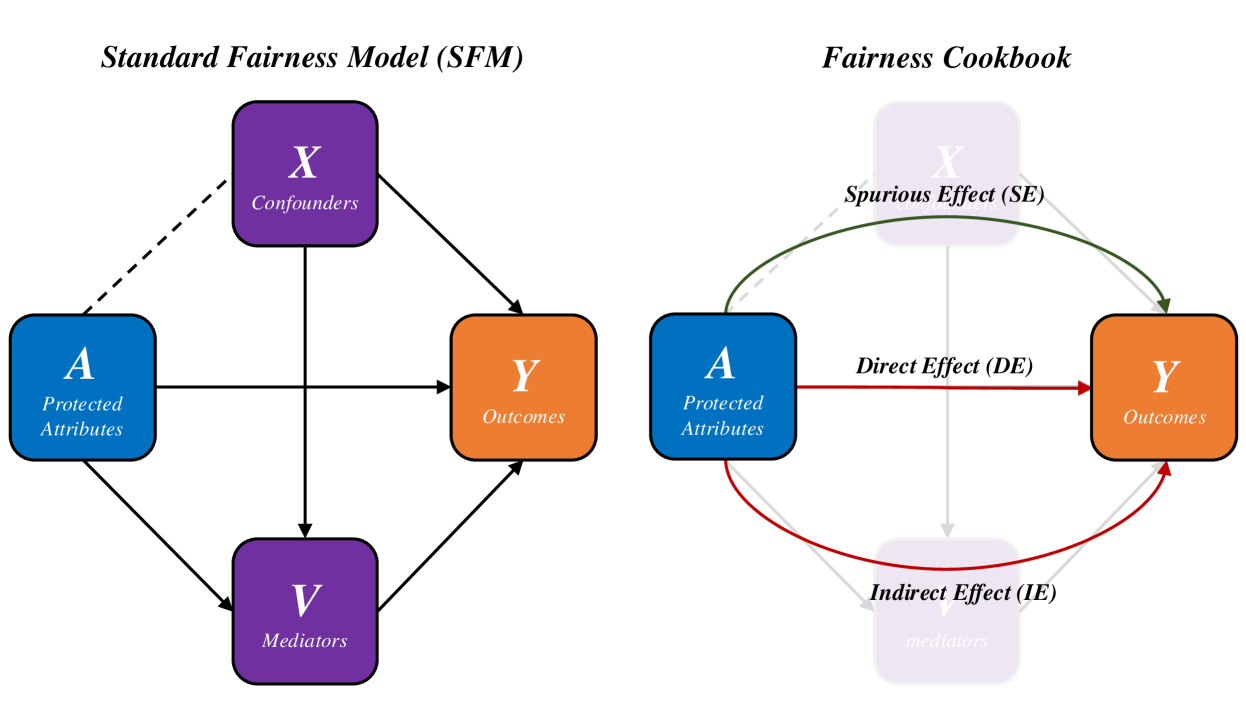
The image presents a comparative diagram illustrating two fairness models: the Standard Fairness Model (SFM) and a model from the "Fairness Cookbook." Both models depict relationships between Protected Attributes, Confounders/Spurious Effects, Mediators, and Outcomes, using directed arrows to indicate causal pathways. The diagram aims to visually contrast how these models account for potential sources of unfairness in machine learning or statistical systems.
### Components/Axes
The diagram consists of four main components, each represented by a differently shaped node:
* **Protected Attributes (A):** Represented by a blue triangle. Labeled "Protected Attributes".
* **Confounders/Spurious Effect (X):** Represented by a purple diamond. Labeled "Confounders" in the SFM and "Spurious Effect (SE)" in the Fairness Cookbook model.
* **Mediators (V/mediators):** Represented by a purple rounded rectangle. Labeled "Mediators" in the SFM and "mediators" in the Fairness Cookbook model.
* **Outcomes (Y):** Represented by a yellow circle. Labeled "Outcomes".
The arrows indicate the direction of influence between these components. Different arrow styles (solid vs. dashed, colored) denote different types of relationships.
### Detailed Analysis or Content Details
**Standard Fairness Model (SFM) - Left Side:**
* A (Protected Attributes) has a dashed arrow pointing to X (Confounders).
* X (Confounders) has a solid arrow pointing to Y (Outcomes).
* A (Protected Attributes) has a solid arrow pointing to Y (Outcomes).
* V (Mediators) has a solid arrow pointing to Y (Outcomes).
* X (Confounders) has a solid arrow pointing to V (Mediators).
* A (Protected Attributes) has a solid arrow pointing to V (Mediators).
**Fairness Cookbook Model - Right Side:**
* A (Protected Attributes) has a solid arrow pointing to Y (Outcomes) labeled "Direct Effect (DE)".
* X (Spurious Effect) has a solid arrow pointing to Y (Outcomes).
* X (Spurious Effect) has a curved, grey arrow pointing to A (Protected Attributes).
* A (Protected Attributes) has a solid arrow pointing to mediators.
* mediators has a solid arrow pointing to Y (Outcomes) labeled "Indirect Effect (IE)".
* X (Spurious Effect) has a solid arrow pointing to mediators.
### Key Observations
* The SFM shows a more direct influence of confounders on outcomes, while the Fairness Cookbook model introduces the concept of a "Spurious Effect" and emphasizes the role of mediators in both direct and indirect effects.
* The dashed line in the SFM suggests a weaker or less direct relationship between protected attributes and confounders.
* The Fairness Cookbook model explicitly labels the direct and indirect effects, providing a more granular view of the causal pathways.
* The curved grey arrow in the Fairness Cookbook model indicates a feedback loop or influence of the spurious effect on the protected attributes.
### Interpretation
The diagram illustrates a shift in thinking about fairness in machine learning. The SFM represents a more traditional view where confounders directly influence outcomes. The Fairness Cookbook model, however, acknowledges that spurious correlations can exist and that these can influence both the protected attributes themselves and the outcomes through mediators. This model highlights the importance of understanding and mitigating these indirect effects to achieve true fairness. The inclusion of "Direct Effect" and "Indirect Effect" labels in the Fairness Cookbook model suggests a focus on decomposing the total effect of protected attributes on outcomes to identify and address sources of bias. The diagram suggests that a more nuanced understanding of causal relationships is necessary to build fair and equitable systems. The grey curved arrow in the Fairness Cookbook model is particularly interesting, as it suggests that the spurious effect can reinforce existing biases in the protected attributes, creating a feedback loop that perpetuates unfairness.