## Diagram: String Diagram Transformation
### Overview
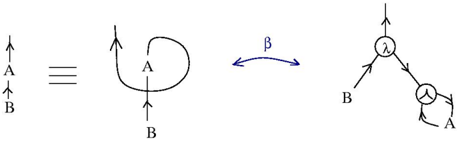
The image depicts a transformation of a string diagram. It shows an equivalence between a simple vertical stack of strings labeled A and B, and a more complex diagram involving loops and nodes labeled with λ. The transformation is mediated by a beta (β) reduction.
### Components/Axes
* **Strings:** Represented by vertical lines with arrows indicating direction.
* **Labels:** A, B, and λ are used to label strings and nodes.
* **Nodes:** Represented by circles, some containing the symbol λ.
* **Arrows:** Indicate the direction of flow along the strings.
* **Equivalence Symbol:** Three horizontal lines indicating equivalence.
* **Transformation Symbol:** A blue double-headed arrow labeled with β above it.
### Detailed Analysis
The diagram can be broken down into three main sections:
1. **Left Diagram:**
* Two vertical strings, one above the other.
* The top string is labeled "A".
* The bottom string is labeled "B".
* Both strings have upward-pointing arrows.
2. **Middle Section:**
* An equivalence symbol (≡).
* A diagram with a single vertical string labeled "B" at the bottom, with an upward-pointing arrow.
* The string splits into a loop labeled "A" with an upward-pointing arrow, and then rejoins the original string.
3. **Right Diagram:**
* A blue double-headed arrow labeled "β" above it, indicating a transformation.
* A diagram with a string labeled "B" on the left, pointing towards a node containing "λ".
* A string exits the top of the "λ" node with an upward-pointing arrow.
* Another string exits the "λ" node and connects to another node containing "¬λ".
* A loop labeled "A" with an upward-pointing arrow emerges from the "¬λ" node.
### Key Observations
* The transformation involves replacing a simple stack of strings with a more complex network of nodes and loops.
* The "β" symbol suggests a beta reduction, a common operation in lambda calculus and related formalisms.
* The presence of "λ" and "¬λ" nodes suggests a connection to lambda calculus or a similar system of logic.
* The arrows indicate the direction of flow, which is important for understanding the meaning of the diagram.
### Interpretation
The diagram illustrates a transformation rule within a string diagram calculus. The "β" reduction transforms a simple composition of strings into a more complex structure involving lambda abstractions and applications. This type of transformation is common in areas like quantum computation, category theory, and programming language semantics, where string diagrams are used to represent computations and logical operations. The diagram suggests that the simple stack of strings "A" and "B" is equivalent to a more complex expression involving lambda abstractions and applications, as represented by the nodes and loops on the right-hand side. The diagram is a visual representation of a formal rule for manipulating string diagrams.