## Bar Chart: Energy per Operation by Processor Type
### Overview
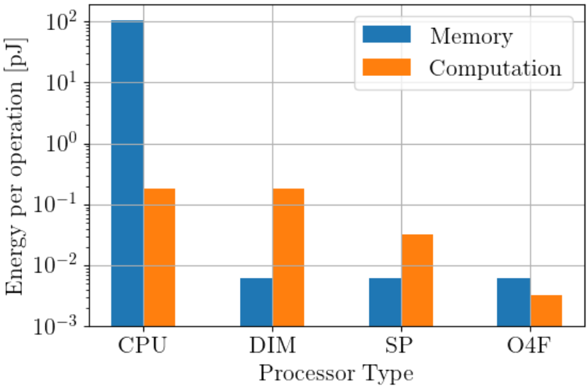
The chart compares energy consumption (in picojoules, pJ) for memory and computation operations across four processor types: CPU, DIM, SP, and O4F. Energy values are plotted on a logarithmic scale (10^-3 to 10^2 pJ), with separate bars for memory (blue) and computation (orange) operations.
### Components/Axes
- **X-axis**: Processor Type (CPU, DIM, SP, O4F)
- **Y-axis**: Energy per operation [pJ] (logarithmic scale: 10^-3 to 10^2)
- **Legend**:
- Blue = Memory
- Orange = Computation
- **Legend Position**: Top-right corner
- **Bar Grouping**: Processor types grouped vertically, with memory and computation bars side-by-side for each type.
### Detailed Analysis
1. **CPU**:
- Memory: ~100 pJ (blue bar, tallest in chart)
- Computation: ~0.1 pJ (orange bar, ~10^-1 pJ)
2. **DIM**:
- Memory: ~0.1 pJ (blue bar, ~10^-1 pJ)
- Computation: ~0.1 pJ (orange bar, ~10^-1 pJ)
3. **SP**:
- Memory: ~0.1 pJ (blue bar, ~10^-1 pJ)
- Computation: ~0.01 pJ (orange bar, ~10^-2 pJ)
4. **O4F**:
- Memory: ~0.1 pJ (blue bar, ~10^-1 pJ)
- Computation: ~0.001 pJ (orange bar, ~10^-3 pJ)
### Key Observations
- **Memory Energy Outlier**: CPU memory operations consume ~1000x more energy than computation operations (100 pJ vs. 0.1 pJ).
- **Consistency in Memory**: DIM, SP, and O4F show nearly identical memory energy (~0.1 pJ).
- **Computation Efficiency**: Computation energy decreases by ~100x from CPU (0.1 pJ) to O4F (0.001 pJ).
- **Logarithmic Scale Impact**: The y-axis compression emphasizes differences in computation energy (e.g., O4F computation is 100x lower than SP).
### Interpretation
The data suggests that **memory operations dominate energy consumption in CPUs**, while **computation efficiency improves significantly in specialized processors (O4F)**. The logarithmic scale highlights the stark contrast between memory and computation energy in CPUs, whereas O4F demonstrates near-parity between the two. This implies that processor architecture (e.g., O4F’s design) optimizes computation energy, making it suitable for tasks requiring high computational throughput with minimal energy waste. The consistency in memory energy across DIM, SP, and O4F suggests shared memory management strategies, while CPU’s high memory energy may reflect legacy or general-purpose design trade-offs.