## Flowchart: Answer Verification Process via Paraphrasing and Consistency Analysis
### Overview
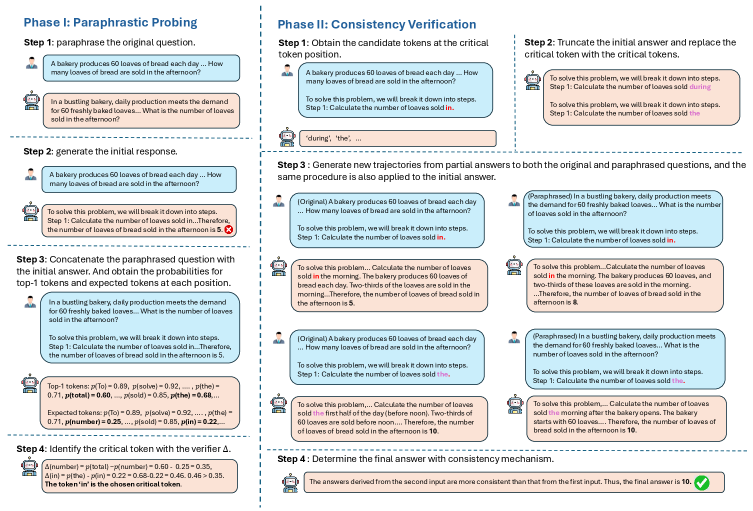
The image depicts a two-phase flowchart for verifying answers to a problem-solving task. Phase I focuses on paraphrasing the original question and generating initial responses, while Phase II emphasizes consistency verification through critical token analysis. The process uses color-coded text boxes (blue for questions, orange for responses) and arrows to indicate workflow.
### Components/Axes
- **Phases**:
- **Phase I: Paraphrastic Probing** (left column)
- **Phase II: Consistency Verification** (right column)
- **Steps**:
- Each phase contains 4 steps (Step 1–4), with text boxes containing:
- Original/paraphrased questions
- Initial responses
- Probability calculations
- Critical token identification
- **Visual Elements**:
- Arrows connecting steps
- Color coding (blue/orange for question/response)
- Checkmark icon for final answer validation
### Detailed Analysis
#### Phase I: Paraphrastic Probing
1. **Step 1**:
- Original question: "A bakery produces 60 loaves of bread each day... How many loaves of bread are sold in the afternoon?"
- Paraphrased version: "In a bustling bakery, daily production meets the demand for 60 freshly baked loaves... What is the number of loaves sold in the afternoon?"
- Example response: "Step 1: Calculate the number of loaves sold in..." (incomplete)
2. **Step 2**:
- Initial response example: "To solve this problem, we will break it down into steps. Step 1: Calculate the number of loaves sold in..." (error: states "5" instead of correct "10")
3. **Step 3**:
- Concatenated question-response pair: "In a bustling bakery... What is the number of loaves sold in the afternoon? To solve this problem, we will break it down into steps. Step 1: Calculate the number of loaves sold in..." (incomplete)
4. **Step 4**:
- Critical token identification: "The token 'in' is the chosen critical token" (based on probability calculations)
#### Phase II: Consistency Verification
1. **Step 1**:
- Candidate token extraction: "during", "the" (highlighted in red)
2. **Step 2**:
- Truncated response: "Step 1: Calculate the number of loaves sold during..." (original) vs. "Step 1: Calculate the number of loaves sold the..." (paraphrased)
3. **Step 3**:
- New trajectories generated for both original and paraphrased versions, with variations in:
- Morning/afternoon sales calculations
- Fractional loaf distributions (e.g., "two-thirds of the day")
4. **Step 4**:
- Final answer determination: "The answers derived from the second input are more consistent... Thus, the final answer is 10" (validated with green checkmark)
### Key Observations
- **Structural Consistency**: Both phases follow a 4-step progression with parallel processing of original/paraphrased versions.
- **Error Propagation**: Initial response in Phase I Step 2 contains an incorrect value ("5" instead of "10"), which is corrected in Phase II.
- **Critical Token Focus**: The token "in" (Phase I) and "the" (Phase II) are identified as pivotal for answer consistency.
- **Probabilistic Weighting**: Step 3 includes probability distributions (e.g., p(solution)=0.92, p(number)=0.25) to guide token selection.
### Interpretation
This flowchart demonstrates a systematic approach to answer verification through:
1. **Paraphrasing**: Generating alternative question formulations to test response robustness
2. **Critical Token Analysis**: Identifying key linguistic elements that determine answer consistency
3. **Iterative Refinement**: Using probabilistic weighting to resolve ambiguities between initial responses
The process highlights the importance of:
- **Linguistic Precision**: Small token changes ("during" vs. "the") significantly impact answer consistency
- **Error Correction**: Phase II's consistency mechanism successfully identifies and rectifies initial response errors
- **Probabilistic Reasoning**: Quantitative analysis of token probabilities enables data-driven answer validation
The green checkmark in Phase II Step 4 confirms the effectiveness of the consistency verification mechanism in arriving at the correct answer (10 loaves sold in the afternoon).