## Diagram: Data Routing System Architecture
### Overview
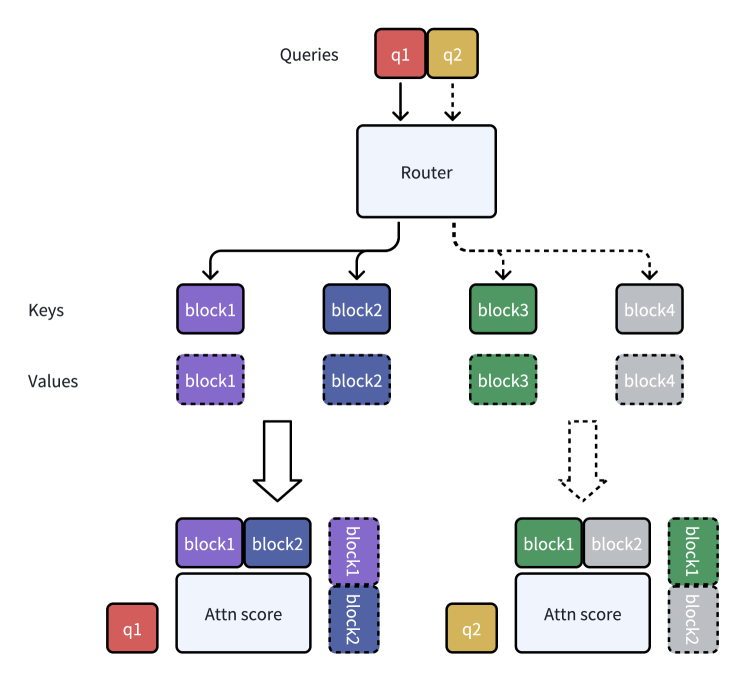
The diagram illustrates a data routing system architecture with a central router processing queries (q1, q2) through key-value blocks and attention score aggregation. The system uses color-coded blocks to represent data components and their flow paths.
### Components/Axes
- **Central Router**: Gray rectangle labeled "Router" at the top center
- **Queries**:
- Red square (q1) at top-left
- Yellow square (q2) at top-right
- **Keys**:
- Blue square (block1) and purple square (block2) under "Keys" label
- **Values**:
- Purple square (block1) and blue square (block2) under "Values" label
- **Attention Score**:
- White rectangle labeled "Attn score" at bottom
- Contains combined blocks from both key and value paths
- **Dashed Pathway**:
- Connects router to green (block3) and gray (block4) blocks
- Separate from main key-value flow
### Spatial Grounding
- Router (center-top) connects to:
- Queries (top-left/right)
- Keys (left-center)
- Values (right-center)
- Dashed pathway (right-center) connects to:
- Green block3 (right-center)
- Gray block4 (right-center)
- Attention score (bottom-center) aggregates:
- Purple/blue blocks from left path
- Green/gray blocks from right path
### Key Observations
1. Color-coded blocks maintain consistent color associations:
- q1 (red) → purple/blue blocks
- q2 (yellow) → green/gray blocks
2. Dashed pathway creates parallel processing stream
3. Attention score combines both key-value paths with query-specific blocks
4. System shows bidirectional flow from queries to router and back
### Interpretation
This architecture demonstrates a hybrid routing system where:
1. Queries split into key-value processing paths
2. Dashed pathway suggests alternative processing route
3. Attention scores combine multiple data sources
4. Color coding enables visual tracking of data lineage
The system appears designed for parallel processing with query-specific data aggregation, where the dashed pathway might represent error handling or secondary processing. The attention score mechanism suggests a transformer-like architecture where multiple data sources are combined for final output generation.