## Diagram: Directed Graph Representation
### Overview
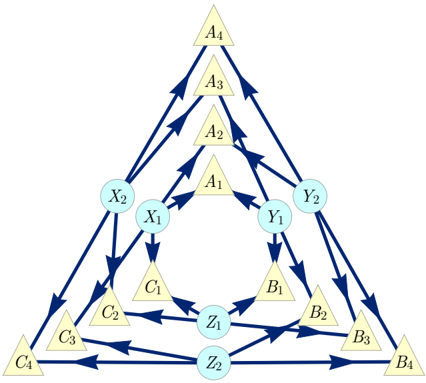
The image displays a directed graph, likely representing a system with interconnected nodes and defined pathways. The nodes are depicted as either light yellow triangles or light blue circles, and the connections are represented by dark blue arrows indicating the direction of flow or relationship. The overall structure is triangular, with nodes arranged in layers.
### Components/Axes
There are no explicit axes or legends in this diagram. The components are:
* **Triangular Nodes (Light Yellow):**
* A series labeled 'A' with indices 1 through 4, arranged vertically from bottom to top.
* A series labeled 'B' with indices 1 through 4, arranged along the bottom-right edge.
* A series labeled 'C' with indices 1 through 4, arranged along the bottom-left edge.
* **Circular Nodes (Light Blue):**
* A series labeled 'X' with indices 1 and 2, positioned to the left of the 'A' series.
* A series labeled 'Y' with indices 1 and 2, positioned to the right of the 'A' series.
* A series labeled 'Z' with indices 1 and 2, positioned at the bottom center.
* **Directed Edges (Dark Blue Arrows):** These represent the connections and direction of flow between nodes.
### Detailed Analysis
The diagram shows a complex network of directed relationships. We can analyze the connections originating from and leading to each type of node:
**Triangular Nodes:**
* **A Series:**
* A1: Receives input from X1, Y1, and Z1. It has outgoing edges to A2, X2, and Y2.
* A2: Receives input from A1, X1, and Y1. It has outgoing edges to A3, X2, and Y2.
* A3: Receives input from A2, X2, and Y2. It has outgoing edges to A4, X2, and Y2.
* A4: Receives input from A3, X2, and Y2. It has no outgoing edges depicted within this diagram.
* **B Series:**
* B1: Receives input from Y1 and Z1. It has outgoing edges to B2 and Y2.
* B2: Receives input from B1 and Y1. It has outgoing edges to B3 and Y2.
* B3: Receives input from B2 and Y1. It has outgoing edges to B4 and Y2.
* B4: Receives input from B3 and Y1. It has no outgoing edges depicted within this diagram.
* **C Series:**
* C1: Receives input from X1 and Z1. It has outgoing edges to C2 and X2.
* C2: Receives input from C1 and X1. It has outgoing edges to C3 and X2.
* C3: Receives input from C2 and X1. It has outgoing edges to C4 and X2.
* C4: Receives input from C3 and X1. It has no outgoing edges depicted within this diagram.
**Circular Nodes:**
* **X Series:**
* X1: Receives input from A1, A2, C1, C2, C3, and C4. It has outgoing edges to A1, A2, C1, C2, C3, and C4.
* X2: Receives input from A1, A2, A3, A4, C1, C2, C3, and C4. It has outgoing edges to A2, A3, A4, C2, C3, and C4.
* **Y Series:**
* Y1: Receives input from A1, A2, B1, B2, B3, and B4. It has outgoing edges to A1, A2, B1, B2, B3, and B4.
* Y2: Receives input from A1, A2, A3, A4, B1, B2, B3, and B4. It has outgoing edges to A2, A3, A4, B2, B3, and B4.
* **Z Series:**
* Z1: Receives input from A1, B1, and C1. It has outgoing edges to A1, B1, and C1.
* Z2: Receives input from B2 and C2. It has outgoing edges to B3 and C3.
**Summary of Connections:**
* The 'A' series nodes form a vertical hierarchy, with A1 at the bottom and A4 at the top.
* The 'B' and 'C' series nodes form diagonal hierarchies along the right and left edges, respectively.
* The 'X' nodes are primarily connected to the 'A' and 'C' series.
* The 'Y' nodes are primarily connected to the 'A' and 'B' series.
* The 'Z' nodes appear to act as intermediate connectors, linking nodes from different series.
* There are many bidirectional relationships indicated by arrows pointing in both directions between certain nodes (e.g., X1 to A1 and A1 to X1).
### Key Observations
* **Hierarchical Structure:** The 'A', 'B', and 'C' series exhibit a clear hierarchical arrangement, suggesting levels or stages.
* **Interconnectivity:** The 'X', 'Y', and 'Z' nodes act as bridges, connecting different parts of the network.
* **Feedback Loops:** The presence of bidirectional arrows indicates potential feedback loops within the system. For example, X1 receives input from A1 and also sends output to A1.
* **Fan-out/Fan-in:** Some nodes have multiple outgoing arrows (fan-out), distributing information or influence, while others have multiple incoming arrows (fan-in), aggregating information or influence. For instance, A4 has multiple incoming arrows but no outgoing ones shown.
* **Centralization:** The 'A' series nodes are centrally located within the triangular structure, suggesting they might be core components.
### Interpretation
This diagram represents a complex, directed system with multiple interacting components. The triangular nodes (A, B, C) likely represent distinct states, entities, or processes, arranged in a hierarchical or sequential manner. The circular nodes (X, Y, Z) appear to be intermediary nodes that facilitate communication or influence between these primary components.
The presence of bidirectional arrows strongly suggests a dynamic system where components can influence each other reciprocally. This could represent a system with feedback mechanisms, learning capabilities, or a complex interplay of forces. The specific arrangement and connections might be indicative of a particular algorithm, a state machine, a neural network architecture, or a process flow in a technical or scientific domain.
Without further context, it is difficult to definitively state what the data suggests. However, the structure implies a system that is:
1. **Layered:** The arrangement of A, B, and C nodes suggests distinct layers or levels of processing.
2. **Interconnected:** The X, Y, and Z nodes ensure that information or influence can flow between different parts of the system.
3. **Potentially Recursive:** The feedback loops suggest that the system's behavior might be iterative or self-regulating.
The diagram is a visual representation of relationships and flows, and its interpretation would depend heavily on the domain it is intended to model. It could be a simplified representation of a complex computational model, a biological pathway, or a network of dependencies. The specific labels (A, B, C, X, Y, Z with indices) are placeholders for actual entities or concepts within that domain.