\n
## Diagram: System Architecture Overview
### Overview
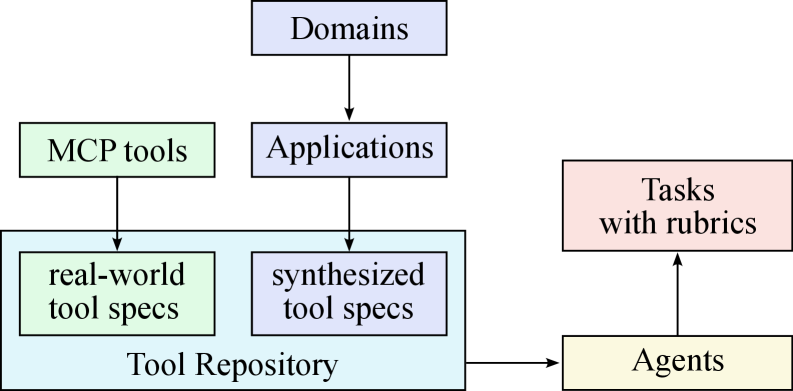
The image depicts a system architecture diagram illustrating the relationships between various components involved in a task-oriented system. The diagram shows a flow of information and dependencies between "Domains", "MCP tools", "Applications", "Tool Repository", "Agents", and "Tasks with rubrics".
### Components/Axes
The diagram consists of the following components:
* **Domains:** A purple rectangle at the top-center.
* **MCP tools:** A light green rectangle positioned to the left of the "Tool Repository".
* **Applications:** A light blue rectangle positioned above the "Tool Repository".
* **Tool Repository:** A larger rectangle encompassing two smaller rectangles labeled "real-world tool specs" and "synthesized tool specs". It is positioned in the lower-left quadrant.
* **Agents:** A yellow rectangle positioned in the lower-center.
* **Tasks with rubrics:** A light pink rectangle positioned to the right of the "Domains".
Arrows indicate the direction of relationships and dependencies between these components.
### Detailed Analysis or Content Details
The diagram illustrates the following relationships:
1. "Domains" have outgoing arrows to both "Applications" and "MCP tools".
2. "MCP tools" feed into the "real-world tool specs" component within the "Tool Repository".
3. "Applications" feed into the "synthesized tool specs" component within the "Tool Repository".
4. The "Tool Repository" has an outgoing arrow to "Agents".
5. "Agents" have an outgoing arrow to "Tasks with rubrics".
The "Tool Repository" is explicitly labeled and contains two sub-components: "real-world tool specs" and "synthesized tool specs". These are positioned side-by-side within the larger "Tool Repository" rectangle.
### Key Observations
The diagram highlights a system where "Domains" drive the creation of both real-world and synthesized tool specifications, which are then utilized by "Agents" to perform "Tasks with rubrics". The "Tool Repository" acts as a central storage and source for these tools. The flow is largely sequential, with information moving from higher-level concepts ("Domains") to more concrete actions ("Tasks with rubrics").
### Interpretation
This diagram likely represents a system for automated task execution or problem-solving. The "Domains" represent areas of expertise or knowledge. "MCP tools" and "Applications" are used to generate tool specifications, which are stored in the "Tool Repository". "Agents" then leverage these tools to complete "Tasks with rubrics", suggesting a focus on evaluation and quality control. The separation of "real-world" and "synthesized" tool specs indicates a hybrid approach, potentially combining existing tools with newly generated ones. The diagram suggests a pipeline where high-level domain knowledge is translated into actionable tasks through a structured tool ecosystem. The diagram does not provide any quantitative data, but rather a qualitative representation of system architecture.