\n
## Bar Chart: Generative Accuracy vs. Transformation Type
### Overview
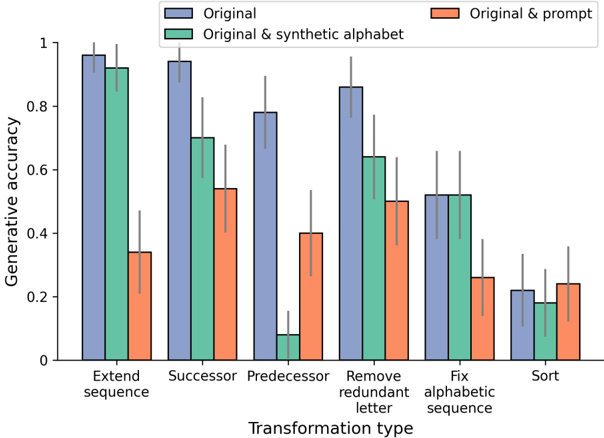
This bar chart compares the generative accuracy of different transformation types using three different approaches: "Original", "Original & prompt", and "Original & synthetic alphabet". The chart displays the mean generative accuracy with error bars representing the variance.
### Components/Axes
* **X-axis:** Transformation type. Categories are: "Extend sequence", "Successor", "Predecessor", "Remove redundant letter", "Fix alphabetic sequence", "Sort".
* **Y-axis:** Generative accuracy, ranging from 0 to 1.
* **Legend:**
* Blue: "Original"
* Green: "Original & synthetic alphabet"
* Orange: "Original & prompt"
* Error bars are present for each bar, indicating the standard deviation or confidence interval.
### Detailed Analysis
The chart consists of six groups of three bars, each representing a different transformation type. The height of each bar represents the generative accuracy.
**1. Extend sequence:**
* Original (Blue): Approximately 0.96, with an error bar ranging from approximately 0.93 to 0.99.
* Original & synthetic alphabet (Green): Approximately 0.94, with an error bar ranging from approximately 0.91 to 0.97.
* Original & prompt (Orange): Approximately 0.34, with an error bar ranging from approximately 0.28 to 0.40.
**2. Successor:**
* Original (Blue): Approximately 0.95, with an error bar ranging from approximately 0.92 to 0.98.
* Original & synthetic alphabet (Green): Approximately 0.69, with an error bar ranging from approximately 0.64 to 0.74.
* Original & prompt (Orange): Approximately 0.58, with an error bar ranging from approximately 0.52 to 0.64.
**3. Predecessor:**
* Original (Blue): Approximately 0.75, with an error bar ranging from approximately 0.70 to 0.80.
* Original & synthetic alphabet (Green): Approximately 0.08, with an error bar ranging from approximately 0.04 to 0.12.
* Original & prompt (Orange): Approximately 0.42, with an error bar ranging from approximately 0.36 to 0.48.
**4. Remove redundant letter:**
* Original (Blue): Approximately 0.88, with an error bar ranging from approximately 0.84 to 0.92.
* Original & synthetic alphabet (Green): Approximately 0.62, with an error bar ranging from approximately 0.57 to 0.67.
* Original & prompt (Orange): Approximately 0.51, with an error bar ranging from approximately 0.45 to 0.57.
**5. Fix alphabetic sequence:**
* Original (Blue): Approximately 0.52, with an error bar ranging from approximately 0.46 to 0.58.
* Original & synthetic alphabet (Green): Approximately 0.45, with an error bar ranging from approximately 0.39 to 0.51.
* Original & prompt (Orange): Approximately 0.26, with an error bar ranging from approximately 0.20 to 0.32.
**6. Sort:**
* Original (Blue): Approximately 0.22, with an error bar ranging from approximately 0.16 to 0.28.
* Original & synthetic alphabet (Green): Approximately 0.18, with an error bar ranging from approximately 0.12 to 0.24.
* Original & prompt (Orange): Approximately 0.24, with an error bar ranging from approximately 0.18 to 0.30.
### Key Observations
* The "Original" approach generally achieves the highest generative accuracy across most transformation types.
* The "Original & prompt" approach consistently shows the lowest generative accuracy, particularly for "Extend sequence" and "Fix alphabetic sequence".
* The "Original & synthetic alphabet" approach shows variable performance, sometimes comparable to "Original" (e.g., "Extend sequence") and sometimes significantly lower (e.g., "Predecessor").
* The error bars indicate substantial variance in the results, especially for the "Original" approach in "Extend sequence" and "Successor".
### Interpretation
The data suggests that the baseline "Original" approach is the most effective for these sequence transformation tasks. The addition of prompts ("Original & prompt") consistently *decreases* performance, indicating that the prompts may be misleading or unhelpful in this context. The use of a synthetic alphabet ("Original & synthetic alphabet") yields mixed results, sometimes improving and sometimes degrading performance depending on the specific transformation type.
The large error bars suggest that the results are sensitive to the specific data or experimental conditions. The wide variance in the "Original" approach for "Extend sequence" and "Successor" could indicate that these transformations are particularly challenging or that the data contains inherent ambiguity.
The fact that "Original & prompt" performs so poorly across the board suggests that the prompt engineering is not effective for these tasks, or that the prompts are actively hindering the model's ability to generate accurate sequences. Further investigation into the prompts themselves would be necessary to understand why they are detrimental. The "Predecessor" transformation type is particularly problematic for the "Original & synthetic alphabet" approach, suggesting that the synthetic alphabet is not well-suited for this type of transformation.