\n
## Diagram: Maze with Agents
### Overview
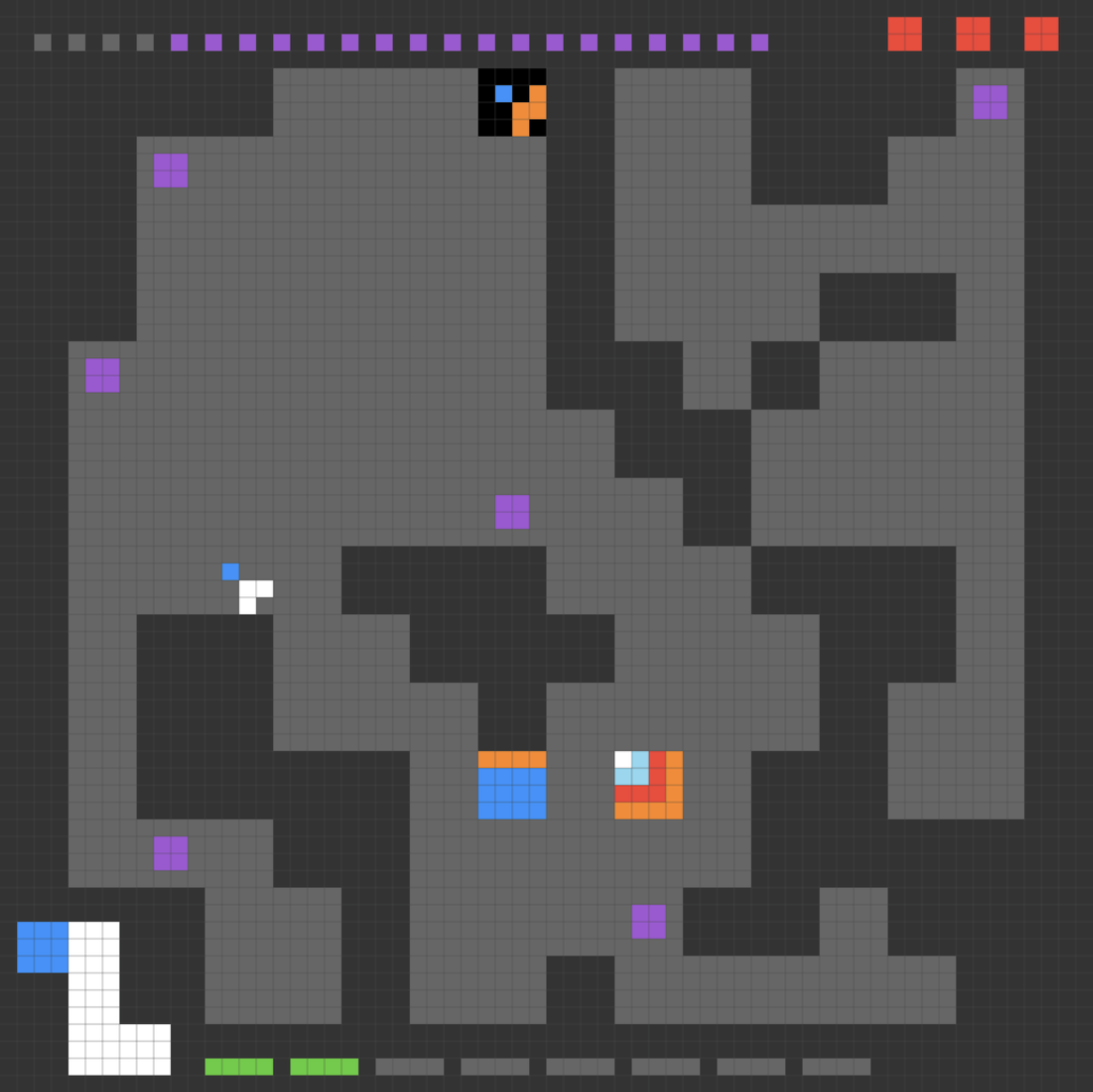
The image depicts a top-down view of a maze-like environment with several agents represented by colored squares. The maze is constructed from dark gray blocks, with open pathways between them. There are several purple squares scattered throughout the maze, potentially representing goals or points of interest. A row of purple squares is present at the top of the image, and a row of green and gray squares is present at the bottom.
### Components/Axes
There are no explicit axes or scales. The environment is defined by the arrangement of gray blocks. The agents are differentiated by color: blue, orange, and white. The purple squares are scattered throughout the maze. The top row consists of approximately 20 purple squares. The bottom row consists of approximately 10 squares, alternating between green and gray.
### Detailed Analysis or Content Details
The maze is roughly rectangular. The agents are positioned as follows:
* **Blue Agent:** Located in the bottom-left corner of the maze.
* **Orange Agent 1:** Located in the bottom-right quadrant of the maze.
* **Orange Agent 2:** Located in the top-right quadrant of the maze.
* **White Agent:** Located in the central-left quadrant of the maze.
The purple squares are distributed unevenly throughout the maze. There is a higher concentration of purple squares in the left and right sides of the maze. The green and gray squares at the bottom do not appear to be part of the maze structure itself, but rather a separate indicator or status bar.
### Key Observations
The agents appear to be navigating the maze. The distribution of purple squares suggests that the maze may be designed to encourage exploration or to test the agents' pathfinding abilities. The different colors of the agents may indicate different roles or objectives. The bottom row of green and gray squares could represent progress or status indicators.
### Interpretation
This image likely represents a simulation or game environment where agents are tasked with navigating a maze. The purple squares could be goals that the agents are trying to reach, or obstacles that they need to avoid. The different agent colors could represent different teams or players. The green and gray squares at the bottom could indicate the progress of the simulation or the status of the agents.
The maze's complexity suggests a non-trivial pathfinding challenge. The uneven distribution of purple squares could be intentional, creating areas of higher and lower reward or difficulty. The overall design suggests a focus on agent behavior and decision-making in a complex environment. The image does not provide any quantitative data, but it offers a rich visual representation of a potential problem space for artificial intelligence or robotics research.