\n
## Diagram: Pixel Art Maze/Game Level Layout
### Overview
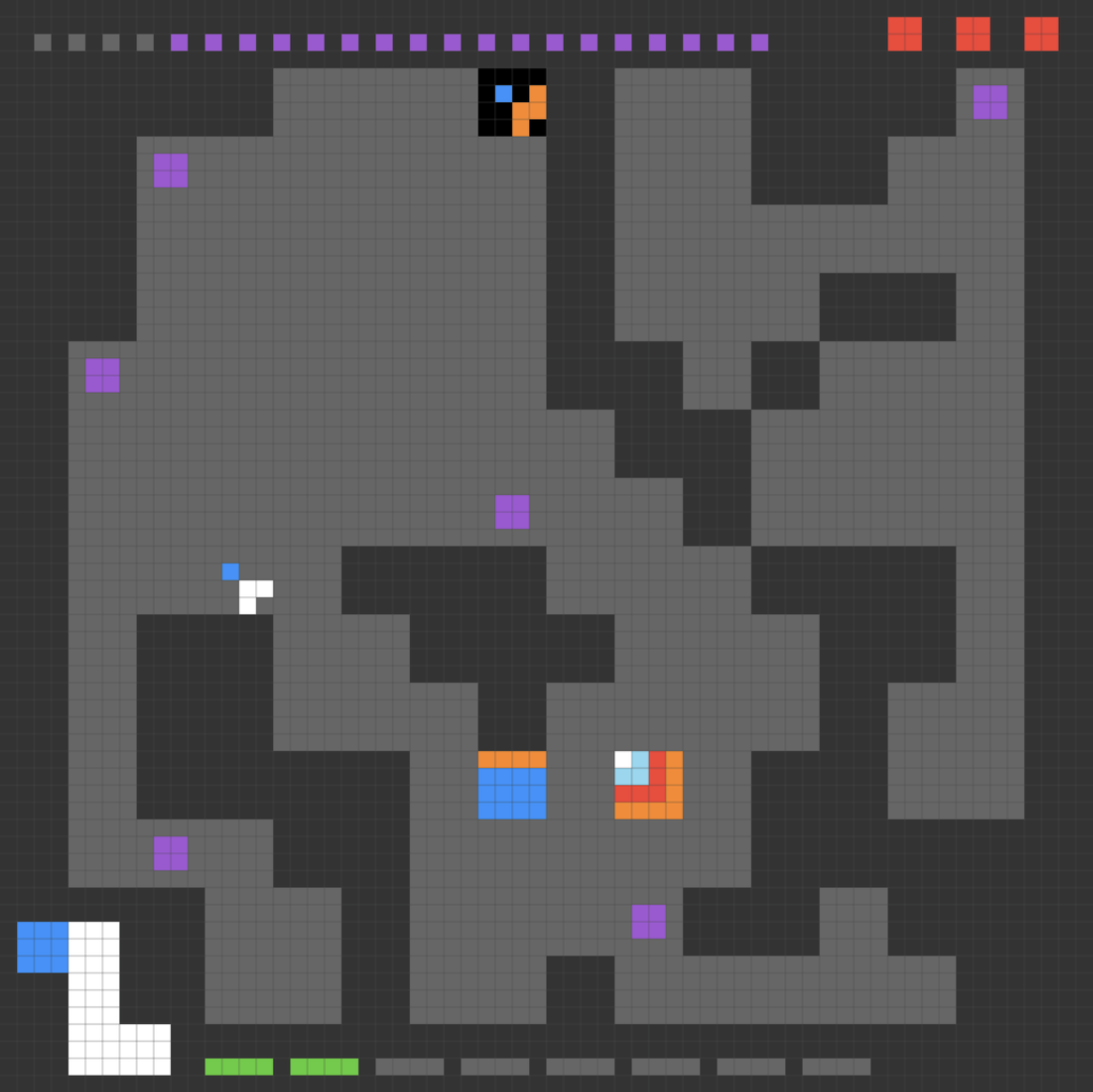
The image is a pixel art representation of what appears to be a top-down view of a maze or a level in a grid-based video game. The entire scene is rendered on a dark gray grid background. The layout consists of navigable pathways (lighter gray), impassable walls (darker gray), and various colored pixel clusters that likely represent interactive elements, items, or characters. There is no textual information present in the image.
### Components/Axes
* **Grid Structure:** The entire image is built on a uniform square grid. Each "pixel" in the art corresponds to one grid cell.
* **Primary Terrain:**
* **Pathways:** Lighter gray cells forming interconnected corridors and open areas.
* **Walls/Obstacles:** Darker gray cells that block movement, creating the maze structure.
* **Interactive Elements (by color and approximate location):**
* **Purple Blocks:** Scattered single 2x2 pixel blocks. Found in the top-left quadrant, center, lower-left, and bottom-center areas.
* **Blue & Orange Clusters:**
* A 3x3 cluster in the bottom-center: top row is orange, bottom two rows are blue.
* A 2x2 cluster in the top-center: left column is blue, right column is orange.
* A 3x3 cluster in the lower-right quadrant: a mix of light blue, red, and orange pixels.
* **White & Blue Shapes:**
* A small, irregular white shape with a single blue pixel on its top-left, located in the left-center area.
* A larger, L-shaped white structure in the bottom-left corner, with a 2x2 blue block attached to its top-left.
* **Green Blocks:** A horizontal row of four 2x2 green blocks located at the very bottom edge, left of center.
* **Status/Indicator Bar (Top Edge):**
* **Left Segment:** A sequence of 5 gray squares followed by 11 purple squares.
* **Right Segment:** Three red squares in the top-right corner.
### Detailed Analysis
* **Spatial Layout:** The maze is non-linear. The main pathways form a rough, inverted "U" shape around a central wall structure. There are several dead-end pockets, particularly on the right side.
* **Element Distribution:**
* Purple blocks are distributed across different sections of the maze, possibly as collectibles or markers.
* The blue/orange clusters are placed at what appear to be junctions or significant locations within the pathways.
* The white shapes are positioned in more isolated corners (left-center and bottom-left).
* The green blocks are aligned neatly at the bottom boundary, suggesting a possible exit, goal, or inventory bar.
* The top status bar is divided into two distinct color groups (gray/purple and red), which may represent different resource counts or game states.
### Key Observations
1. **No Text:** The image contains zero alphanumeric characters. All information is conveyed through color, shape, and spatial arrangement.
2. **Color-Coded Elements:** The use of distinct, solid colors (purple, blue, orange, white, green, red) for specific pixel clusters strongly implies they are interactive or significant objects within the game's logic.
3. **Asymmetrical Design:** The maze layout is not symmetrical, with more open space on the left and a denser, more convoluted wall structure on the right.
4. **Boundary Elements:** The status bar at the top and the green blocks at the bottom frame the main play area, suggesting UI elements or level boundaries.
### Interpretation
This image is a schematic or asset for a grid-based game level. The **lighter gray pathways** define the navigable space for a player or agent. The **darker gray walls** create the puzzle or obstacle structure. The **colored pixel clusters** are almost certainly game objects:
* **Purple blocks** could be coins, keys, or points of interest.
* **Blue/Orange clusters** might represent enemies, NPCs, switches, or special terrain (e.g., water/lava).
* **White shapes** could be the player character(s) or major interactive machinery.
* **Green blocks** at the bottom likely indicate the level's goal, exit zone, or a persistent UI element like a health bar.
* The **top bar** is a classic video game HUD (Heads-Up Display) element. The sequence of gray and purple squares may track a collected resource (e.g., 5/16 units), while the three red squares could represent lives, health, or a warning indicator.
The design suggests a exploration or puzzle-solving gameplay loop where the player navigates the gray maze, interacts with or avoids the colored objects, and aims to reach the green zone or fulfill the condition shown in the top bar. The lack of text implies the game relies on visual symbolism and player experimentation to understand mechanics.