## Diagram: ArcFace and Geodesic Correspondence
### Overview
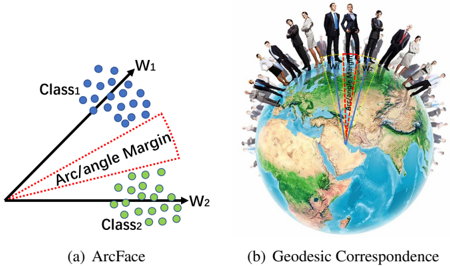
The image contains two distinct diagrams:
1. **(a) ArcFace**: A 2D vector diagram illustrating class separation with an angular margin.
2. **(b) Geodesic Correspondence**: A 3D globe with human figures and vectors representing correspondences.
### Components/Axes
#### (a) ArcFace
- **Labels**:
- **Class1**: Blue dots clustered in the top-left quadrant.
- **Class2**: Green dots clustered in the bottom-right quadrant.
- **W1**: Black arrow pointing to Class1.
- **W2**: Black arrow pointing to Class2.
- **Arc/angle Margin**: Red dotted line between W1 and W2, labeled as the angular margin.
- **Positioning**:
- Class1 and Class2 are positioned diagonally opposite.
- Vectors W1 and W2 originate from the origin (bottom-left corner).
- The angular margin is centered between W1 and W2.
#### (b) Geodesic Correspondence
- **Labels**:
- **W1, W2, W3**: Colored vectors (red, blue, green) emanating from the globe’s center.
- **Legend**: Located in the top-right corner, mapping colors to vectors (red=W1, blue=W2, green=W3).
- **Globe**: Central Earth model with human figures arranged in a circular pattern around it.
- **Positioning**:
- Vectors W1, W2, W3 are evenly spaced around the globe.
- Human figures are positioned on the globe’s surface, aligned with the vectors.
### Detailed Analysis
#### (a) ArcFace
- **Class Separation**: Class1 (blue) and Class2 (green) are visually distinct, with no overlap.
- **Vectors**: W1 and W2 are orthogonal, suggesting orthogonal class representations.
- **Angular Margin**: The red dotted line indicates the minimum angular separation required between classes.
#### (b) Geodesic Correspondence
- **Vectors**: W1, W2, W3 are labeled with distinct colors, implying unique correspondences.
- **Human Figures**: Arranged in a circular pattern, suggesting a global or holistic relationship.
- **Legend**: Confirms color-to-vector mapping (red=W1, blue=W2, green=W3).
### Key Observations
1. **ArcFace**: The angular margin is critical for distinguishing classes, emphasizing the importance of directional separation.
2. **Geodesic Correspondence**: The globe and vectors suggest a model where correspondences (e.g., data points) are mapped to a global structure.
3. **Color Consistency**: In both diagrams, colors (blue, green, red, blue, green) are consistently used for classes and vectors, with no mismatches.
### Interpretation
- **ArcFace**: The diagram illustrates a face recognition model where angular margins between class vectors improve discrimination. This aligns with techniques like margin-based loss functions in deep learning.
- **Geodesic Correspondence**: The globe and vectors may represent a global optimization framework, where correspondences (e.g., data points) are aligned to a shared structure (the globe). This could relate to tasks like multi-view learning or global feature alignment.
- **Notable Patterns**: The absence of numerical data in the diagrams suggests a focus on conceptual relationships rather than quantitative metrics. The angular margin in ArcFace and the vector directions in Geodesic Correspondence highlight the importance of geometric and directional properties in the models.
### Limitations
- The image lacks numerical data, making it impossible to extract trends or specific values.
- The diagrams are abstract and may represent theoretical concepts rather than empirical results.