## Tree Diagram: Hierarchical Node Structure
### Overview
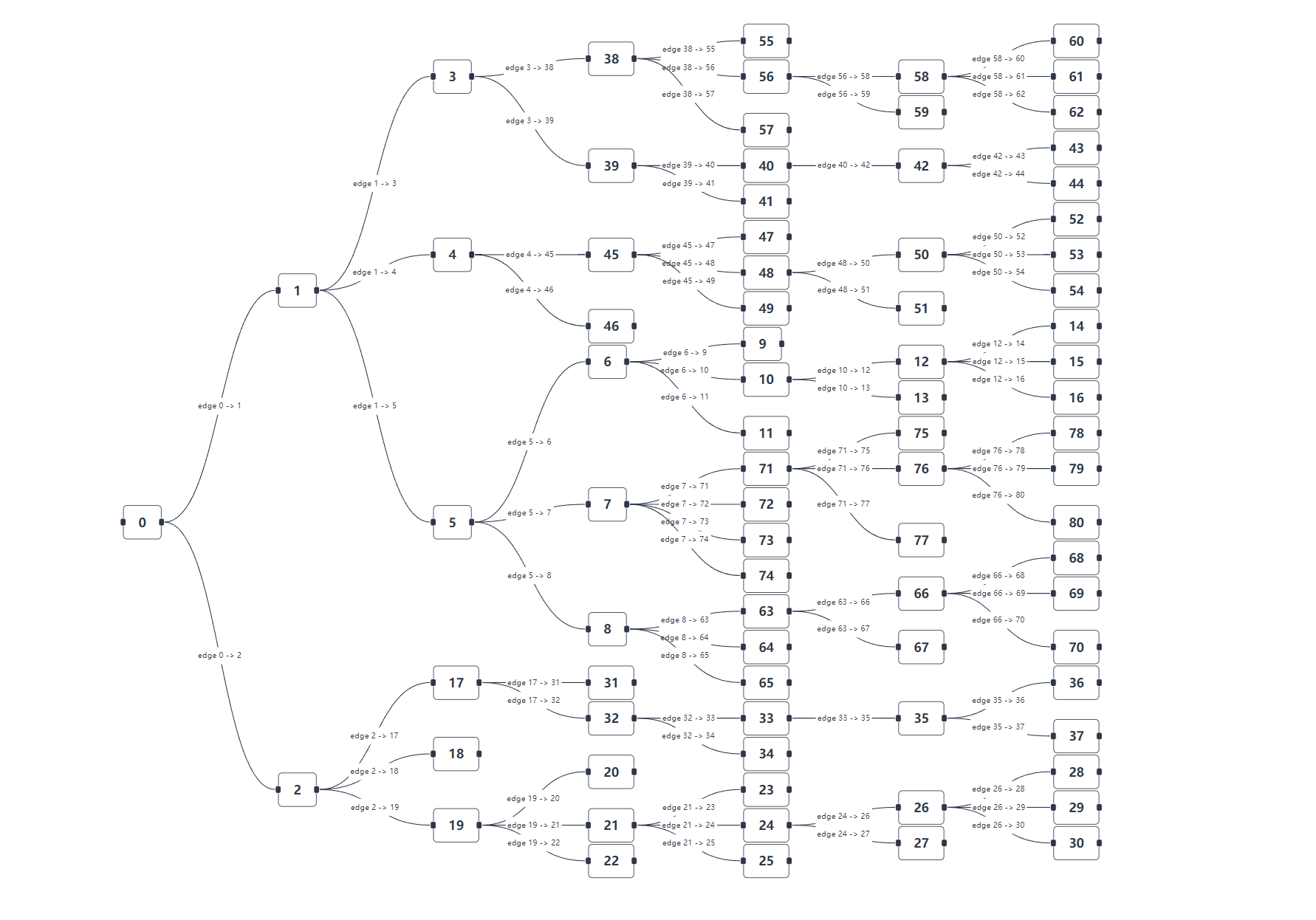
The image depicts a hierarchical tree diagram with nodes labeled numerically from 0 to 80. Nodes are connected by directed edges labeled with "edge X -> Y" notation, forming a branching structure originating from the root node (0). The diagram uses black lines and boxes with white backgrounds for nodes.
### Components/Axes
- **Nodes**: 81 total (0–80), each enclosed in a rectangular box with a black border and white interior.
- **Edges**: 160 directed connections (arrows) between nodes, labeled with "edge X -> Y" text where X and Y are node numbers.
- **Layout**: Nodes arranged in a left-to-right, top-to-bottom hierarchy. Root node (0) at top-left, with branches extending downward and rightward.
### Detailed Analysis
#### Node Structure
- **Root Node**: 0 (top-left corner)
- **Branching Pattern**:
- Node 0 branches to 1 and 2
- Each subsequent node splits into two children (e.g., 1→3/4, 2→17/18)
- Leaf nodes (no children): 38–80
- **Depth**: 7 levels (0→1→3→38/39→...→80)
#### Edge Labels
All edges follow "edge X -> Y" format, with sequential numbering:
- First-level edges: edge 0->1, edge 0->2
- Second-level edges: edge 1->3, edge 1->4, edge 2->17, edge 2->18
- Final-level edges: edge 37->73, edge 37->74, edge 38->75, edge 38->76
#### Spatial Grounding
- **Root Position**: Node 0 at top-left
- **Branching Direction**:
- Left subtree (0→1→3→...) extends rightward
- Right subtree (0→2→17→...) extends downward
- **Node Density**:
- Highest concentration in middle levels (nodes 16–48)
- Sparse distribution in root (1 node) and leaf levels (43 nodes)
### Key Observations
1. **Binary Tree Structure**: Each non-leaf node has exactly two children
2. **Sequential Labeling**: Nodes numbered consecutively from 0 to 80
3. **Edge Consistency**: All edges follow "edge X -> Y" format without exceptions
4. **Symmetry**: Left and right subtrees mirror each other in branching pattern
5. **Leaf Node Range**: Final 43 nodes (38–80) have no children
### Interpretation
This diagram represents a complete binary tree with 81 nodes, demonstrating:
- **Hierarchical Organization**: Clear parent-child relationships through edge labels
- **Process Flow**: Potential representation of decision trees, organizational charts, or data flow structures
- **Efficiency**: Balanced branching minimizes depth (7 levels for 81 nodes)
- **Scalability**: Regular structure allows easy expansion by adding child nodes
The consistent labeling and symmetrical branching suggest this is a deliberately constructed model rather than organic growth, possibly for algorithm visualization, system architecture documentation, or educational purposes.